The story of Greene & Greene and Japan is usually told as a story about looking. Charles Greene saw the Ho-o-den pavilion at the 1893 Columbian Exposition in Chicago. He studied Japanese woodblock prints. He read what little was available, in English, about Japanese building. The influence flowed into the work the way light flows into a room — diffuse, ambient, hard to source to any single window. By the time of the Gamble House the Japanese vocabulary was no longer borrowed ornament but a working language, and historians have spent a century tracing where the brothers might have learned each word.
But influence does not arrive only through the eye. It arrives through trade. Somebody had to import the prints, the porcelain, the lacquer, the bronze. Somebody had to unpack the crates that came off the Pacific steamers, price the objects, and put them in a window where a Pasadena architect could stand on the sidewalk and look in. That somebody had a name. In fact he had two names, because there were two brothers, and the brothers were the Bentzes.
The source of the brothers’ Japan was not abstract. It had a storefront.

The Trade in an Idea
The American fascination with Japan in the decades around 1900 was not a spontaneous mood. It was a market. The opening of Japan to Western trade in the 1850s, the displays at the Philadelphia Centennial of 1876 and the Chicago Exposition of 1893, and the steamship lines that linked San Francisco to Yokohama all combined to make Japanese and Chinese goods both desirable and, for the first time, obtainable. What had been the province of a few wealthy collectors became, by the 1890s, a retail proposition. The objects had to be sold by someone who knew what they were.
Southern California received this trade through a small number of importers, and in Pasadena and Santa Barbara the trade ran largely through one family. The Bentz brothers were dealers in Chinese and Japanese art and antiquities. They were among the people who decided which objects crossed the Pacific, what they cost, and how they were displayed to the public. They were, in the most literal sense, the conduit between the aesthetic the Greenes admired and the city the Greenes worked in.
This matters because the brothers’ Japonisme is often described as if it floated into Pasadena on the air. It did not. It came in crates, through dealers, into shops. The brothers’ admiration for the joinery of a temple gate and their admiration for the surface of a piece of export porcelain belonged to the same cultural moment, and that moment had a supply chain. The Bentz family was part of it. And when the family needed buildings — a store, a house, then another house — it hired the architects whose work it recognized as kin.
John Bentz, Importer and Developer
John C. Bentz was a Pasadena businessman who specialized in importing Chinese and Japanese art and artifacts. He was a figure in the early-twentieth-century California enthusiasm for Asian culture, not as a theorist of it but as a merchant of it. He sold the objects. He also did something that turned out to matter for the architectural record: he developed land.
In 1904 Bentz joined with two other local businessmen to purchase the thirty-two-acre Cooly Tract on the western edge of Pasadena. The partners recorded the parcel in 1906 as the Prospect Park Tract and subdivided it into sixty-four lots. Prospect Park was conceived as a neighborhood of architect-designed houses, an enclave of the new domestic architecture for which Pasadena was becoming known. The developer who laid out the lots was also a client who knew exactly which architects he wanted. Bentz had a personal relationship with Charles and Henry Greene, and he used it twice — first for a place to sell, then for a place to live.
This is the detail most accounts of the brothers’ work pass over. The Greenes are remembered for their wealthy clients — the Gambles, the Blackers, the Pratts — the heirs to soap and mining and lumber fortunes who could afford the most expensive houses in California. The Bentz commissions are a different and quieter thing. They are the architects working for a man who was not buying a monument but building a business and a neighborhood, and who happened to traffic in the very aesthetic the architects were translating into wood.
A Storefront for the Trade
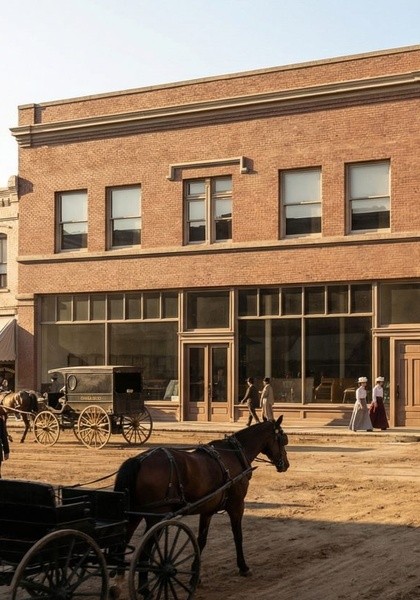
The first Bentz commission was not a house. It was the John C. Bentz commercial building, designed by Greene & Greene and constructed in Pasadena in 1901 — a brick block built to showcase imported wares. It belongs to a part of the brothers’ practice that is almost never discussed, because it does not fit the narrative of the firm as makers of romantic wooden houses. The Greenes designed commercial buildings. They designed a few of them well, and the Bentz block was one.

Read the elevation and the building’s purpose is plain. The ground floor is given over almost entirely to display glass, the upper floor kept simple above it. This is the logic of a shop that lives by what it can show. The objects Bentz imported were small, precise, and made to be examined closely — porcelain, bronze, lacquer, carved wood, prints under glass. The store was the frame around them. A Pasadena architect of the period who wanted to see good Japanese work did not have to cross the Pacific. He had to walk downtown and look in the Bentz window, where the Greenes had built the frame and Bentz had supplied the pictures.
There is no record that Charles Greene drew his ideas directly from the stock in the Bentz store. The point is smaller and more certain than that. The aesthetic the brothers were absorbing had a physical address in their own city, and the brothers had built it. Whatever else the Greenes learned about Japan from books and expositions, they were also living a few blocks from a working dealer in the real objects, a man they knew well enough to design for. The influence and the trade were neighbors.
The First House on Prospect Park
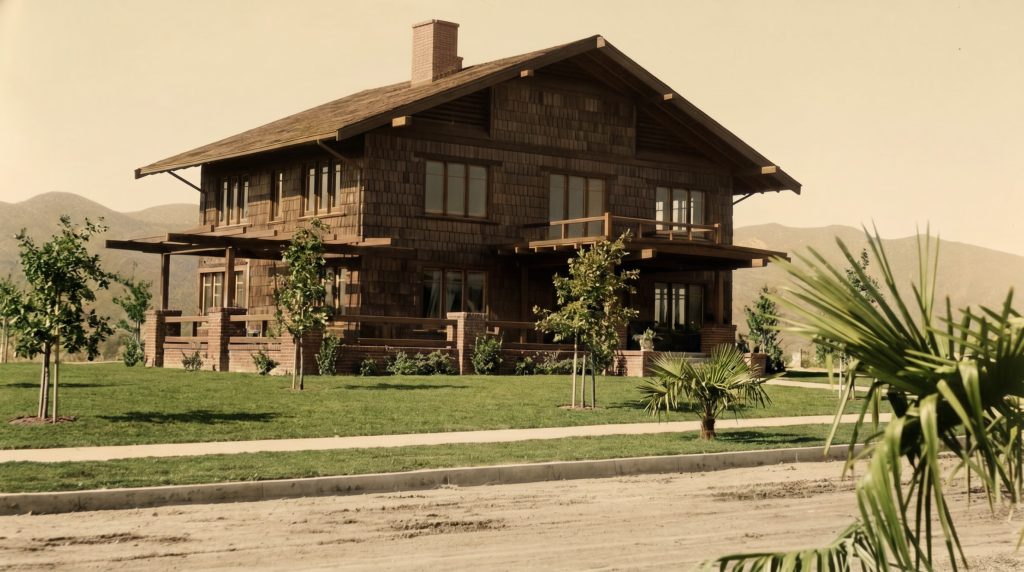
In 1906 the Greenes designed Bentz a house, and it became the first house built in the Prospect Park Tract he had subdivided that same year. It stands at 657 Prospect Boulevard and is recorded on the National Register of Historic Places under the name of the Louise C. Bentz House, for John Bentz’s wife. It is not an Ultimate Bungalow. It was never meant to be. It is the best surviving example of the houses the Greenes designed for the Pasadena middle class — the everyday register of the practice, most of which has since been demolished or remodeled past recognition.

The house is a two-story shingled bungalow with a broad, low-pitched gable and deep overhanging eaves. Its proportions are horizontal, its roofline emphatic, its upper story partly recessed behind a sleeping balcony. The National Register nomination notes its chalet character in the overhangs and pitch, and its Japanese character in the treatment of the roof edges and the overall horizontal emphasis. Those two readings are not in conflict. They are the two halves of the brothers’ early manner — the Swiss chalet and the Japanese temple braided into a single Pasadena house — and the Bentz House holds them in clear, modest balance.

What makes the house valuable now is exactly its ordinariness. A great deal can be learned about an architect from the masterpiece, but almost as much from the competent everyday work, where the principles show through without the budget to hide behind. The Bentz House is the brothers thinking about how an ordinary family lives — where the light falls in the morning, how the porch meets the street, how the brick foundation gives the wooden house a base to stand on. The same instincts that produced the silent grammar of the Ultimate Bungalow are here, working at a fraction of the cost and almost none of the fame.
The Rooms Themselves
Inside, the house keeps the discipline of the larger commissions in smaller terms. The entry opens into the living space rather than holding it at arm’s length. The woodwork is honest and unfussy. There is a logic to how one room gives onto the next, the kind of considered plan that distinguishes an architect’s house from a builder’s.

The center of the living room is a broad brick fireplace flanked by built-in bookcases, the ceiling crossed by exposed beams. It is the Arts and Crafts hearth in its clearest domestic form — the fire at the heart of the house, the books within reach of the fire, the structure of the ceiling left visible overhead. There is no clinker-brick pyrotechnics here, no inglenook on the scale of the Reeve House inglenook. There is a family’s fireplace, well made.

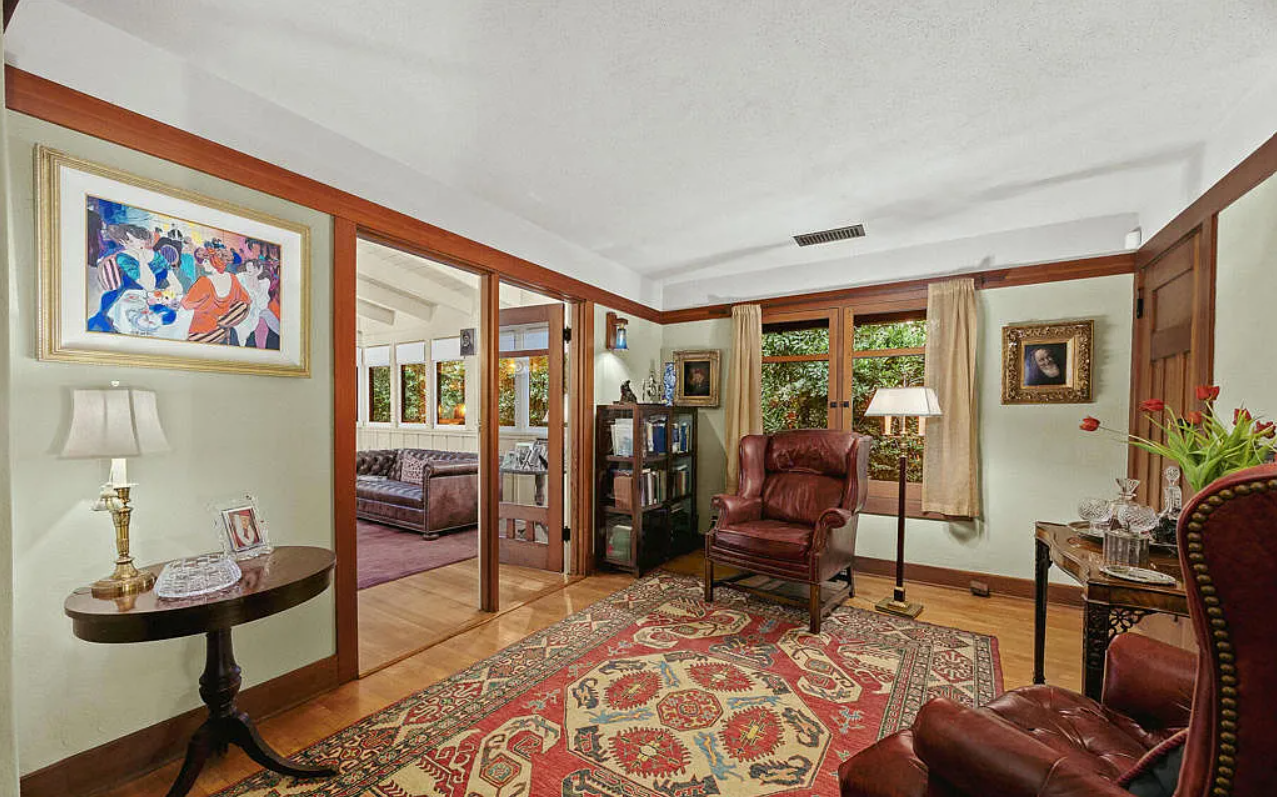
The dining room is the room where the house remembers who owned it. Its walls are wainscoted in wood to a high rail, with a built-in sideboard and a plate shelf running above for the display of objects. This is a standard feature of the better Craftsman dining room, but in a house owned by a dealer in Asian art it reads differently. The plate rail is a display fixture. The man who lived here spent his days deciding how porcelain and prints should be shown to buyers, and he came home to a room the brothers had fitted with shelves for showing the same kinds of things. The instinct for display ran straight from the shop into the dining room.

Upstairs the rooms are simpler still, lit by the broad eaves and the recessed balcony, the kind of quiet, well-proportioned bedrooms and sitting rooms that the brothers produced when they were not trying to dazzle anyone. The house does not perform. It works.
The Brother in Santa Barbara
John Bentz had a brother, and the brother had the same trade in a different city. Nathan Bentz was, for some fifty years, a major figure in the cultural life of Santa Barbara — a collector and connoisseur of Asian art who built a business international in scope. His path to it is worth telling, because it explains the seriousness of the family’s expertise.
Born and raised in upstate New York, Nathan Bentz settled in San Francisco in 1881 and apprenticed for ten years under Horace Fletcher, one of the city’s most distinguished antiques dealers and a specialist in Japanese items. In 1891 he struck out on his own and relocated to Santa Barbara, opening his first antiques store on State Street in 1892. In 1896 he made his first buying trip to China and Japan, and these voyages became nearly annual events — a remarkable commitment in an age when crossing the Pacific meant weeks aboard a steamship. In 1911 the local paper described a collection of Japanese art he had brought back valued at nearly seventy thousand dollars. With his brother Philip he opened stores in Los Angeles and San Francisco. The Bentz name, across three cities, meant Asian art.
In the spring of 1911 Nathan Bentz paid the local contractor Isaac Hardy five thousand dollars to build a two-story house on the Santa Barbara Riviera, on Prospect Avenue, and he chose Charles and Henry Greene to design it. According to the account preserved by the Santa Barbara Independent, Nathan knew of the Greenes through his brother John, who knew them personally, and he was drawn to the brothers precisely because of their use of Asian elements. The house is the only Greene & Greene building in Santa Barbara, and it remains one of that city’s finest examples of Craftsman architecture.
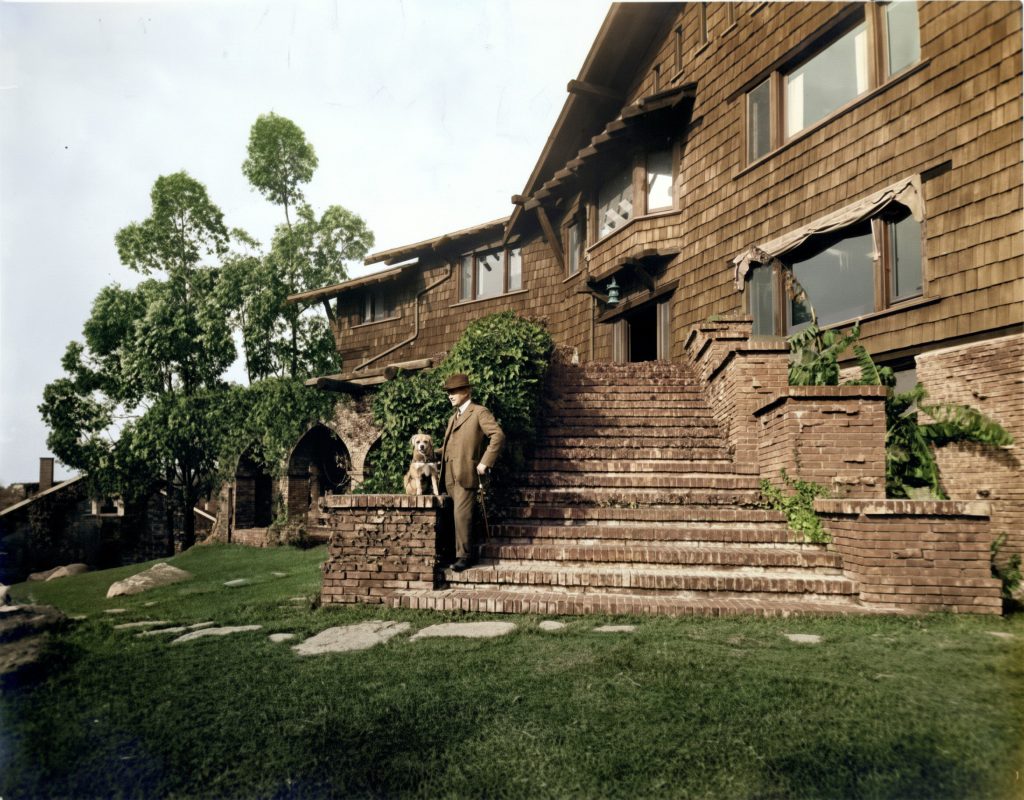
Consider what that choice means. Nathan Bentz had handled more authentic Japanese objects than almost any American of his generation. He had crossed the Pacific dozens of times. He knew the difference between a good and a great piece of export porcelain the way a vintner knows wine. And when he built his own house, he did not commission a literal Japanese building, which he of all people could have specified accurately. He hired the Greenes, whose Japan was a translation — an American architecture that had taken the principles of Japanese building and rendered them in California redwood. The most expert eye in the West chose the interpreters over the originals.
What Crossed the Threshold
Here is the loop the Bentz commissions close. The Greenes’ Japanese vocabulary was fed, like everyone’s in that period, by the objects coming off the Pacific steamers — and those objects reached Pasadena and Santa Barbara through dealers like the Bentzes. The dealers, in turn, recognized in the Greenes’ architecture the same sensibility they trafficked in, and hired the brothers to build their stores and their houses. Influence ran in both directions across the same threshold. The architects looked at what the dealers imported; the dealers commissioned the architects who had looked.
This does not mean the Bentz store taught Charles Greene how to design. The brothers’ Japonisme had many sources, the prints and the expositions chief among them, and the deepest of those sources was Charles’s own long study of what he saw — the same study that put a Japanese black pine in the art glass at the Gamble House front door and made the joint itself the ornament. The claim is narrower and harder to dismiss. The aesthetic was not floating free in the California air. It was a trade good, sold by named people in known shops, and two of those people were clients of Greene & Greene.
The brothers’ most overtly Japanese gesture came not for the Bentzes but a little earlier, at Long Beach, where the Adelaide Tichenor House was given a tile-roofed gate and a garden with a pond and an arched bridge — the design, in the words of the historical record, reflecting the mutual interest in the Orient of both client and architects. Mutual interest. That phrase is the whole story. The Greenes did not impose Japan on their clients, and their clients did not impose it on them. They met in it. With the Bentzes, the meeting was especially exact, because the clients did not merely share the interest. They sold it.
The full architectural record of the Pasadena house, with its plans and its place in the brothers’ catalog, is collected on the Louise C. Bentz House page. The drawings for the Santa Barbara house and the Pasadena commissions survive in the institutional collections; the Greene & Greene Collection at Columbia’s Avery Library holds material on the Nathan Bentz House among the firm’s papers. They are worth seeking out, because the Bentz commissions are the part of the brothers’ work where the architecture and its sources can be seen standing next to each other.
Most of the brothers’ famous clients are remembered for the houses. The Bentzes should be remembered for the threshold. They stood at the point where the idea became an object and the object became a building. The Greenes designed their store so the objects could be shown, and their houses so the family could live among the things it sold, and somewhere in that exchange the California version of Japan acquired an address.
The aesthetic had a storefront. The storefront had an architect. The architect had been looking in the window all along.