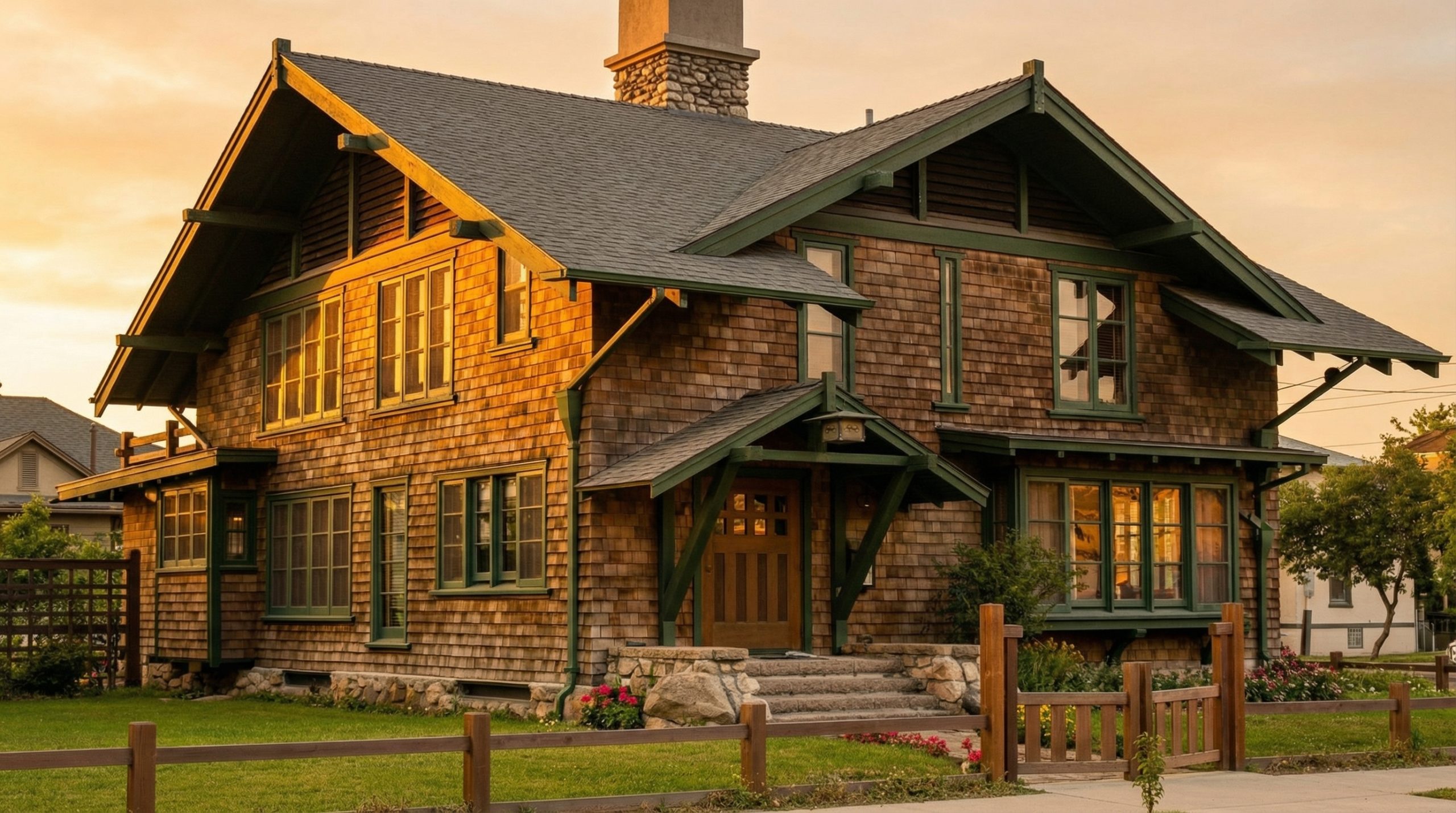
The brothers built the Jennie A. Reeve House in Long Beach in 1903–1904. It was a modest commission by Pasadena standards — a two-story shingled cottage for a single woman, on a corner lot in a city that in 1904 had only nine thousand people in it. Jennie Reeve was a real estate investor, a suffragist, and one of the first women elected to the Long Beach Library Board. She wanted a house that looked like nothing else in town, and she was willing to pay for the brothers to figure out what that meant.
The Reeve House is not the most famous Greene & Greene commission. It is not on most short lists. It does not appear on the postcards or the calendars. It is, however, the house in which the brothers first attempted to design every single thing in it.
This is the point that most accounts of the brothers’ career glide past. The Gamble House is treated as the high water mark of integrated design — and it is — but the integration started at the Reeve. According to the records held by the Greene & Greene Virtual Archives, the brothers produced 139 separate decorative drawings for this single commission: furniture, lighting, leaded glass, gates, fences, planters, the cabinet for the dining room, the mirror on the bedroom door, the andirons in the inglenook, and the inglenook itself. It was the first time they tried to design every object their client would touch. Nothing in the previous Pasadena commissions had asked for that scope. The Reeve asked, and the brothers answered with one hundred and thirty-nine drawings.
The inglenook was the architectural seed of all of it.
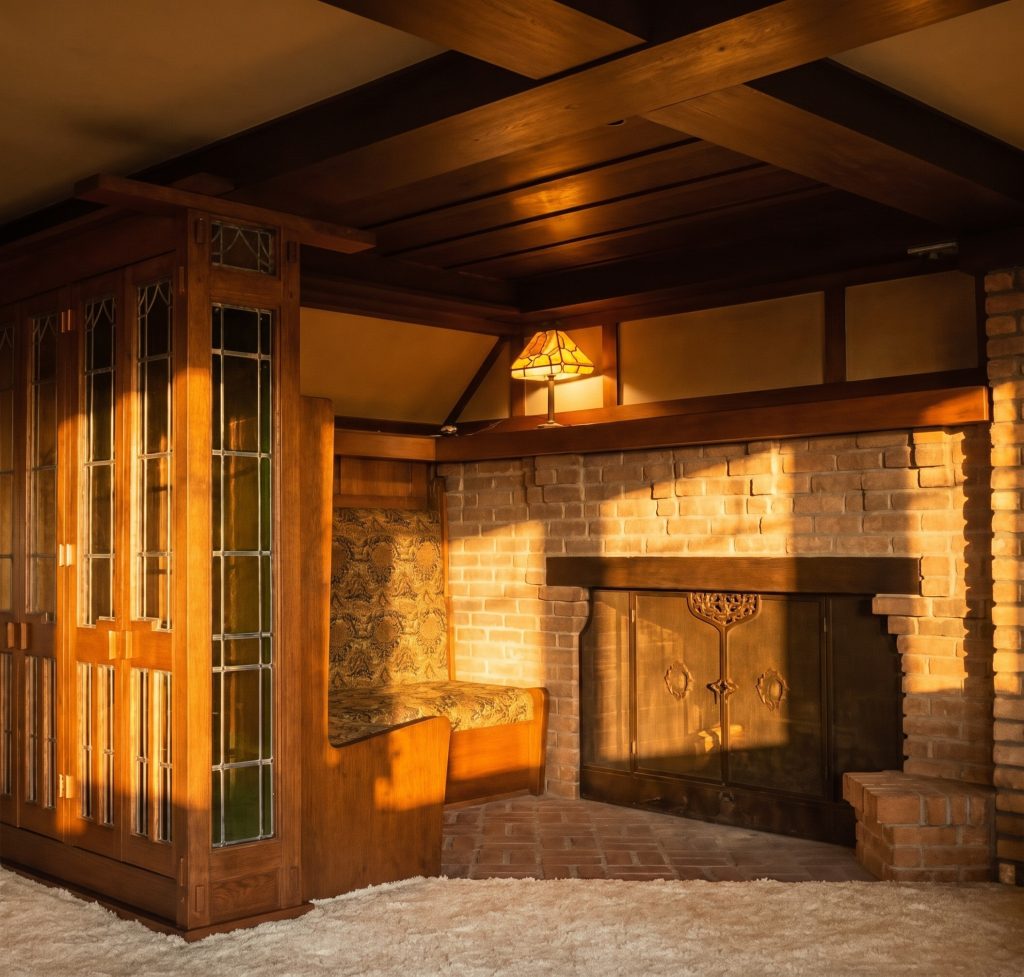
You enter the Reeve House through a low front door under a deep eave, and the public room of the house is dominated by a brick chimney mass that interrupts the living-room wall. Set into that mass, on either side of the fireplace, are the two built-in benches that make the inglenook itself — the small inset alcove just deep enough to sit two people facing the fire and shut the rest of the room out. The fire box is brick. The mantle is a single timber. The bench tops are flat and unornamented. The hardware on the andirons is hand-forged iron. There is no other decoration in the space at all.
It is the simplest single architectural element in the house, and it is also the model for every Greene & Greene inglenook that follows. The Gamble inglenook of 1908 is more elaborate, and the Robinson House inglenook of 1906 carries lanterns at the corners that the Reeve does not, but the spatial conception — the seat shoved into the chimney mass, the fire as the room within the room — was first worked out here.
What makes the Reeve inglenook a piece of evidence rather than a curiosity is the survival problem.
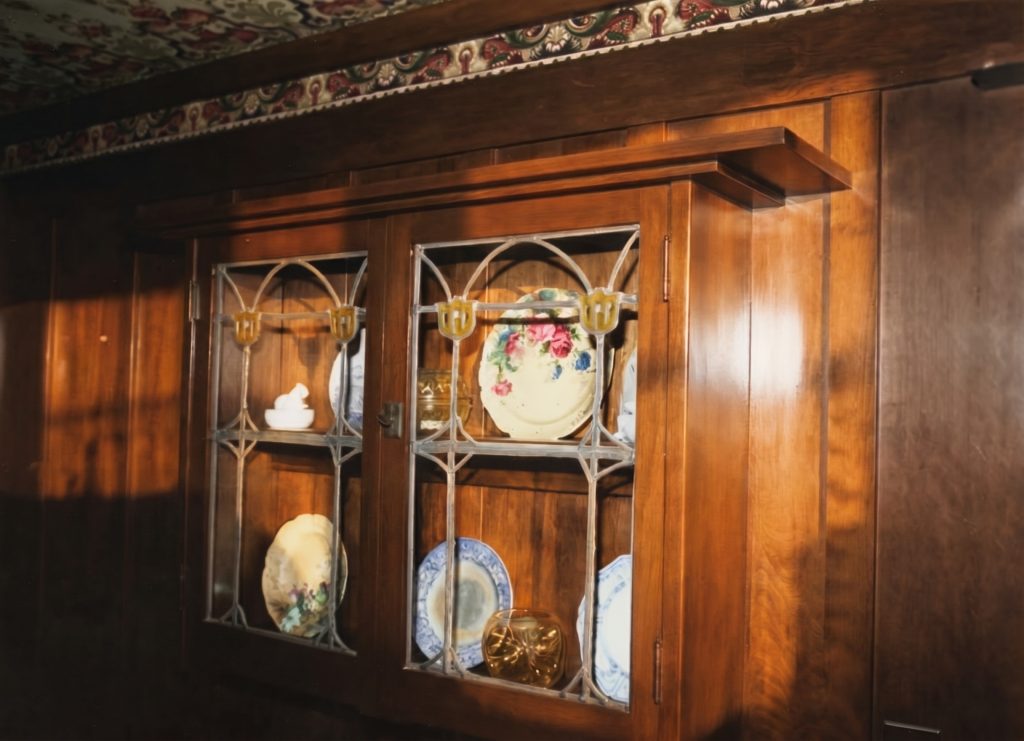
Of the 139 decorative pieces the brothers designed for the house, four are still in it. The literature on the Reeve House, which is small, returns to this number again and again. Four out of a hundred and thirty-nine. A front porch light. A dining room display cabinet. A bedroom door mirror. And a pair of andirons in the inglenook fireplace.
The other 135 are gone. Some sold off when Jennie Reeve died in 1916. Some scattered when the house was put on blocks in 1917 to make way for a downtown business district. Some left when the doctor V. Ray Townsend bought the house off its blocks, moved it to Tenth and Pine in 1925, and hired Henry Greene to supervise a second move further inland — the only documented case of either brother personally overseeing the relocation of one of their own houses. Some are simply unaccounted for, vanished into private collections or estate sales whose records do not survive.
The andirons stayed.
They are not the most valuable surviving piece. The cabinet, by any auction standard, is worth more. The porch light is more often photographed. But the andirons, in the inglenook the brothers conceived as the spatial seed of the house, are the piece that the building required to remain a Greene & Greene work. Without the andirons the inglenook would still be a brick alcove with two benches. With them, it is what the brothers drew.
I want to be careful here, because the temptation with a survival story is to make the surviving object carry more weight than it can hold. The Reeve andirons are not magic. They are hand-forged iron of the type that any competent blacksmith working from Greene drawings could have produced. What matters is the continuity — the fact that the seat the brothers shaped, the fire box they placed, the chimney mass they detailed, and the andirons they drew for it are all still in the same room. The architectural seed and one of the four surviving objects from it are still in physical contact with each other.
That is rarer than it sounds. The Blacker House andirons are in museum collections in Pasadena and Los Angeles. The Gamble House andirons are in the Gamble House itself, which is preserved as a museum. The other early commissions — the Bandini, the Tichenor, the Hollister — are demolished or so altered that the integrated design is essentially gone. The Reeve is one of the very few small early commissions where the inglenook still has the iron the brothers drew for it.
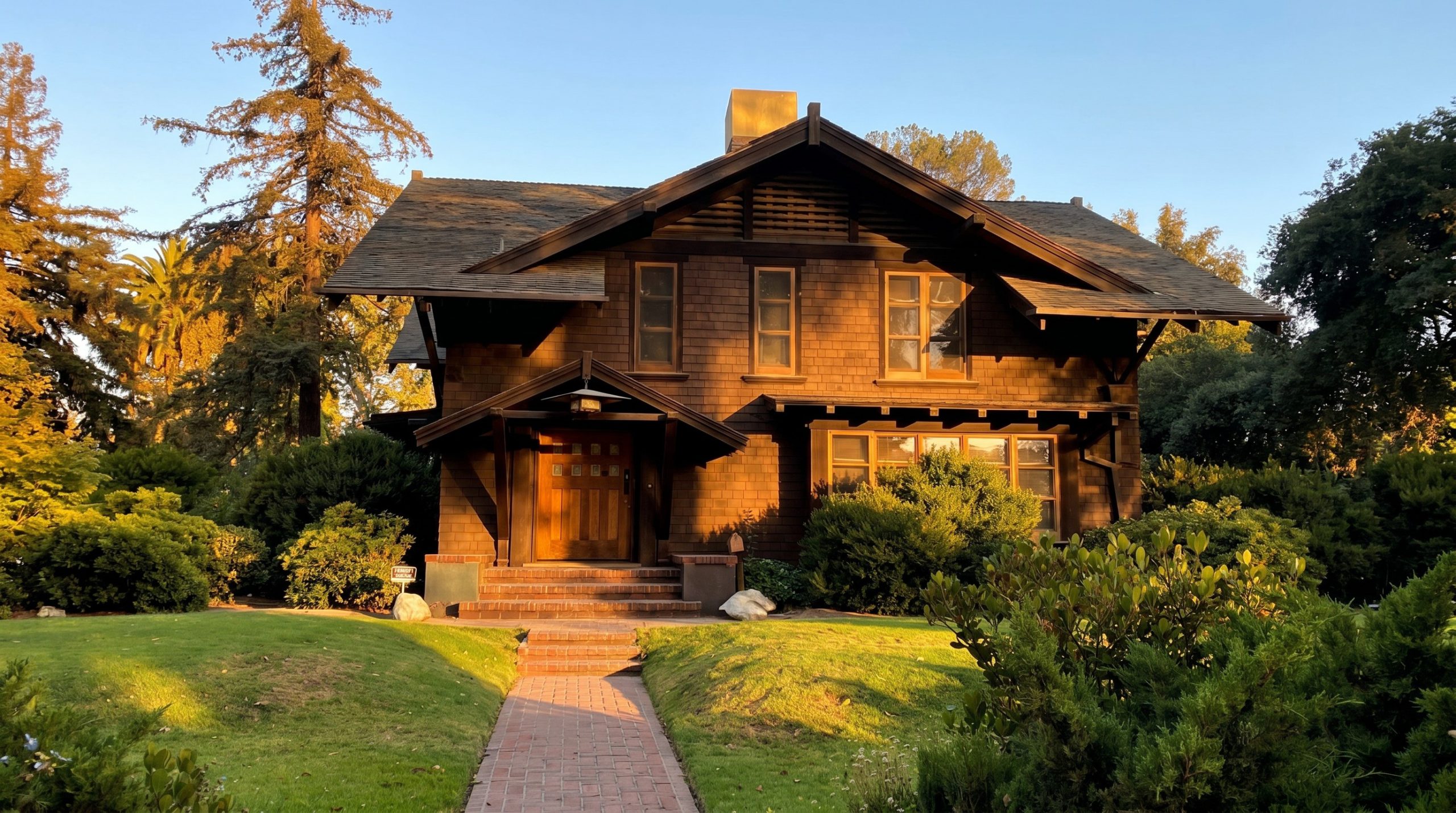
The house itself nearly did not survive. In 2003 it came up for sale at a price that would have allowed a developer to demolish it and put two houses on the lot. It was bought instead by Ted Wells, then the president of the Greene & Greene preservation trust, in a transaction whose primary purpose was to keep the building standing. It now sits near the Virginia Country Club in Long Beach, on its third location, restored carefully, with the four pieces still inside it.
When you visit — and a small number of tours are offered each year through the Long Beach Heritage organization — what you are seeing is a building that has been moved twice, restored once, stripped of 135 of its original 139 decorative pieces, and saved from demolition more than once. What you are also seeing is the room where Greene & Greene first attempted to make a building in which nothing was generic. The inglenook is the room within that room. The andirons in the inglenook are one of four objects the brothers personally drew that are still where they were originally placed.
It is not the largest piece of evidence we have for what the brothers were trying to do. It is one of the smallest. It is also one of the most exact. The drawings exist. The objects exist. They are in the same room. The brick is the brick they specified, the iron is the iron they specified, and the seat is the depth they specified for two people to face a fire. The rest is documentation.
The Reeve inglenook is the moment the brothers’ philosophy first became a method. Four of the one hundred and thirty-nine objects that the method produced are still in the house. The andirons are one of them. They are still in the fireplace they were drawn for, and the fireplace is still in the inglenook, and the inglenook is still in the house, and the house is still standing in Long Beach.
That is what survives. It is enough.