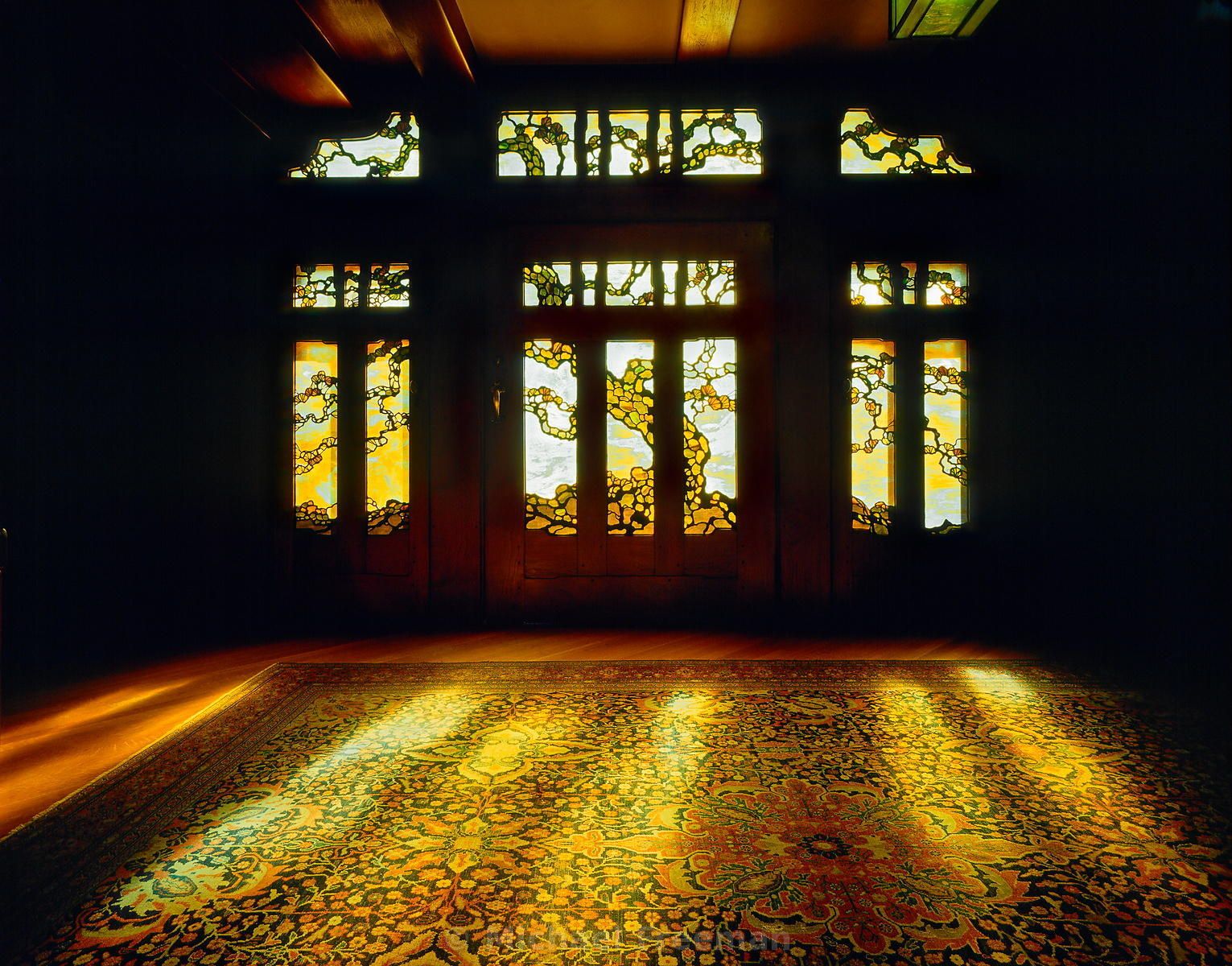
Stand on the front terrace of the Gamble House at the threshold of the entry, and the door is the first thing the house asks you to read. It is not a single panel but three: a wide central door flanked by two narrower sidelights, with a low transom above, all of them in leaded art glass. The frames are dark — Burmese teak weathered to near-black — and the glass between them holds, at a glance, what most visitors take to be a sprawling tree spreading its branches across the entire composition. The branches climb from a low trunk at the lower-left sidelight, cross the central panel in a great arching reach, and continue into the upper-right sidelight, where the canopy thins into needles against a high sky.
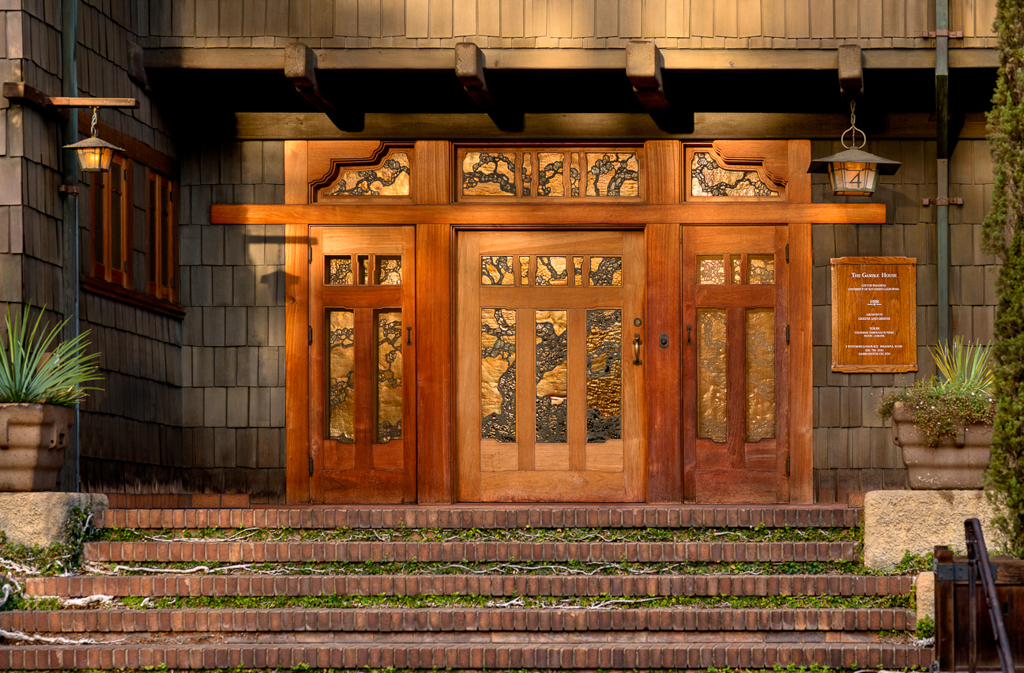
The descriptions of this door over the years have called it many things. An oak. A tree of life. A symbolic tree. A tree in the Arts and Crafts manner. The exhibits at the Gamble House have, at different periods, used different names. The popular guides settle for “the tree door.”
The tree is none of those things. It is a Japanese black pine.
Pinus thunbergii. The species that grows on the rocky coasts and headlands of Japan, the species that bends and twists in the salt wind, the species that becomes, in age, the gnarled and asymmetric form that Japanese gardeners cultivate for centuries to teach the eye what endurance looks like. The black pine appears in the woodblock prints of Hokusai and Hiroshige with the regularity of a signature. It appears, traditionally, beside the threshold of important buildings — at temple gates, at shrine entries — because in the symbolic vocabulary of Japanese culture the pine is what stands the longest. It is the tree of permanence, of patient living, of weathering without yielding.
The Greenes chose it on purpose. Charles Greene first saw Japanese architecture at the 1893 Columbian Exposition in Chicago, where the Ho-o-den pavilion stood on its small island in the lagoon. He had been studying Japanese prints for years before that, and would continue to study them for decades after. By the time of the Gamble commission in 1908 the Japanese vocabulary was not borrowed ornament to him — it was a working language. The black pine was a word in that language. Setting it at the front door of the most ambitious house he and Henry would ever build was a deliberate sentence.
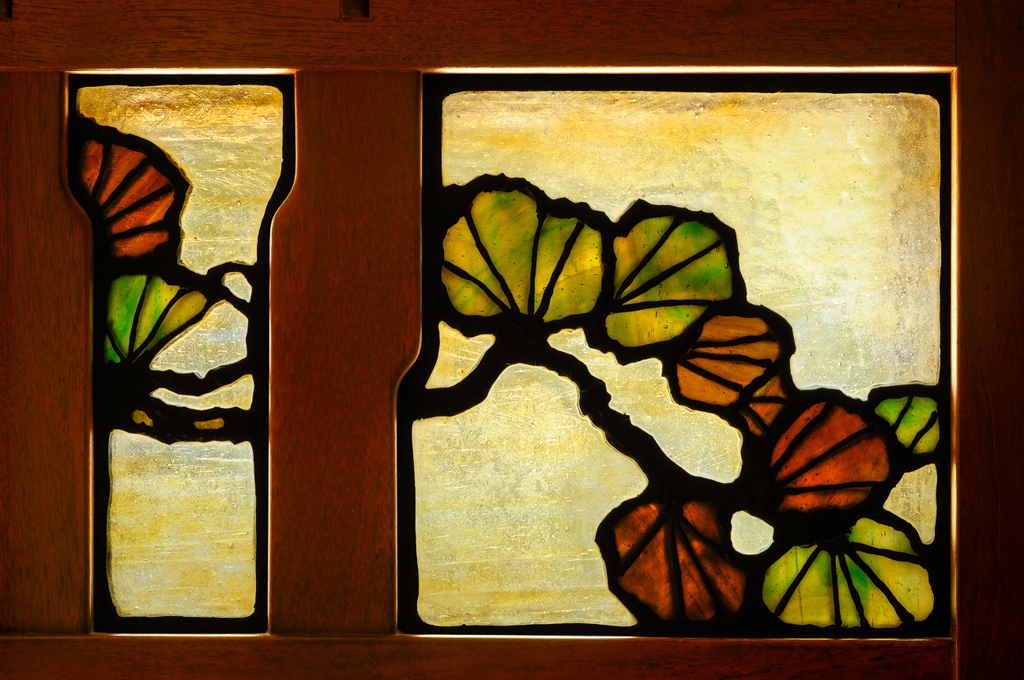
Look closely at the glass and the species is visible. The bark of the trunk and the lower limbs is rendered in dark, almost charcoal-toned leaded panels, irregular and craggy — the characteristic plate-bark of Pinus thunbergii, not the smoother bark of an oak. The branches do not fork in the symmetrical, broad-canopy way of oaks; they reach asymmetrically, twisting back on themselves, the way a coastal pine reaches against wind. The needles, where they catch the light at the upper-right corner, are needles in bundles, not the lobed leaves of an oak. The art glass technique — copper foil at the joints, iridescent rolled glass for the canopy, deep amber and rose for the bark — was Emil Lange’s, working from cartoons drawn in the office. The cartoon was Charles’s hand. The species was his choice.
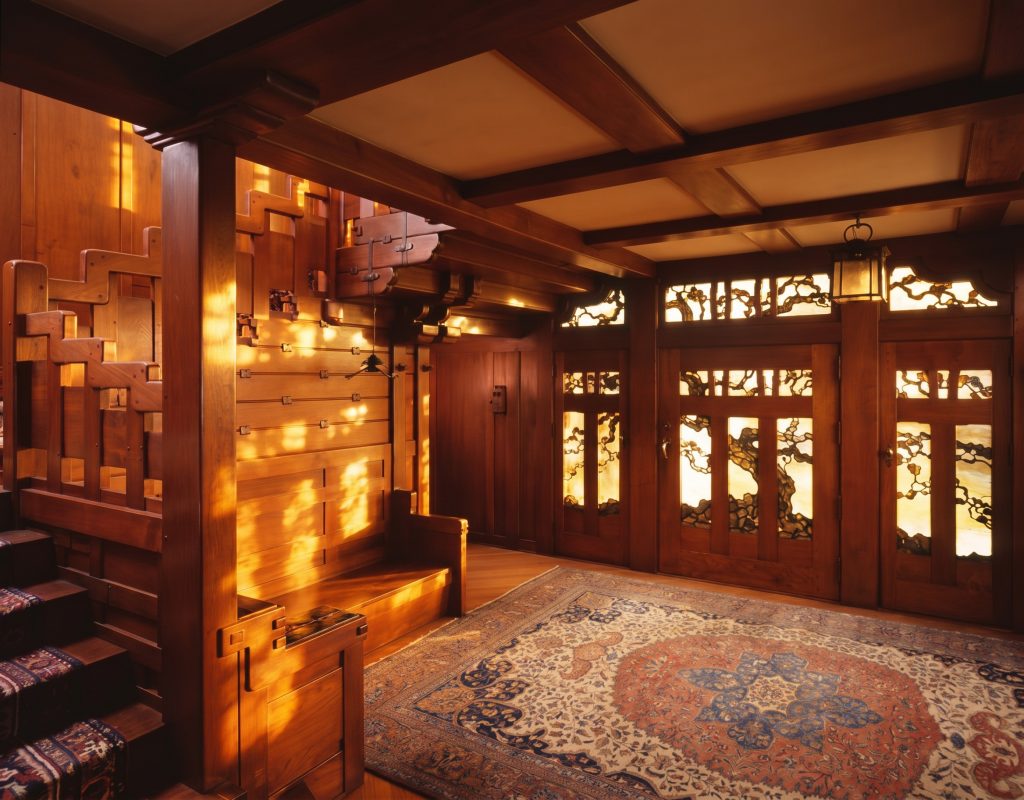
Pass through the door — and you should pause first, because the door asks for the pause — and the pine recurs. Carved into the lintel of the entry hall. Inlaid in the leaded glass of the dining room and the den. Etched in the metalwork of the lanterns. The Japanese black pine is the unifying motif of the house. It begins at the door because the door is the threshold, and at the threshold is where the pine is meant to stand, in the older language the Greenes were quietly speaking.
There is a deeper reading worth offering. The pine is what survives. The pine bends, twists, weathers, and remains. The Gamble House, like the species at its front door, is the surviving specimen of a movement that did not, by and large, survive. The black pine in the glass is the brothers’ implicit prayer for the building behind it.
Approach in late afternoon, when the western sun strikes the door obliquely and the iridescent glass throws a slow shifting light into the entry hall behind. The bark glows for a moment. The needles catch.
It is a Japanese black pine. It is the door of the most photographed house in American Arts and Crafts architecture. The species is the argument. The argument is permanence.
For more on Charles Greene’s Japanese sources, see The Joint is the Ornament. For more on Emil Lange’s glass at the brothers’ major commissions, see The Man Who Made the Light.