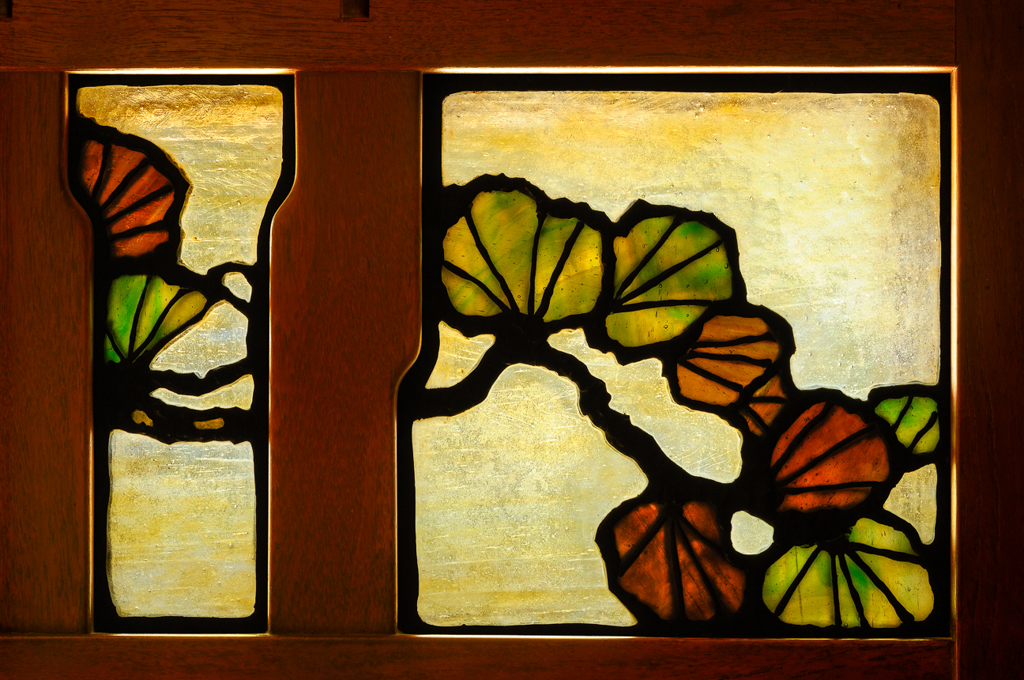
Stand inside the entrance hall of the Gamble House just after sunrise, when the eastern light first strikes the front door, and you understand that you are not looking at glass. You are looking at a tree — a Japanese black pine rendered in leaded fragments, its gnarled branches spreading across the width of the doorway and its flanking sidelights in a single unified composition, its amber and green and white glass transformed by the rising sun into something that feels less like architecture than weather.
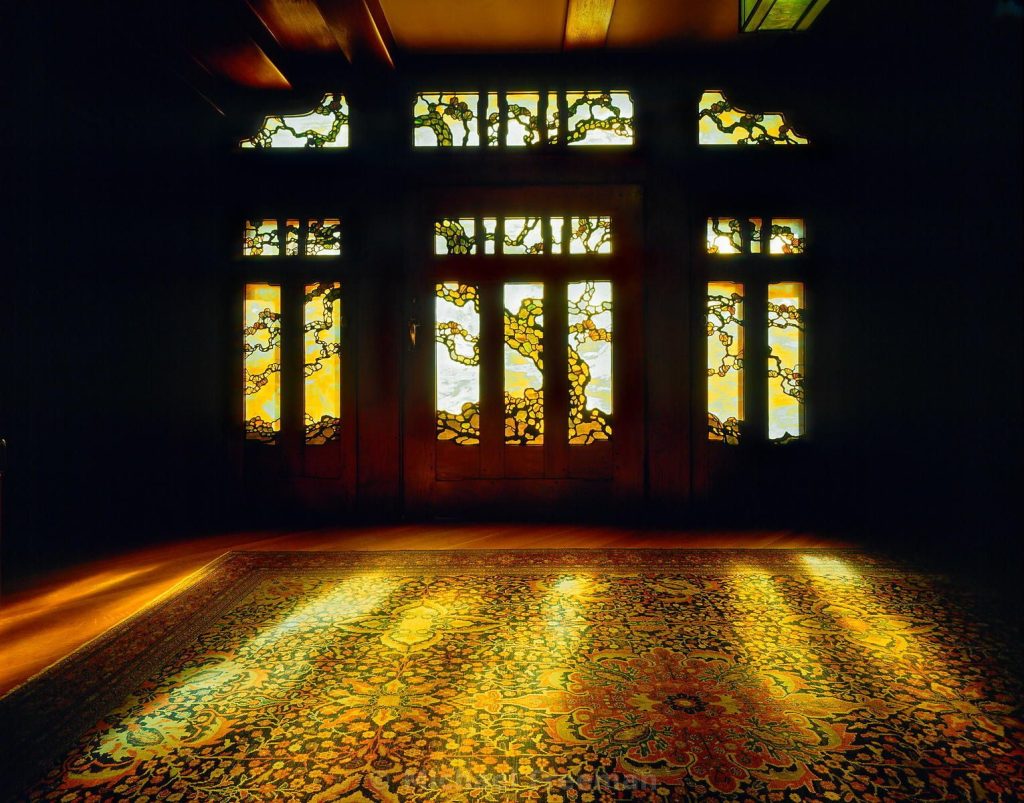
Charles Greene drew that door. Peter Hall’s shop made the frame. But the glass — the thing that turns a threshold into an encounter — was made by Emil Lange, in a small shop on South Broadway in Los Angeles, working with a handful of craftsmen and an understanding of how light moves through colored material that bordered on the devotional.
His name, if it appears at all in the standard literature on Greene & Greene, appears in passing. The histories of American art glass tend to be histories of Tiffany — of Louis Comfort Tiffany and the New York studio whose products defined the medium for a generation of American clients and critics. Lange worked in Tiffany’s shadow in the way that many of the finest regional craftsmen of the period worked in Tiffany’s shadow: producing work of comparable ambition and, in certain specific respects, superior refinement, but without the celebrity apparatus that would carry his name forward into the art-historical record. His work survives. His story is harder to recover.
The man from the East
Emil Lange came to Southern California from the East Coast, carrying with him training that placed him in direct contact with the American art glass tradition at its most technically advanced. He had worked for Louis Comfort Tiffany in New York before moving west — an apprenticeship that gave him firsthand knowledge of the leading methods of the American studio glass movement: the copper-foil technique that Tiffany had pioneered, the use of iridescent and opalescent glass, the integration of painted and fired elements with leaded composition, the entire visual vocabulary that distinguished American art glass from its European antecedents.
When Lange established himself in Los Angeles in the early years of the twentieth century, he brought that training into contact with a regional market that was just beginning to develop a serious appetite for architectural glass. Southern California in 1905 was not yet what it would become — not yet the cultural capital of the American West — but it was growing rapidly, wealthy, and increasingly interested in the kind of integrated domestic architecture that the Arts & Crafts movement was then making fashionable for prosperous clients. The commissions coming to Pasadena architects in particular were of a scale and ambition that called for art glass of a quality the regional market could not easily supply from within itself. Lange’s shop answered that call.
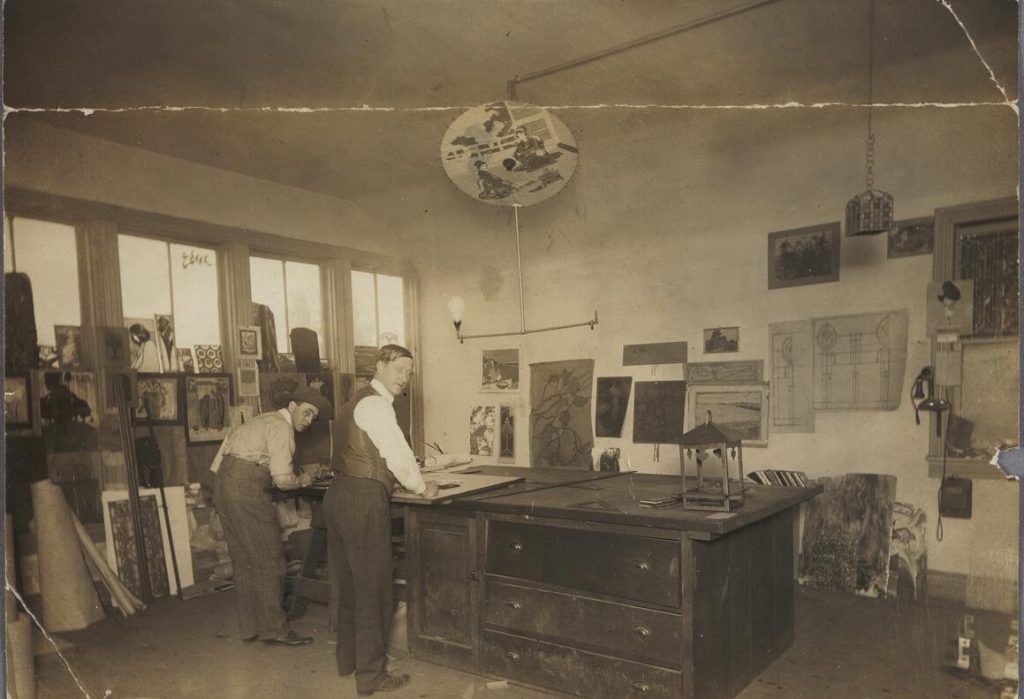
How exactly the collaboration between Lange and the Greene brothers began is not perfectly documented. What is clear is that by the time of the major commissions — the Blacker House of 1907, the Gamble House of 1908, the Thorsen House of 1909 — Lange had become the art glass maker the brothers trusted to execute the most demanding architectural glass of their careers. The relationship was not exclusive on either side; Lange produced glass for other architects, and the Greenes specified glass from other sources for some commissions. But for the masterwork houses, the partnership with Lange was consistent, sustained, and evidently productive of work that neither party could have produced alone.
What Lange brought to the drawing
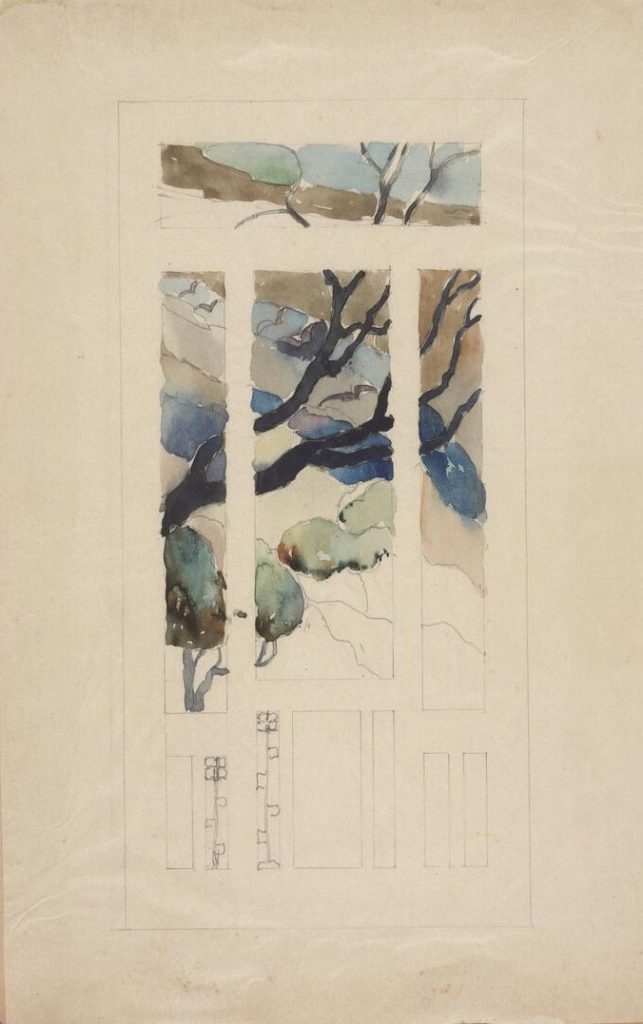
Charles Greene was the draftsman for the art glass programs of the major commissions. The drawings survive, and they are beautiful objects in their own right — watercolor and ink renderings of leaded compositions, carefully calibrated to the architectural spaces they would eventually fill, with the leading indicated as fine dark lines and the glass tones suggested through washes that approximated the color temperature of the finished panels. These drawings gave Lange the basic design. They did not give him the glass.
The translation from drawing to finished panel was where Lange’s expertise became indispensable. A watercolor study can indicate a general tonal range — an amber sky, a green branch, a gold and white background — but the selection of the specific glass sheets from which those tones would be cut required judgments that only an experienced art glass maker could make. American art glass of the period was not produced in standardized colors. Each sheet, hand-rolled in small batches at specialty glass houses in the East, had its own particular qualities: its own specific tone, its own internal variations, its own characteristic figure of waves, striations, or bubbles. The same nominal color — “amber,” say — might present itself across dozens of different sheets with dozens of different specific qualities, each suited to different applications and different effects.
Lange’s shop maintained a substantial inventory of such sheets, and Lange himself had developed, through years of practice, the eye that could match a particular sheet to a particular location within a particular composition. The amber that would work for the sky behind the black pine on the Gamble House door was not the same amber that would work for the interior iridescent panels beside the living room fireplace — even though a drawing might have indicated both with the same watercolor wash. The selection was interpretive, and the interpretation required understanding not just color but light: how a specific sheet would behave under specific lighting conditions, how its iridescence would read at different times of day, how its density would interact with the room it illuminated.
This is a subtle point that repays attention. The art glass of the Gamble House is not, in the ordinary sense, illustrated. It does not depict a tree the way a Tiffany lamp depicts a dragonfly — as a legible image rendered in colored fragments. It operates instead at the boundary between the figurative and the abstract, suggesting the pine without literally representing it, using color and composition to evoke the feeling of looking through branches into sky rather than to produce a picture of branches against sky. This required glass selection at a level of sophistication that purely figurative work does not demand. The specific quality of each amber, each green, each white and gold — the way those specific qualities cohered into an overall light effect — was the work, and it was Lange’s work.
The Gamble House door
No single piece of art glass in American domestic architecture is more celebrated than the front door of the Gamble House, and no single piece better illustrates what Lange contributed to the Greenes’ achievement. The composition is Charles Greene’s: a Japanese black pine depicted across the full width of the doorway, its trunk rising from the lower sidelights, its characteristically twisting branches spreading across the transom above, its needled clusters and background filling the intervening space in a carefully orchestrated balance of figure and void. The drawing establishes the iconography — this is a pine, and specifically the black pine of Japanese tradition, rendered in the gnarled asymmetrical pose that Japanese painting had taught Charles Greene to see — but the drawing does not establish the light.
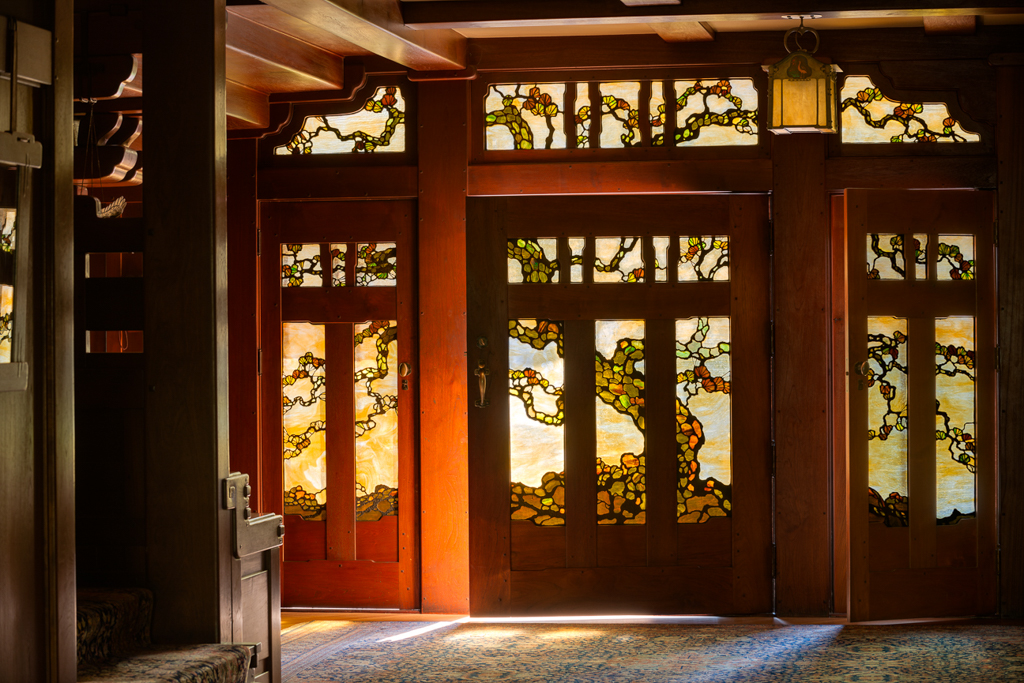
The light is Lange’s. The amber and gold background glass he selected is not a single color but a layered composition of iridescent sheets whose interaction produces a quality of warmth that no single glass could achieve. When the morning sun strikes the door, these sheets do not simply transmit light; they transform it, adding their own internal variations to the external illumination, producing a glow inside the entry hall that seems to come from the glass itself rather than from the sun behind it. The effect is impossible to photograph accurately — every reproduction flattens it into something more static than the real experience — and it is this effect, more than any single design choice, that gives the door its mythic quality in the Greene & Greene literature.
The leading of the door deserves attention as well. The dark lines that define the branches and the edges of the needle clusters are not simply structural — holding the glass pieces in place — but compositional, functioning as the drawing’s contour lines and establishing the visual rhythm that organizes the whole composition. Lange’s leading is characteristically fine, reduced in cross-section to the minimum that will bear the structural loads, so that the lead reads as line rather than as mass. Compare the leading of a typical Tiffany lamp, where the lead is visually heavier and contributes its own weight to the composition, and you begin to see one of the specific ways Lange’s work differed from the studio tradition he had trained in. His glass is more dissolved, more atmospheric, less bounded by its own armature.
The other commissions
The Gamble House door is the most famous piece of Lange’s work, but it is not the only significant piece. The Blacker House interiors contain extensive art glass programs in the same distinctive vocabulary — atmospheric compositions based on natural motifs, executed in iridescent and opalescent sheets, leaded in the characteristic fine manner. The dining room light fixture at the Gamble House, a suspended composition of leaded panels framing a warm interior glow, is Lange’s work throughout. The art glass panels beside the Gamble House living room fireplace — the borrowed-light windows that bring illumination from the entry hall into the living room through the interior partition wall — are Lange’s.
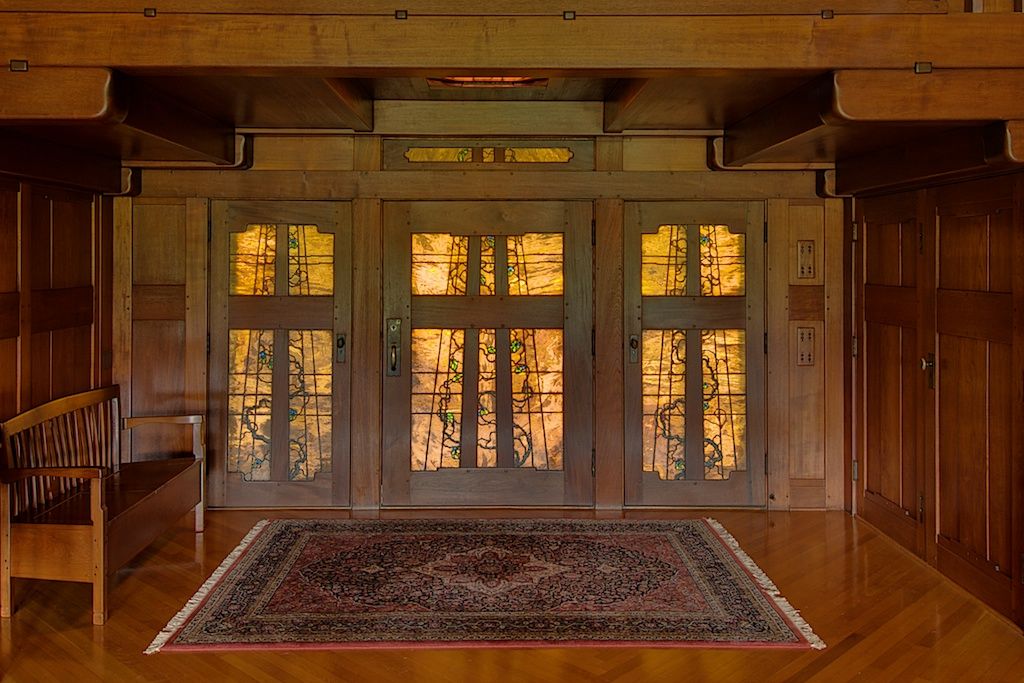
Each of these pieces shows the same characteristic qualities: glass selection of a precision that rewards close looking, leading that dissolves into line rather than announcing itself as frame, atmospheric composition that evokes natural phenomena without literally depicting them, and an overall quality of light that transforms rather than simply filters the illumination passing through. Taken together, they constitute one of the most coherent bodies of architectural art glass produced in America during the Arts & Crafts period — arguably the single most fully integrated art glass program in American residential architecture, with every piece calibrated to the specific architectural context for which it was made.
This integration is the key. Lange’s work for the Greenes was not simply art glass; it was architectural art glass, conceived and executed as part of the overall architectural composition rather than as a decorative addition to it. The panels beside the Gamble House fireplace are not decorative windows — they are the fireplace wall, their amber and green sheets producing the specific light that anchors the entire living room composition. The door is not a decorated door — it is the architectural threshold, and the tree it depicts is the deliberate choice of a Japanese motif at the precise moment of arrival, announcing the house’s philosophical lineage before the visitor has crossed into the entry hall. This architectural integration required a working relationship between architect and glass maker that went well beyond the typical studio-and-client relationship of the period.
What survived, and what did not
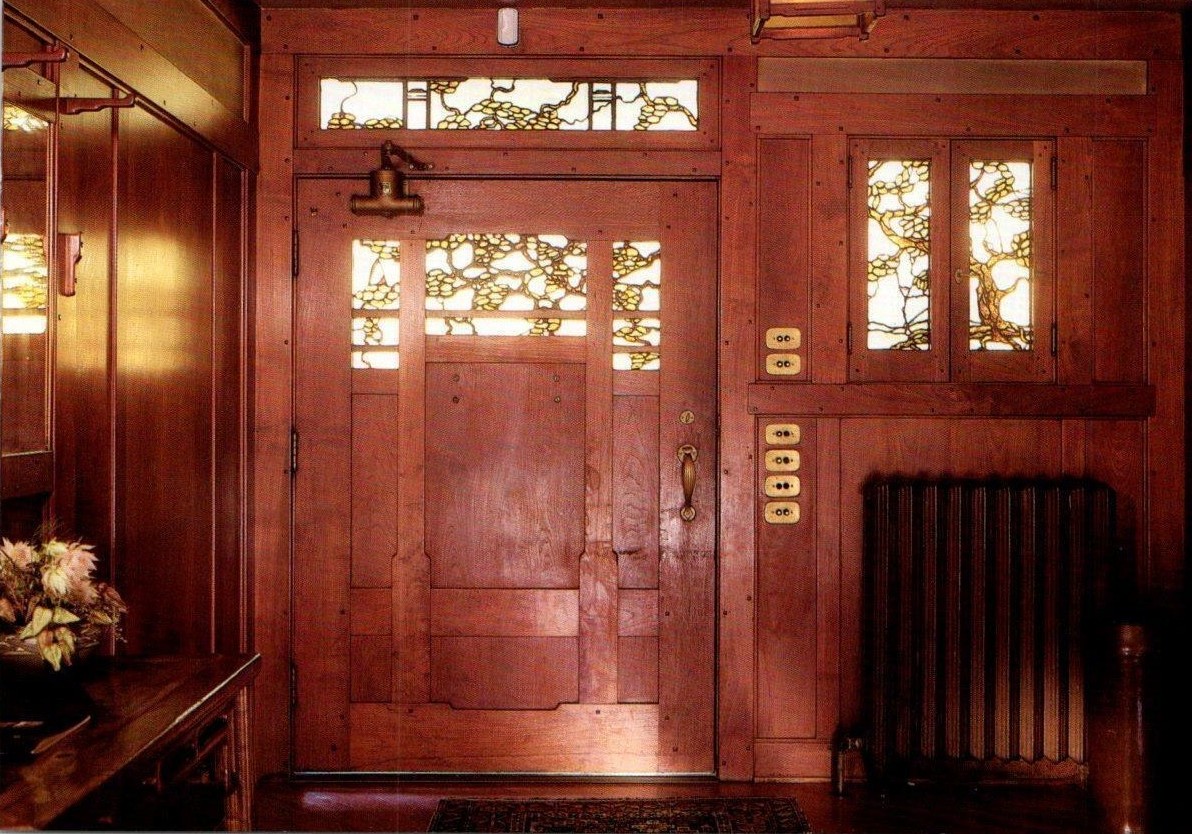
The great Greene & Greene commissions have preserved Lange’s work with an unusual degree of fidelity. The Gamble House glass is almost entirely original, its leading re-soldered in places where time has weakened the joints but its essential compositions and glass selections intact. The Blacker House, which suffered significant dispersal of its contents in the twentieth century — interior fixtures sold off, furniture removed, hardware stripped — lost some of its original Lange glass to this dispersal, though much of the architectural glass remains. The Thorsen House art glass is largely preserved in situ.
Lange’s other work — the commissions he executed for architects other than the Greenes, the speculative pieces produced for commercial clients, the ecclesiastical glass he produced for various Southern California churches — has had a more uneven survival. Much of it was lost to the changes of taste that swept American domestic architecture after the First World War, when Arts & Crafts interiors were rapidly replaced by Colonial Revival and Spanish Colonial fashions that had no use for the kind of atmospheric art glass Lange had made his specialty. Churches, renovation-prone by the nature of their use, lost panels to fire, to remodeling, to the simple expediency of replacement. A comprehensive catalog of Lange’s output does not exist, and may never be possible to compile.
The documentation of Lange himself is similarly incomplete. He does not appear to have left substantial personal papers. The business records of his shop, if they survived at all, have not been located in any public archive. What is known about his life and career has been pieced together largely from the documentation of the architects and clients he worked for — from the correspondence, contracts, and specifications that mention him as the executor of particular commissions. This is the standard epistemological fate of the craftsman in architectural history: the architect’s papers survive because the architect was understood to be the author, and the craftsman’s contribution is preserved only insofar as it is noted in the author’s records.
The light, continuing
It is easy to sentimentalize the craftsman whose name time has lightly held. It is harder, and more useful, to see clearly what Lange actually did. He took the drawings Charles Greene produced and translated them into material. That translation was not mechanical. It required him to make hundreds of decisions, in the selection of each sheet and the cutting of each piece, that the drawings alone could not have specified. He brought to those decisions a training in the American studio glass tradition and an eye for light that was, on the evidence of the surviving work, as fine as any in the regional craft of his moment.
The result is still there, in Pasadena and in Berkeley, doing its work. The morning sun still strikes the Gamble House door and still transforms the entry hall into something that feels like weather. The amber panels beside the living room fireplace still borrow light from the entry and still anchor the living room with the specific warmth their specific glass produces. The dining room light fixture still glows when the chains are drawn and the bulbs within are lit. None of this light was inevitable. It was made — by a specific man, in a specific shop, using specific glass selected by his specific eye, a century ago and more, and it is still making its case for what architectural glass can be when it is treated not as decoration but as the material through which a building’s relationship to light is constructed.
Say his name. Emil Lange. He made the light.
Lange’s surviving work can be studied in the Gamble House, the Blacker House, and the Thorsen House.