
Drive into the Oak Knoll district of Pasadena, where the streets curve and the lots run deep, and at the corner of Hillcrest and Wentworth you come upon a house that is larger than it first appears. The eye reads, at a glance, a long and low timber-framed bungalow — broad eaves, a shingled mass settling into its ground, the familiar grammar of Charles and Henry Greene. Then the mind catches up to the scale. The house runs on, and on. There is a porte-cochère, and beyond it another wing, and beyond that the ground that once carried five acres of terraced garden. This is the Robert R. Blacker House, completed in 1907. It is the largest and most lavish house the brothers ever built.
It is whole today. Every lantern hangs where it was meant to hang. Every leaded-glass door sits in its frame. The shingles are the moss green the Greenes chose and the timbers the dark brown, and a visitor standing at the curb would have no way of knowing that almost none of what he is looking at is a survival.
The Blacker House has been taken apart twice.
Not demolished — taken apart. Once in 1946, and once in 1985. Both times it was sold for its pieces. Both times the dispersal violated an explicit instruction to keep the house whole. And both times the instruction failed for the same reason, which is the reason this essay is about, and which the Blacker House proves more completely than any other building the brothers made.
A total work of art is the easiest kind of building to destroy. Not by demolition. By subtraction.
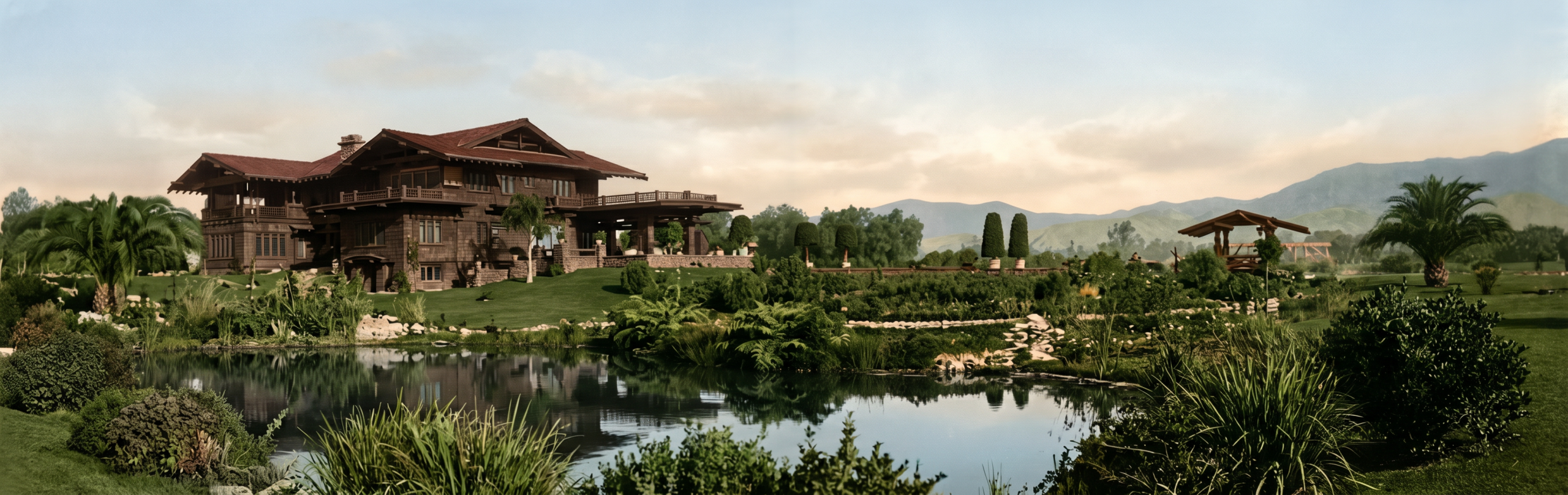
The Largest House the Brothers Built
Robert Roe Blacker was a Michigan lumberman. He had made his fortune in the forests of Manistee, in a series of milling firms that cut the white pine of the upper Midwest, and in 1906, at the age of sixty, he retired and came west. Pasadena in those years was filling with exactly this kind of man — Midwestern, recently wealthy, done with winter — and Blacker did what such men did. He bought a prime parcel of land. The lot was five acres on high ground in the Oak Knoll development, near the corner of Hillcrest and Wentworth, sloping south, full of opportunity for the kind of garden a fortune could buy. Then he hired Greene & Greene.
What he gave them was a commission without compromise. The budget exceeded one hundred thousand dollars — an astronomical figure in 1907, something over three million in today’s money — and the brothers spent it. The house came to roughly twelve thousand square feet. It was the second of the great houses the Greenes designed and the first of them to be built, and in the brief window of their genius it functioned as a kind of design laboratory: the techniques and the vocabulary perfected at the Blacker House would be carried, the following year and at smaller scale, into the Gamble House a few blocks away. The Gamble is the more famous house today, because the Gamble became a museum. But the Gamble is the Blacker’s smaller brother.
The grounds matched the house. The Greenes laid out terraced gardens that stepped down the slope, a lily pond that held the sky, a wisteria-draped pergola of massive timber, a carriage house, allées of trees. The garden was not a setting for the house. It was a continuation of it — outdoor rooms answering indoor rooms, the same compositional mind at work on water and planting as on teak and glass.

A House Conceived Whole
To understand what happened to the Blacker House, it is necessary to understand what kind of object it was. The word that gets used, correctly, is the German one: gesamtkunstwerk, the total work of art. It means a building in which nothing is bought and everything is composed. At the Blacker House this was carried further than anywhere else in the brothers’ work. The furniture was designed for the rooms it would stand in. The fifty-three light fixtures were designed for the ceilings they would hang from. The leaded art glass was drawn for its particular windows. Down to the teak escutcheon plates on the upstairs doors, down to the ebony keys of the linen closets — each cut with a small cloud-lift — the house was a single thought, expressed in several thousand parts, with no part repeated and no part generic.
This is the achievement. It is also, and for exactly the same reason, the vulnerability.
Consider an ordinary house. It can be neglected, altered, or knocked down, but it cannot easily be looted, because it contains almost nothing that is worth more removed than installed. Its doors are catalog doors. Its light fixtures are catalog fixtures. There is no market for its parts because its parts are not particular. The Blacker House was the opposite of an ordinary house in every respect, and this respect included its danger. Every one of its fifty-three fixtures was unique, hand-made, signed in effect by the most celebrated architectural partnership in California. Every one of them was independently beautiful and therefore independently desirable and therefore independently saleable. A house composed entirely of masterpieces is a house composed entirely of things that can be carried out the door and sold one at a time.
The completeness that made the Blacker House great is the completeness that made it fragile. Hold that sentence. The rest of the story is the proof of it.

What Nellie Blacker Asked For
Robert Blacker died in 1931. His wife, Nellie Canfield Blacker — herself the daughter of a Michigan lumber family — lived on in the house for another fifteen years. She died in 1946. The couple had named no heirs, and so the house, the land, and everything in it passed into probate.
Nellie Blacker had left an instruction. Her will specified that the house, the land, and the furnishings were to be sold as a whole — not parceled, not broken up. It is worth pausing on this, because it tells us that she knew precisely what she owned. She did not own a house and, separately, some land and some furniture. She owned a single composed object, and she understood that its value — not its market value, but its actual value, the thing that made it worth caring about — was a function of its remaining one object. Her will is the first of the two written instructions in this story. It asked the future to keep the Blacker House whole.
The future declined.

The First Dispersal
The representative of Nellie Blacker’s estate read the will, understood the instruction, and did the opposite. The reasoning was not malicious. It was simply financial. An estate exists to be liquidated at the highest return, and the highest return on the Blacker property did not come from selling it as a whole. It came from breaking it into parts.
So the five acres were subdivided. The garden the Greenes had composed — the terraces, the lily pond, the pergola, the allées — was carved into separate building lots and, in the carving, destroyed. The main house was left standing on a single acre. The garage became its own residence. The caretaker’s cottage became its own residence. And the furnishings — the chairs and tables and case pieces designed for these particular rooms — were sold off, by most accounts, in something close to yard-sale fashion. One family, the Andersons, lived down the street; they bought a large lot of the furniture and carried it home.
What that furniture was worth is its own grim education. In 1990, an Anderson descendant offered the breakfast-room table back to the then-owners of the house for three hundred and ninety thousand dollars. In 2007, a single Blacker House living-room chair sold at Sotheby’s, with premium, for nine hundred and thirteen thousand six hundred dollars. A bedroom chair, the same day, brought three hundred and ninety-six thousand. The Blacker House dining table found its way into the collection of the Detroit Institute of Arts, where it is held as a major work of American decorative art — which is exactly what it is, and exactly the problem.
The first dispersal had already proved the thesis. The parts outsold the whole. A chair, alone, in a saleroom, commanded a price the intact house in 1946 could not have matched per square foot. The market had spoken, and what it said was that the Blacker House was worth more in pieces. Nellie Blacker’s instruction had no force against that arithmetic, because her instruction was only a will, and a will is only a wish. It can ask. It cannot compel.

The Man They Called Black Bart
For the next four decades the house, reduced to its single acre, passed through a sequence of owners. The Hill family bought it in the 1950s and held it the longest. Then, in 1985, the recently widowed Mrs. Hill sold the Blacker House, and the transaction that followed has its own name in the history of American preservation. Preservationists came to call it the Rape of the Blacker House. It is a brutal phrase. It was meant to be.
The buyers were Barton English — a Princeton graduate and Texas rancher, remembered locally by the nickname Black Bart — and a New York dealer in Arts and Crafts antiques named Michael Carey. The price was about one and a quarter million dollars. Preservationists in Pasadena did a quick and sickening piece of arithmetic and reached a conclusion that the following weeks confirmed: the purchase price was less than the market value of the fixtures still hanging inside the house. The Blacker House had been bought, in effect, for its parts.
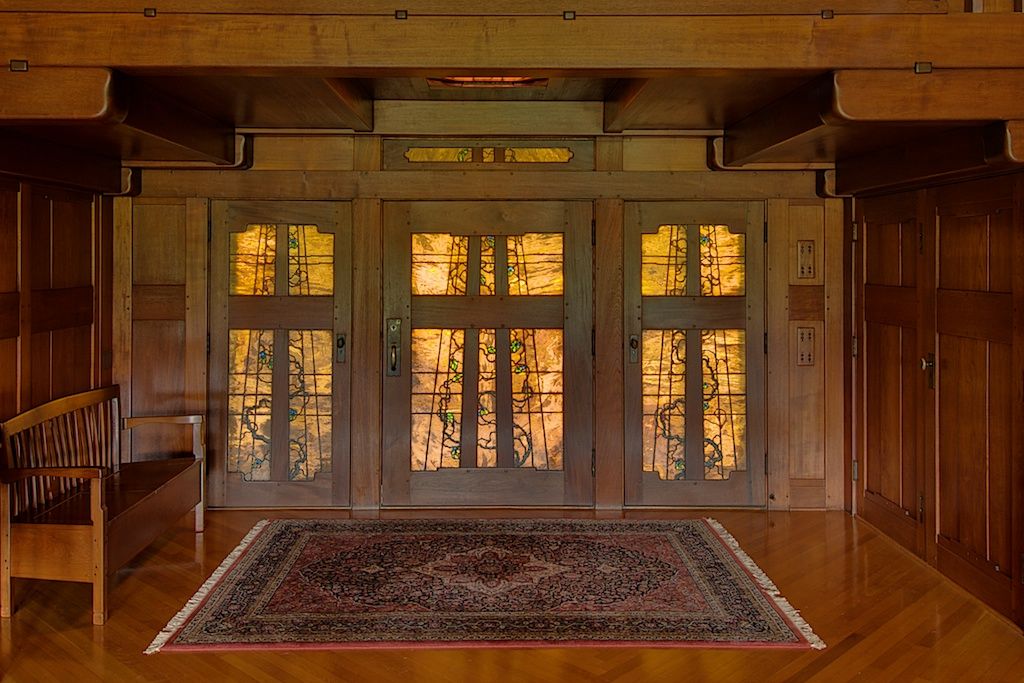
Shortly after escrow closed, English hired a well-known local antique dealer, and the dealer’s crew went to work. They removed the fifty-three light fixtures. They removed the leaded-glass front doors. They removed art-glass windows and transom panels. There was a refinement to the operation that is, in its way, the most telling detail of all: before the originals came out, English commissioned a local studio to produce exact reproductions, so that the holes could be filled and the removal would not show. The plan was not merely to strip the house. The plan was to strip the house invisibly — to extract the art and leave a convincing forgery of the art in its place, so that the building would look untouched while its substance was sold.
And the substance sold well. Individual lamps went for sums in the six figures. The two dining-room chandeliers, by some accounts, brought half a million dollars apiece. English recouped his purchase price and more, and he did all of it within the law, because in 1985 there was no law. No ordinance protected the Blacker House. Nellie Blacker’s will had asked the house be kept whole; thirty-nine years later, nothing on the books required it. English never lived in the house. He sold it in 1988, emptied, for one and a quarter million dollars — about what he had paid for it, the fixtures having already been turned into pure profit.
The pieces scattered. The front doors went, eventually, to the Dallas Museum of Art. A hall lantern went to the Saint Louis Art Museum. Furniture and fixtures entered museums and private collections across the country, each one re-cataloged as an independent masterwork of American design — which, again, is what they are. Every object that left the Blacker House was honored. The house they were taken from was gutted. Both things were true at once, and the contradiction is the whole subject.


The Ordinance and the Vigil
Pasadena did not stay quiet. The executive director of Pasadena Heritage, Claire Bogaard, understood that the stripping of the Blacker House was not a local property dispute but a national disgrace, and she made certain the country heard about it. Articles ran in the Los Angeles Times, in The Washington Post, in The New York Times. And in Pasadena itself, conservation-minded citizens did something quietly extraordinary: they guarded the house. They watched it, day and night, in shifts, to keep anything else from being carried out the door.
Think about what that vigil actually was. It was a group of private people standing in for a law that did not yet exist — supplying, with their own bodies and their own time, the protection that the statute books failed to supply. They were the will of Nellie Blacker, made flesh, forty years late.
The permanent answer came as legislation. Pasadena enacted an emergency measure that quickly became known as the Blacker Ordinance. It was not, and could not be, an outright prohibition — a city cannot simply forbid an owner from altering his own house. What it did instead was buy time. The ordinance allowed the city to delay, for up to one year, any alteration to a Greene & Greene house, subject to review by a committee of the Planning Commission. A year is not forever. But a year is long enough for outrage to organize, for buyers to be found, for a removal to be argued about in public before it becomes irreversible. The ordinance did not make the Blacker House invulnerable. It made the house slow to destroy, which, for a building, is most of what protection means.
In February 1986, the Blacker House was added to the National Register of Historic Places — while Barton English, who had stripped it, still owned it. The timing is bitter and it is also exactly right. The Blacker Ordinance is, in the end, Nellie Blacker’s will rewritten in a form that cannot be ignored. What a private wish could only ask, a public statute could require. The instruction to keep the house whole had finally been given teeth.

Seven Years of Re-Creation
The law could slow the next destruction. It could not reverse this one. Reversing it would take something else entirely, and in 1994 it found the people willing to attempt it. When the emptied house came up for sale, Harvey and Ellen Knell bought it. They were, at the time, already in escrow on a different Greene & Greene house; they backed out of that purchase in order to take on the Blacker. “We bought it with a lick and a prayer,” Ellen Knell later told the Los Angeles Times.
What the Knells undertook became one of the most thorough restorations in American architectural history. They engaged Randell Makinson — the scholar who, more than any other single person, had rescued the brothers’ reputation from obscurity — as restoration architect. For the recovery of the lost objects they turned to a master craftsman, James Ipekjian, whose Pasadena workshop had already reproduced furniture for Greene & Greene houses and for Frank Lloyd Wright’s Hollyhock House. The work that followed was less like renovation than like forensic science.
The exterior told its own buried story. Decades of bad finishes had left the redwood a blackened, rotting mess, and as the crews stripped it back they found, on one original shake, a fleck of green stain no larger than a pinhead. That single fleck, chemically analyzed, returned the house its original palette: moss green for the shingles, a medium dark brown for the timbers. For the first time in over fifty years, the Blacker House could be seen in the colors the Greenes had chosen.
The interior was the harder labor. Fifty-three light fixtures and dozens of pieces of furniture had to be brought back from nothing. Ellen Knell became a kind of detective, networking through museums, auction houses, and private collectors across the country to locate what had been scattered; she succeeded in buying back a few of the original windows. The rest had to be re-created. Working from the brothers’ original drawings — preserved at Columbia University’s Avery Library — and from his own painstaking measurements of surviving originals, which he traveled the country to study, Ipekjian and his team rebuilt the lost fixtures over the better part of seven years. The reproductions came out so exact that they had to be signed and dated, deliberately, so that a future scholar could still tell a 1990s re-creation from a 1907 original. The front doors were rebuilt from the originals held in Dallas. The Knells even persuaded neighbors to sell back parcels of the subdivided estate, and began to reconstruct the gardens and the pond. When the restoration was complete, the actor Brad Pitt — an architecture enthusiast who would, years later, buy Charles Greene’s cliffside house at Carmel — hosted a benefit dinner to mark it.
This is the second answer to the problem the Blacker House poses. If the law is the answer that buys time, craft is the answer that buys back the whole. But notice the cost of that answer, and notice its honesty. The re-creation took seven years, a team of master craftsmen, a fortune, and the original drawings of the original architects — and at the end of it the new fixtures still had to be signed and dated, because they are not the originals and the restorers refused to pretend otherwise. The whole can be reassembled. It cannot be un-broken.

Worth More in Pieces
Stand again at the corner of Hillcrest and Wentworth. The house is whole. The lanterns hang, the doors are leaded, the shingles are green. By any honest measure the Blacker House has been saved, twice over — once by a law and once by a restoration — and it is right to be glad of it.
But the lesson of the house is not a comfortable one, and it would be a disservice to the building to soften it. The Blacker House teaches the hard economics of the total work of art. The more completely a building is composed — the more every part of it is particular, hand-made, irreplaceable — the more completely it consists of objects that the market will value, individually, above the building they belong to. A masterpiece assembled entirely from masterpieces is a masterpiece that can be disassembled at a profit. This is not a flaw the Greenes could have designed away. It is the shadow side of the achievement itself. The same quality we praise — that nothing here is generic, that the whole house is one unrepeatable thought — is the quality that puts every lantern permanently at risk.
Twice the Blacker House was sold for its pieces, and twice the parts outsold the whole, because the parts always will. A will could not prevent it; a will is a wish. What finally held the house together was the pairing that the 1985 disgrace forced into being — a law that makes destruction slow, and a craft that can, at ruinous expense, reverse it. Pasadena did not arrive at that pairing by foresight. It arrived at it by loss.
The Blacker House is whole today. It is whole by ordinance and by signature — held together by a statute that can delay the next hand and by a craftsman’s dated mark on every re-created fixture. It is no longer whole the way Nellie Blacker hoped it would simply stay whole, on its own, because someone was asked nicely. A masterpiece is worth more whole. The Blacker House is the proof of that — and the proof, also, of how easily, and how nearly, the market forgets it.

For more on the Blacker House’s scattered lighting, see The Lantern in Gallery 129 and The Pagoda at the Porte-Cochère. For the comprehensive account of the house, see the Blacker House.
On another Greene & Greene legacy scattered and recovered, see The Divided Archive.