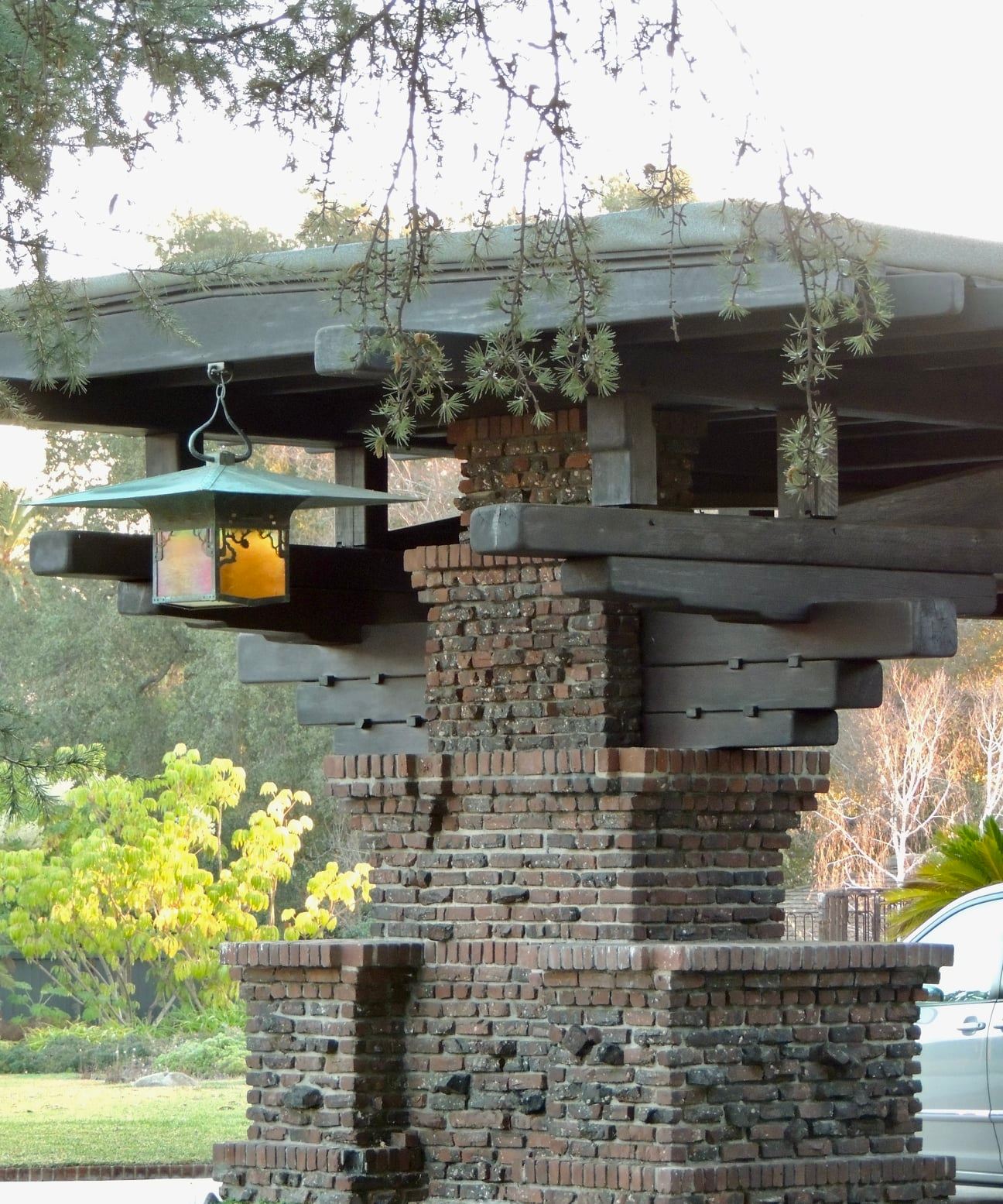
At the porte-cochère of the Robert R. Blacker House in Pasadena, suspended from the heavy timber overhang where the carriage drive meets the entry, hangs one of the most photographed objects in the entire Greene & Greene catalog. It is a copper lantern with an oversized pagoda-form roof, leaded art glass panels in amber and rose, and applied bronze openwork at the upper register depicting a single branch of pine reaching across the glass.

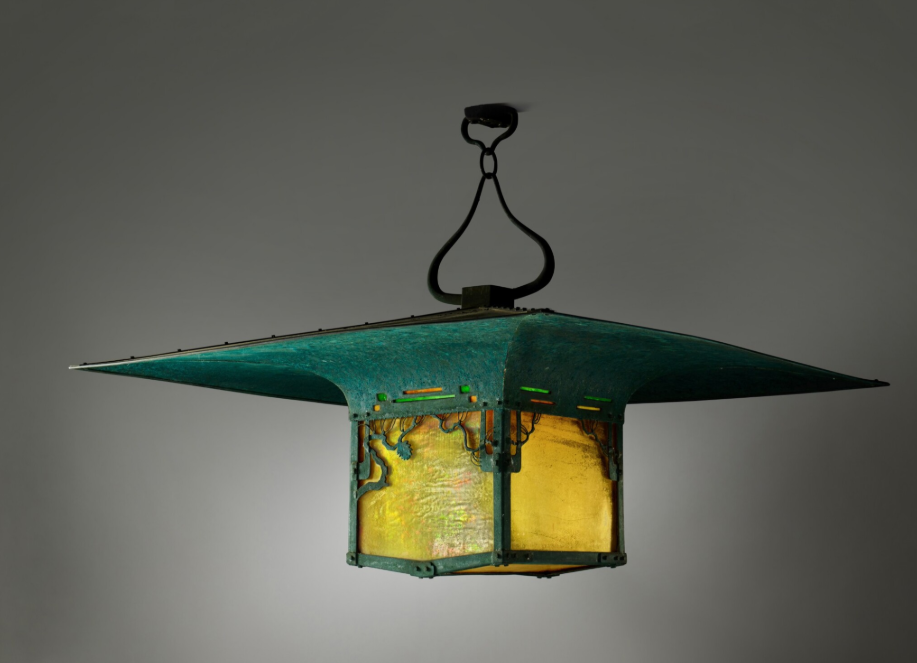
The roof is what arrests you first. The four-sided cap, far broader than the lantern body it shelters, with each side curving slightly upward at the edges in the unmistakable profile of a Japanese pagoda eave. The proportions are the proportions of a temple roof seen at its smallest possible scale — a piece of religious architecture rendered at the size of a domestic light fixture, hung above the place where the brothers wanted you to pause before entering the house.

The copper has aged into a verdigris green so saturated it reads, in certain light, as almost teal. A century of Pasadena weather has done what only a century of Pasadena weather can do — turned the metal into a surface that no foundry could produce on commission, organic in its mottling, irregular in its hue, alive in a way that newly fabricated copper never is. The patina is not damage. The patina is the lantern reaching its mature condition.

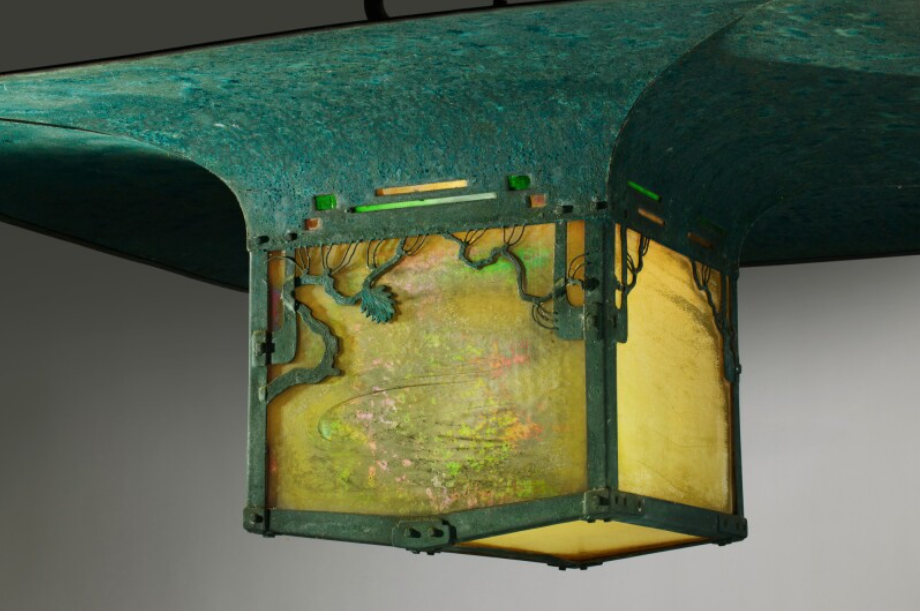
The art glass panels at the body — amber, rose, the occasional shot of green — are signed by Emil Lange, whose collaboration with Charles Greene began at the Robinson House and reached its fullest expression in the doors and windows of the Gamble House. The glass at the Blacker lantern is small in scale relative to those larger commissions, but the same logic governs it: glass selected and assembled to transform California sunlight rather than merely transmit it, leaded with a precision that allows the bronze openwork above to read as drawn line rather than as structural frame.
The pine branch at the upper register is the detail that rewards the closest looking. A single branch, rendered in applied bronze, with the needle clusters articulated as small dimensional sprays — visible only when you stand directly beneath the lantern and look up into its underside. This is the detail no photograph quite captures. The pine is not there to be seen from the carriage drive. The pine is there for the person who has stopped, who has noticed the lantern overhead, who has lifted their eyes from the brick column and the heavy timber overhang to ask what the lantern actually is. The branch is the reward for that asking.
The brothers placed it here, at the threshold between arrival and entry, for a reason. The pagoda lantern at the porte-cochère is the first object of the house’s interior intelligence that the visitor encounters — before the front door, before the entry hall, before the stair. The lantern says, by what it is and how it is made: this is what the house you are about to enter cares about. The Japanese sources, the master craftsmanship, the bronze and glass and copper combined into a single integrated object, the detail that reveals itself only on close attention. All of it, compressed into a single hanging fixture, suspended from a timber beam at the moment of arrival.
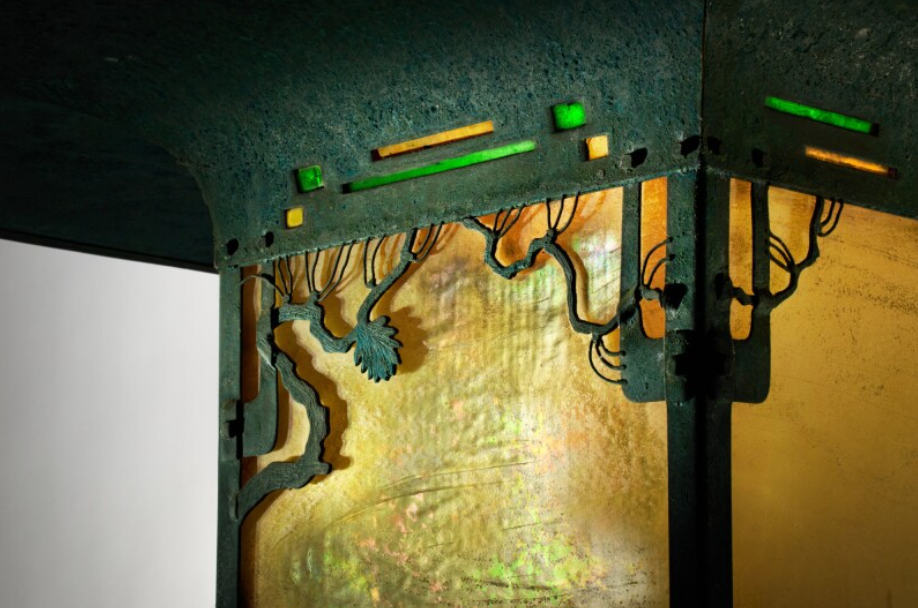
The pine reaches across the glass. The copper holds its century of green. The lantern waits.
For more on Emil Lange’s glass at the brothers’ major commissions, see The Man Who Made the Light.