
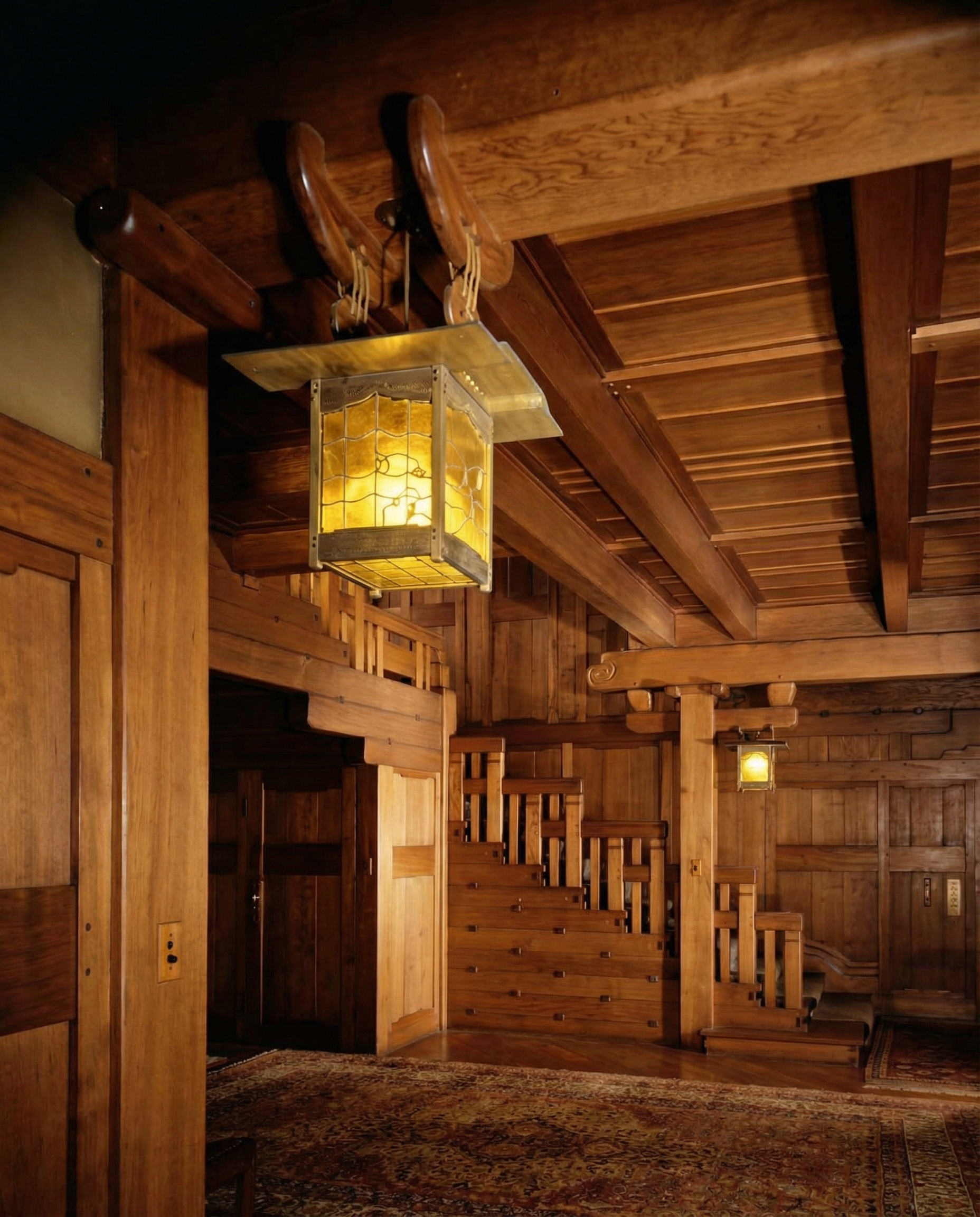
Stand in the entry hall of the Robert R. Blacker House in Pasadena and look up.
There is a lantern over your head. It is a box of mahogany and leaded glass, suspended on an iron strap from a pair of carved wooden brackets, and it has the particular Greene and Greene profile — the wide, gently overhanging roof, the stepped lines, the amber glow when it is lit. It looks as though it has hung in that exact spot, doing that exact work, since the house was new.
It has not. The lantern over your head is a reproduction. It was made in the 1990s by the Pasadena craftsman James Ipekjian, and it was made so precisely — from the Greenes’ own drawings, recovered from the Avery Library at Columbia, and from careful measurement of the surviving originals — that Ipekjian signed and dated each one. He had to. An unsigned copy that good would, sooner or later, be mistaken for a 1907 original, and Ipekjian was not willing to leave that confusion in the world.
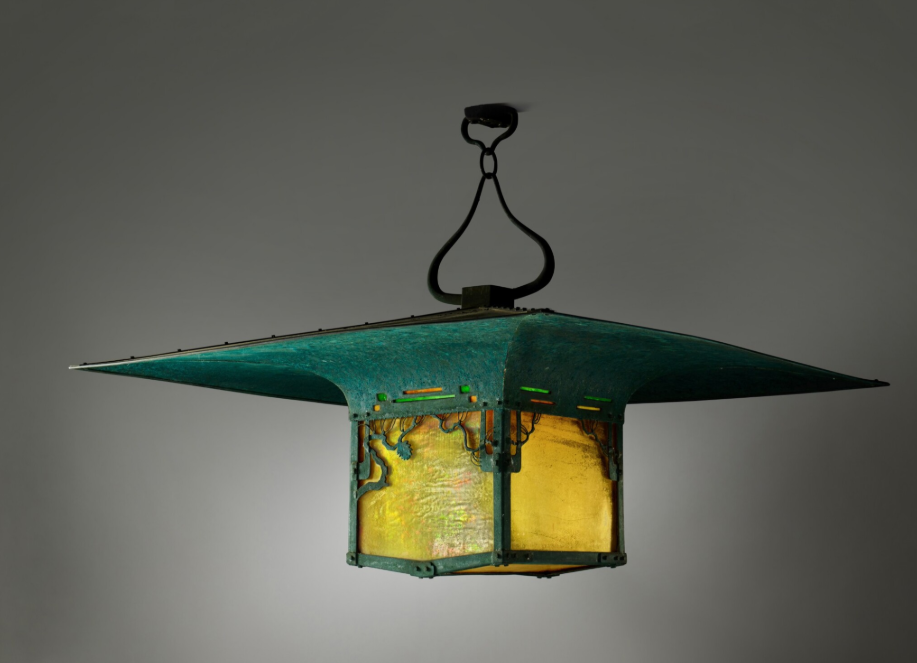
The original — one of a pair that hung in this hall — is in Missouri now. It hangs in Gallery 129 of the Saint Louis Art Museum, catalogued as object number 62:2001. Its mate belongs to the same collection.
How a lantern travels from a Pasadena entry hall to a museum in St. Louis is a story the Blacker House would rather not tell, and it should be told anyway.
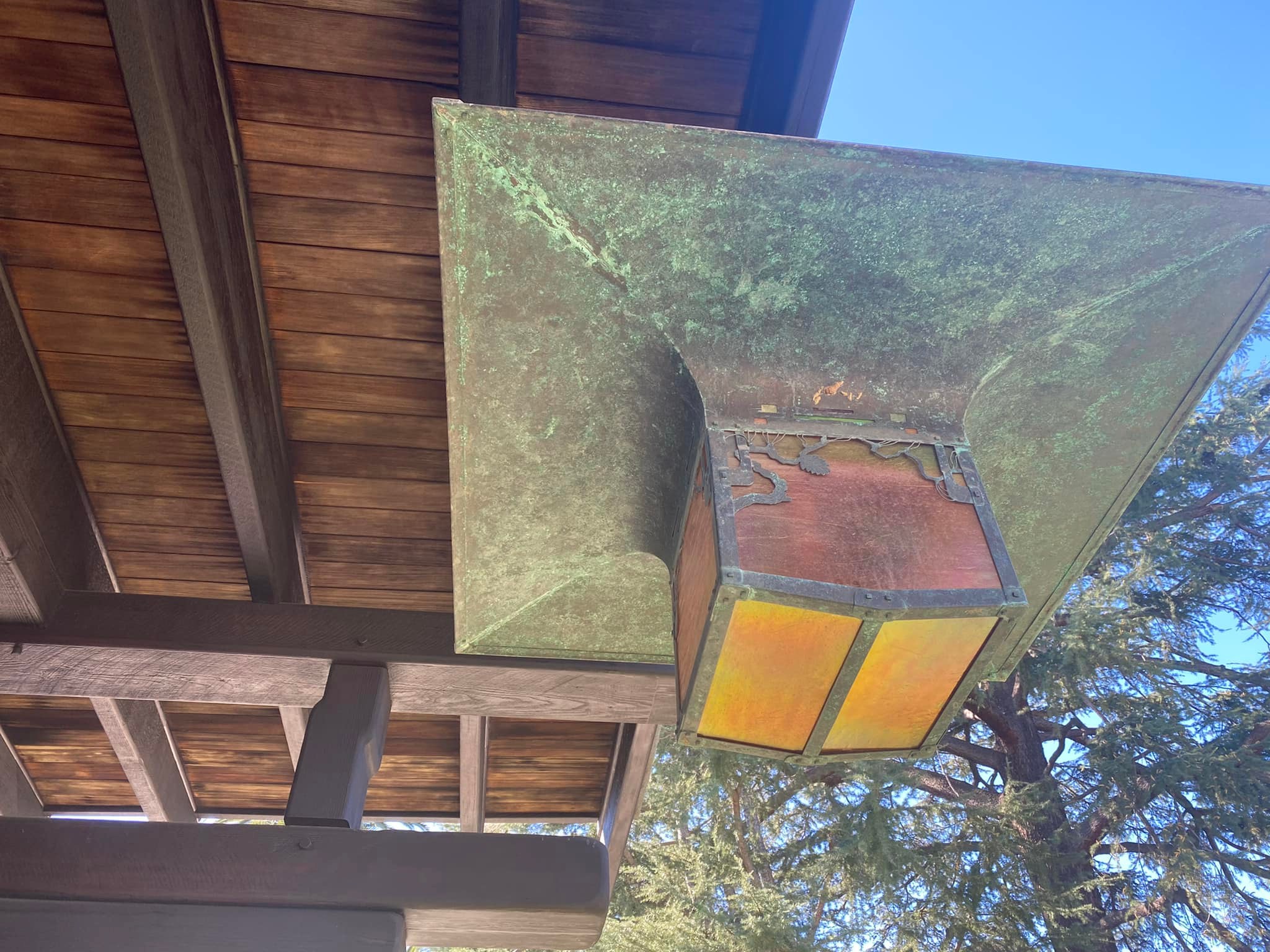
The Blacker House was the first of the ultimate bungalows — the largest, the most expensive, the house in which Charles and Henry Greene first did everything at once. They designed not only the building but everything in it: the furniture, the art glass, and roughly fifty light fixtures, each one drawn for a specific place in a specific room. The hall lanterns were drawn for this hall. They were built by the Peter Hall Manufacturing Company and glazed by Emil Lange — mahogany, leaded glass, ebony, with copper and silver inlay, the panels carrying a pattern of birds in flight. They were not lamps the Blackers happened to buy and hang. They were members of the house, in the way that a beam is a member of the house.
Robert Blacker died in 1931, Nellie Blacker in 1946. Nellie’s will was explicit: the house, the land, and the furnishings were to be sold together, as a whole, and not broken up. That instruction was ignored almost immediately, and it would be ignored again, far more violently, forty years later.
In 1985 the house was bought by a Texas collector named Barton English and a New York dealer named Michael Carey. They paid one million dollars. Within weeks of the close of escrow, English had hired a local antique dealer and begun pulling the fixtures out of the ceilings — more than forty-eight of them, by most counts something close to all fifty. The lanterns, the chandeliers, the sconces. They were sold. Single chandeliers brought a quarter of a million dollars; lamps went for a hundred thousand apiece; the lighting alone earned back the price of the house several times over. English then sold the emptied house, in 1988, for a modest profit. He had never lived in it.
The episode has a name in Pasadena. People there still call it the Rape of the Blacker House. It produced a genuine civic spasm — Pasadena Heritage drove the story into the Los Angeles Times and the Washington Post and the New York Times; ordinary citizens took shifts guarding the house through the night so that nothing more could be carried out of it; and the city passed an emergency measure, still remembered as the Blacker Ordinance, to slow the gutting of the other Greene and Greene houses before it could happen to them too. It was, in the long view, the event that taught Southern California what it owned.
But the lanterns were already gone. The hall pair did not travel straight to St. Louis. They went, as stripped masterpieces go, into the trade — through a Washington gallery, then a private collection in San Francisco, then a New York dealer — and only in 2001 did the Saint Louis Art Museum acquire them and give them a wall, a number, and a permanent place. Sixteen years, five owners, and most of the width of the country between the hall they were drawn for and the gallery they hang in now.
It would be easy to end the story there, on the theft, and call it a crime. It was a crime of a kind. But the more useful thing the lantern has to teach is something about what a Greene and Greene house actually is.
The lantern in Gallery 129 is beautiful. The museum lights it well; the birds still cross the iridescent glass; a visitor in St. Louis can stand in front of it and see, exactly, how good Charles Greene and Emil Lange were. What that visitor cannot see is the hall. The lantern was proportioned to a particular ceiling height, hung to throw its light down a particular run of teak, set in conversation with a particular stair and a particular front door. It was a word in a sentence. On a museum wall it is a word held up by itself — perfectly formed, and unable to mean what it was made to mean.
That is the quiet argument the Blacker House makes against its own dispersal. The Greenes did not design furnishings. They designed wholes. A lantern of theirs removed from its house is not a portable artwork that has found a wider audience; it is a piece of a building that has been broken off the building. Nellie Blacker seems to have understood this in 1946, when she wrote her will and asked that nothing be parceled out. She was overruled by an estate, and then overruled again, decades later, by a man with a moving van.
The reproduction now hanging in the Pasadena hall is, by every technical measure, correct. Ipekjian’s copies are exact; when Harvey and Ellen Knell restored the house in the 1990s, they restored it to a wholeness it had not had since the Hills sold it. The house reads, again, as a single thing. And still Ipekjian signed and dated every fixture — a small, honest mark that says: this is not the original; the original is elsewhere.
Switch on the lantern in Gallery 129 and it still works. The light still falls amber through the glass; the birds still take their flight. But the hall it was made to light is in Pasadena, and the lantern is in Missouri, and the strap it hangs from is bolted to a museum ceiling it was never measured for. It does the one thing it was built to do, in the one place it was never meant to do it.
For more on Emil Lange’s glass, see The Man Who Made the Light. On the scattering and recovery of the firm’s records, see The Divided Archive.