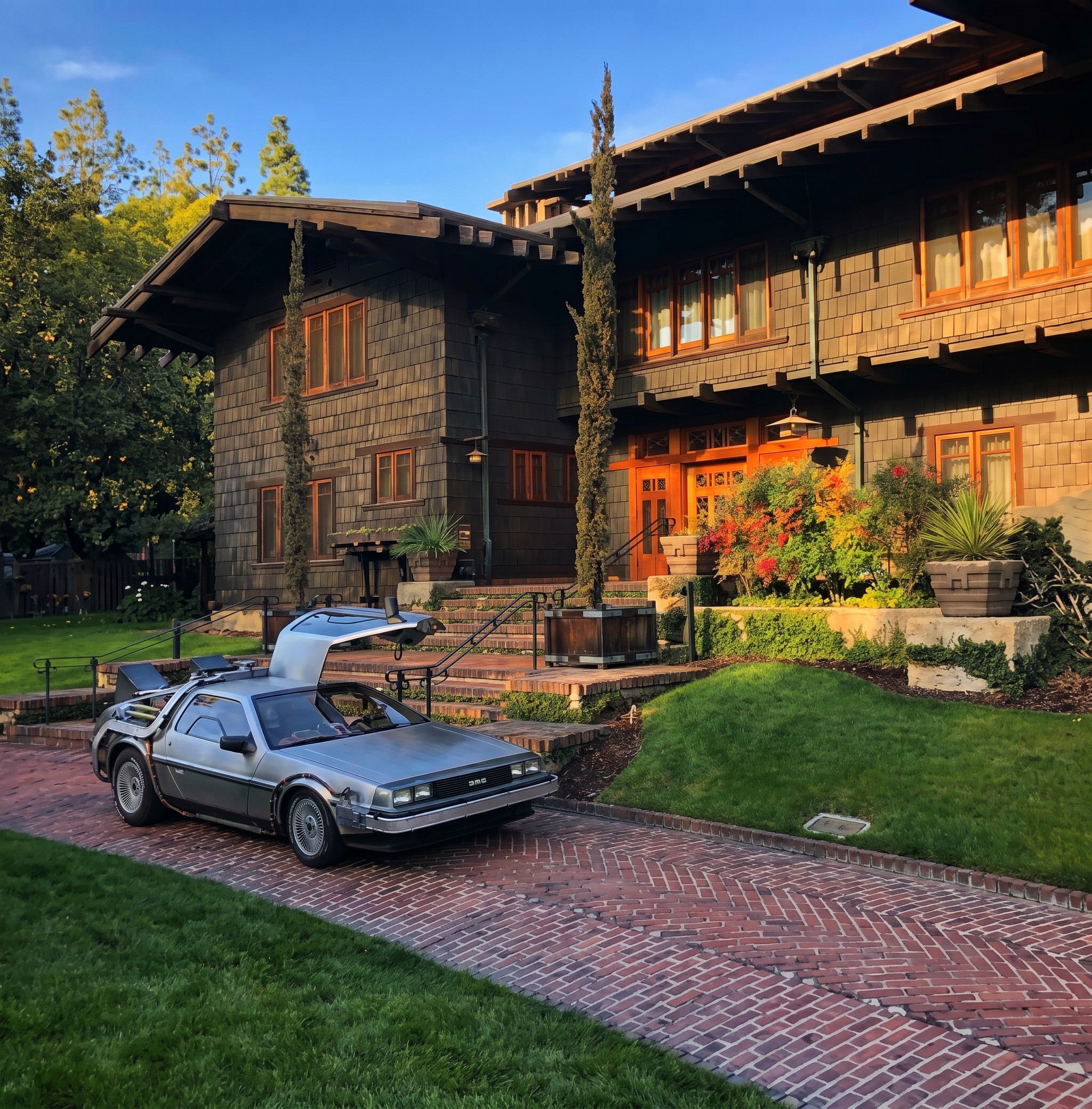
The most widely recognized Greene & Greene exterior in the world is recognized for the wrong house. Ask a certain kind of visitor why the Gamble House looks familiar and you will not hear about Charles and Henry Greene, or the Arroyo, or the timber joinery. You will hear about a mad scientist and a DeLorean. For a great many people the building at 4 Westmoreland Place is not the Gamble House at all. It is Doc Brown’s mansion, from Back to the Future.
Robert Zemeckis and Bob Gale shot their 1985 film in and around Pasadena, and they needed a house for Emmett Brown — an eccentric inventor who, the script implies, had once been rich. They found the Gamble House. In the film’s 1955 scenes it plays the Brown family seat at the height of its grandeur: a great dark-shingled pile glimpsed behind the young Doc, exactly the kind of house a Gilded Age fortune would have built and a mid-century heir would have lost. The casting is, in its way, perfect. The Gamble House really was built by a fortune — soap, not invention — and it really did pass out of the family’s hands, though into a museum’s rather than a wrecking crew’s.

Here is where the film does something quietly telling. The laboratory where Doc keeps his time machine is the Gamble House’s old carriage house — the outbuilding that once sheltered the family’s automobiles, now the museum’s gift shop. In the story’s present day of 1985, the great mansion is gone. Doc has been reduced to living in the garage, which the production placed, with a straight face, in the parking lot of a Burger King. The film invents a fate for the Gamble estate that is the exact inverse of what actually happened: in the movie the house is destroyed and only the garage survives; in life the house survived intact and it is the cars that left.
But the correction worth making is about the inside. People who love the film will tell you they have seen the interior of Doc Brown’s house — the entrance hall, the staircase, the front door he answers. They have. It simply is not the Gamble House. When the production needed interiors, the Gamble House was undergoing restoration and could not be filmed inside. So the location managers did something only Pasadena would let them do: they drove two miles to another Greene & Greene house and shot the interiors there. The inside of Doc Brown’s mansion — including the front-door scene — is the Robert R. Blacker House on Hillcrest Avenue.
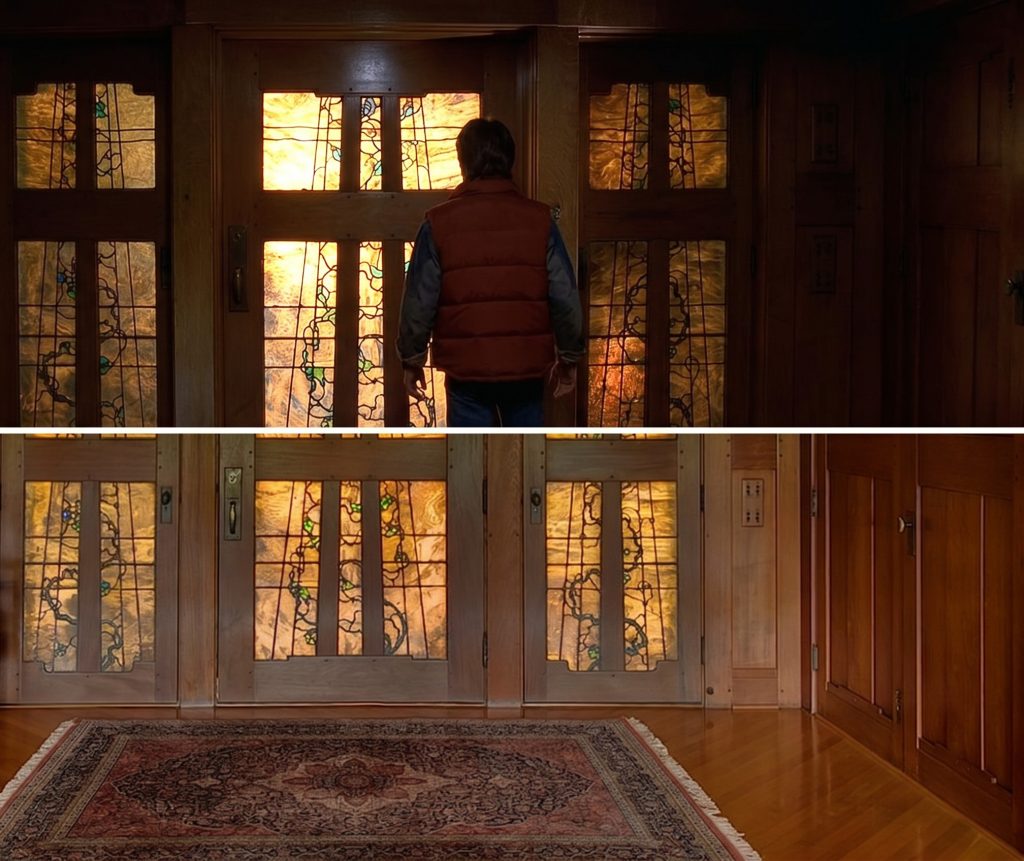
So the house that millions of people carry in their heads as a single place is in fact two houses, stitched together across a cut. The outside is the Gamble. The front door you watch swing open is the Blacker. You step over a Blacker threshold into a Blacker hall while believing yourself inside the Gamble — and the seam is invisible because the two houses are siblings, built by the same hands within a few years of each other, speaking the same language of teak and pegged joinery and amber glass. The film could only get away with the substitution because Greene & Greene were consistent enough that one of their masterpieces can pass for another.
There is a small irony folded into that front-door scene in particular. The Gamble House’s own front door — the leaded-glass triptych with its spreading tree, the single most photographed thing the brothers ever made — is the one element of the real house that the film conspicuously does not use. The door everyone associates with the Gamble House stayed home. The door in the movie belongs to the Blacker. If you have ever wondered why Doc Brown’s entrance never quite matches the postcards, that is why; the postcard door is the tree at the Gamble House door, and it never appears on screen.
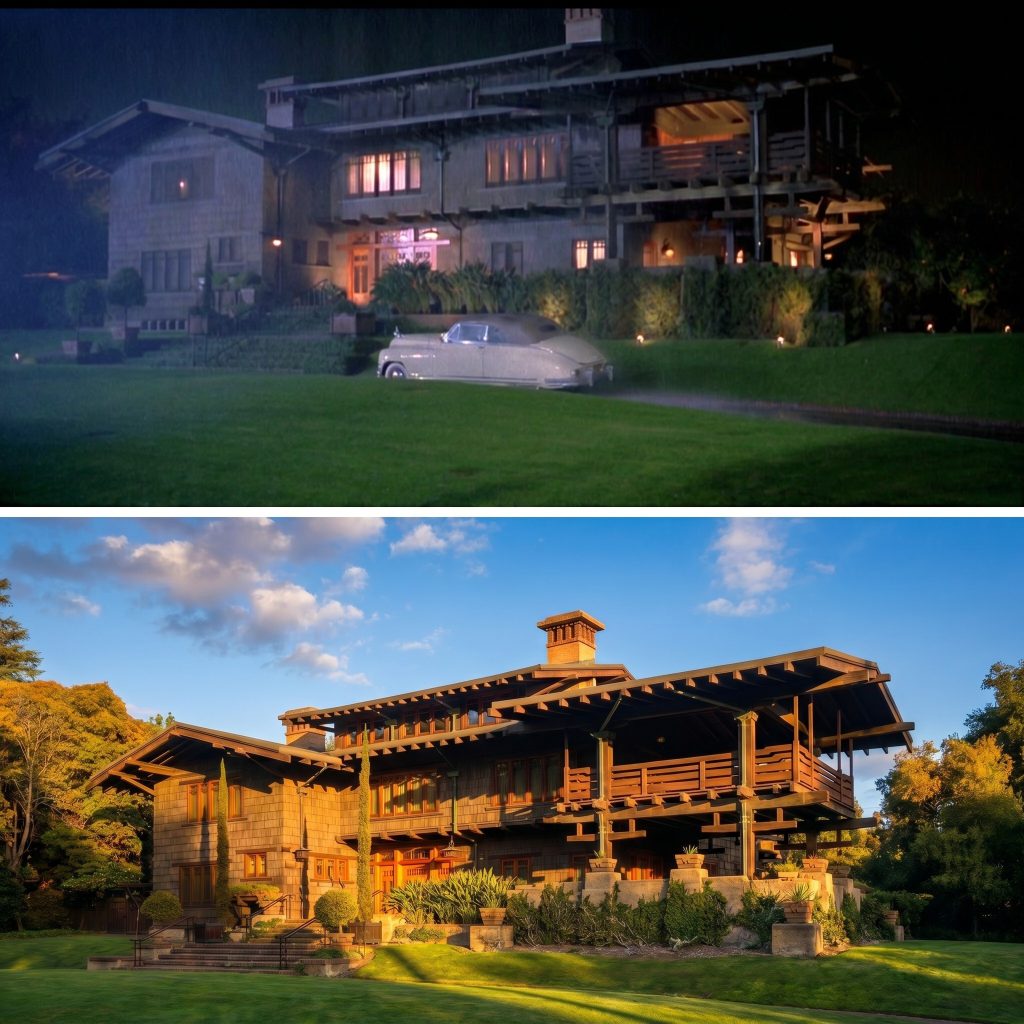
It would be easy to be sniffy about all this — to treat the film as a vulgar second life imposed on a serious building. I do not think that is right. The movie has very likely brought more first-time visitors to the Gamble House than any monograph ever will, and a fair number of them stay for the architecture once the novelty wears off. A house that can carry a fortune, lose it on screen, double for its own sibling, and still send people home wanting to know who Charles and Henry Greene were has lost nothing by lending its face to a comedy about a DeLorean.
That last detail has a sting the filmmakers could not have intended. While the Gamble House was being filmed as a mansion that fiction destroys, the Blacker House — lending its rooms to the same fiction — was about to be genuinely gutted. In 1985, the very year the film reached theaters, a new owner of the Blacker House began selling off its hand-made lanterns and light fixtures piecemeal to dealers and collectors, an act that became a landmark cautionary tale in American preservation. The interior that doubles for Doc Brown’s home on screen was, in life, losing the very fixtures that make it a Greene & Greene interior. I have written about that real loss in the two undoings of the Blacker House. The film’s invented ruin and the building’s actual one were unfolding at the same moment, two miles apart.
The record is worth getting straight, because the truth is stranger than the myth. The Gamble House plays a house that is destroyed; it was in fact rescued. The carriage house plays the inventor’s last refuge; it is in fact a gift shop. The interior is not the Gamble House at all but the Blacker, a house that suffered its own real undoing in the very year the cameras rolled. Two Greene & Greene houses wear one fictional name on screen, and only one of them is the one we mean when we say it. The face is the Gamble’s. The rooms are the Blacker’s. The fame belongs to a car.