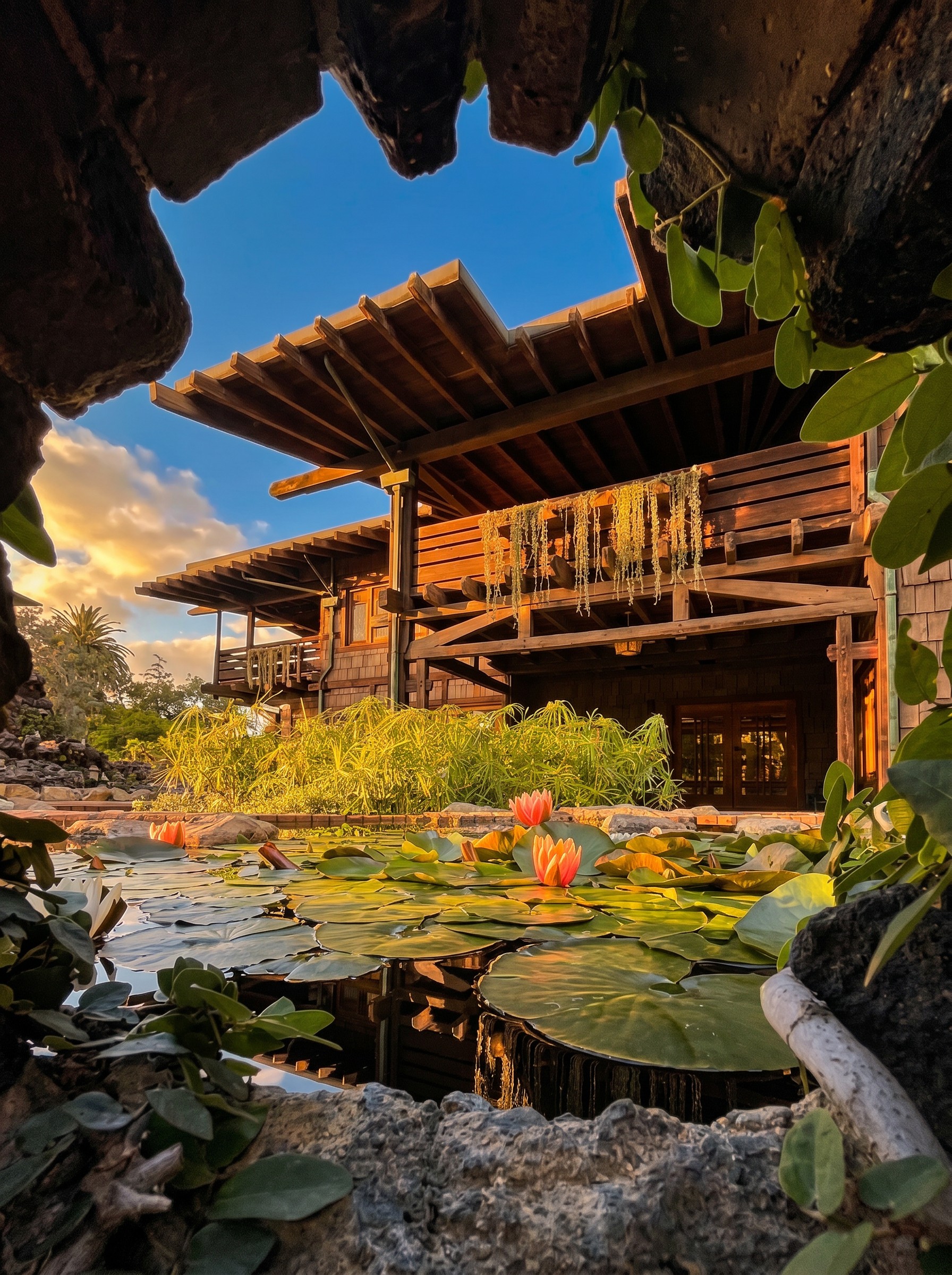
On the rear terrace of the Gamble House, set into the clinker brick a few steps down from the sleeping porches, there is a small pool of water. It is easy to walk past. Most visitors do. They come for the staircase and the front-door glass and the great overhanging eaves, and the pool sits quietly at the back of the house doing the modest thing it was designed to do, which is to hold the sky.
It is worth stopping at, because it is the Gamble House’s one gesture toward something the brothers built lavishly elsewhere and gave the Gambles only in miniature. A few miles away, at the Robert R. Blacker House, Charles and Henry Greene laid out five acres of designed ground around a broad reflecting lily pond, a water garden you could walk a circuit around — the still surface I have written about as the working hinge of the rear garden. The Blacker pond was an event. The Gamble pool is an aside. And the difference between them is not a difference of skill or intention. It is a difference of scale, and the scale was the point.
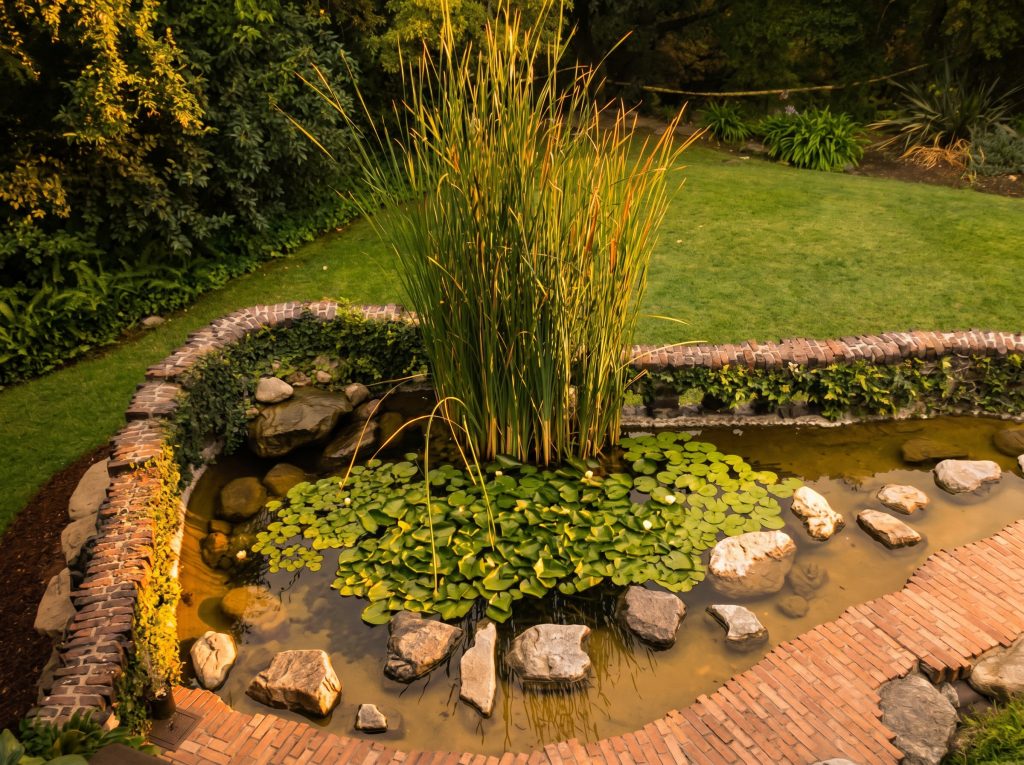
The Gamble lot is generous by suburban standards but ordinary by the standards of the great commissions. It is a town lot above the Arroyo, not an estate. David and Mary Gamble were heirs to the Procter & Gamble fortune, which is to say they could have had whatever they wanted, and what they wanted was a house that did not announce their money. They were retiring people. They built a large house and then declined to make it grand, and the brothers, who understood their clients as well as any architects of their generation, gave them grandeur translated into restraint. The pool is that translation made literal. It is everything the Blacker water garden was — a horizontal sheet of water that doubles the house, anchors the terrace, and pulls the eye outward and down — compressed into a basin you could nearly step across.
Look at how it is made and you see the same intelligence working at the small scale that worked at the large one. The pool is edged and bedded in the same clinker brick that runs through the foundation, the terrace walls, and the chimneys — the over-fired, misshapen, dark-vitrified brick the kiln meant to discard, which the brothers chose on purpose for its irregular surfaces and its color. The water does not sit in a foreign tray dropped onto the terrace. It sits in the terrace, in the building’s own material, so that the pool reads as a part of the floor that happens to be liquid. Arroyo boulders and the warm rough brick carry the eye from the dry paving to the wet without a seam. This is the same refusal of the off-the-shelf that governs the whole house, applied to a puddle.
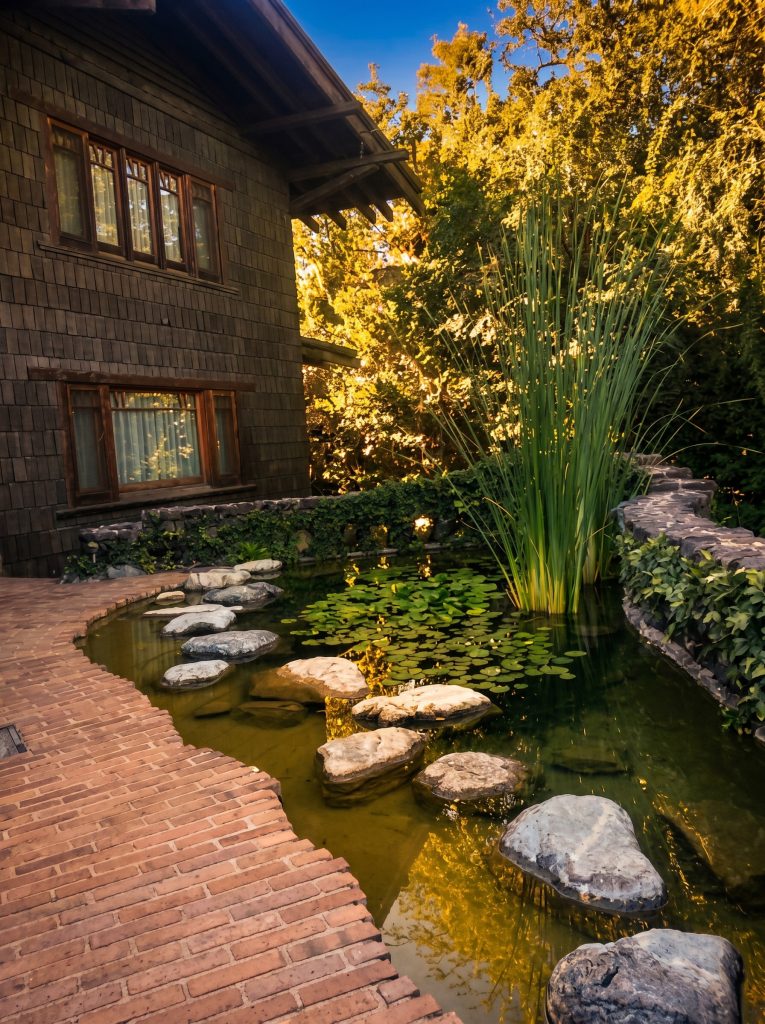
What the pool does, functionally, is finish the back of the house. The Gamble’s rear elevation is its best — the broad sleeping porches stepping out over the terrace, the eaves reaching far past the wall, the timber balconies stacked and cantilevered. All of that mass leans outward toward the garden, and it needs something at its feet to complete the composition, the way a long horizontal line needs a base to rest on. The pool is that base. It lies flat where the house leans out, still where the timber projects, and it takes the whole vertical accumulation of porch and eave and balcony and lays it back down, reflected, into the ground. Stand on the terrace on a still afternoon and the house appears twice — once in timber above you and once in water below — and the second version is the one that tells you the design is finished.
This is not decoration. It is the same compositional logic the brothers brought to the way the house meets its whole site, the relationship I have described in the arroyo and the house — a building that does not sit on its ground so much as settle into it. The pool is the smallest instrument in that settling. It is where the architecture, having reached as far out and down as the eaves can carry it, finally touches the earth and stops.
It is tempting to read the modesty as a limitation, as though the Gambles simply could not have the Blacker’s acres and made do with a smaller pond. But that gets the temperament backward. The Gambles could have had the acres. They chose the lot, the house, the restraint. The pool is not a reduced version of the Blacker water garden forced on the brothers by a tighter budget. It is a deliberate statement that this house would do with a few feet of water what the Blacker did with half an acre, and would do it just as completely. The brothers were perfectly capable of grandeur. What the Gamble proves is that they were equally capable of withholding it, and that withholding, done this well, is its own kind of luxury.
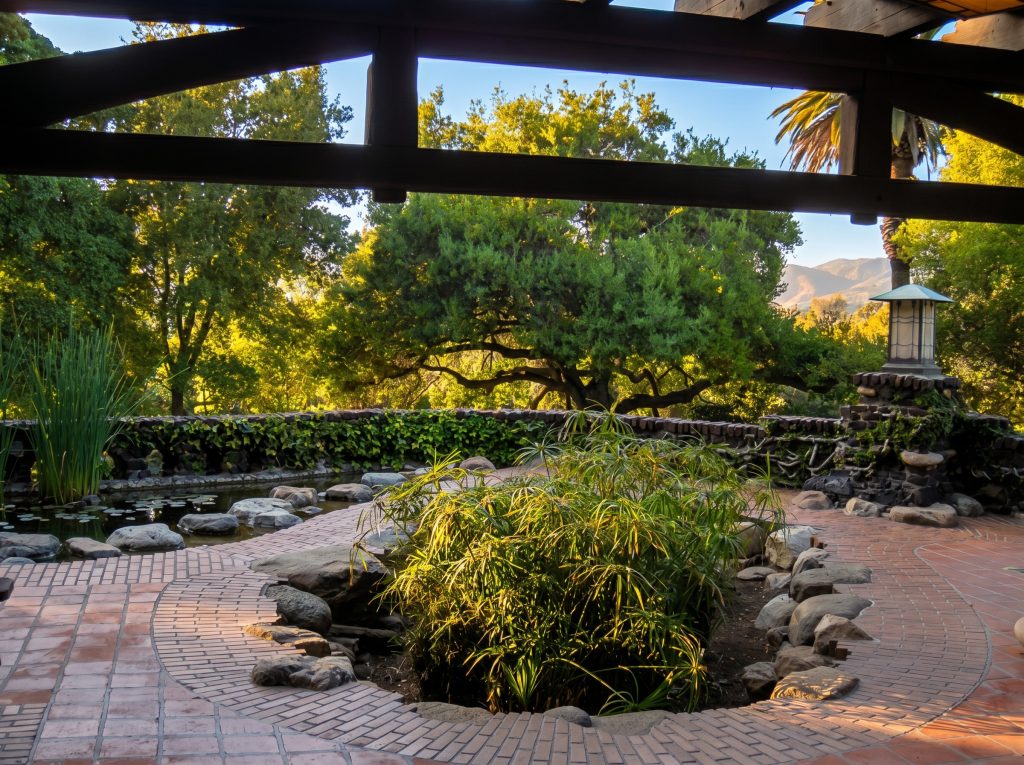
There is one more thing the small pool does that the great one could not. Because it is so close to the house — at the foot of the porches, in the brick of the terrace, within a few steps of the doors — it is available every day, in the ordinary use of the house, in a way a water garden across a lawn never quite is. The Blacker pond was a destination. The Gamble pool was a habit. A family living in the house would have passed it constantly, seen the sky in it constantly, registered the weather in its surface without ever making a trip of it. It is domestic water. It belongs to the back terrace the way a doorstep belongs to a door.
That is the whole argument of the Gamble House in one small basin. The brothers could make a building say everything it needed to say at the scale of an estate, and they could make it say the same thing at the scale of a back terrace, in a pool you can step across. The house did not need the acres. It needed the idea, and the idea fits in a few feet of water.