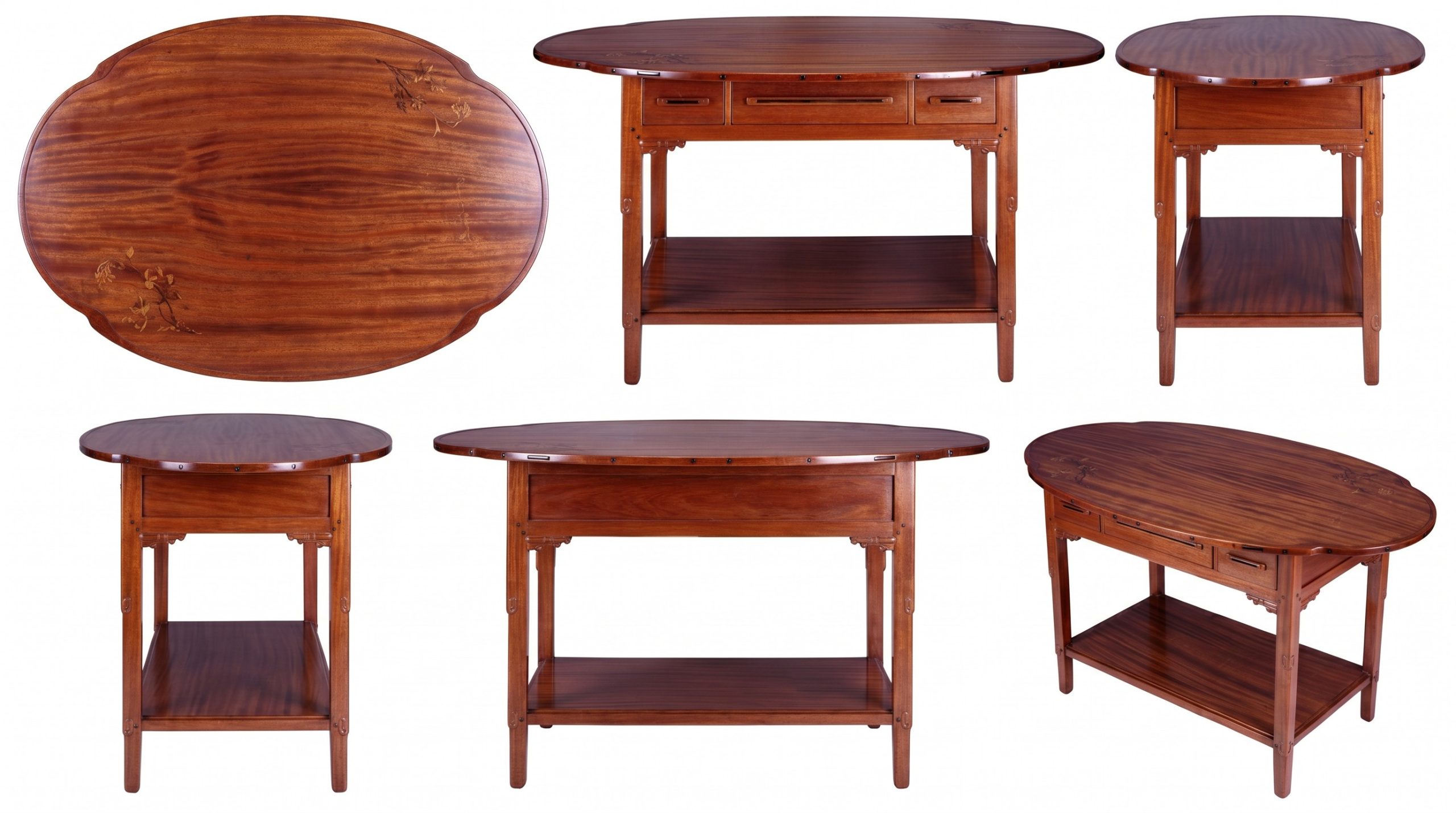
Nearly everything Greene & Greene built is credited to Charles. This is not unfair, exactly — Charles was the designer, the one with the restless eye, the one who drew the doors and the windows and the spreading trees in the glass. But the habit hardens into a reflex, and the reflex hides a more interesting question. There are pieces in these houses that do not quite sound in Charles’s voice, and one of them stands in the living room of the William R. Thorsen House in Berkeley. It is a library table. It may be Henry’s.
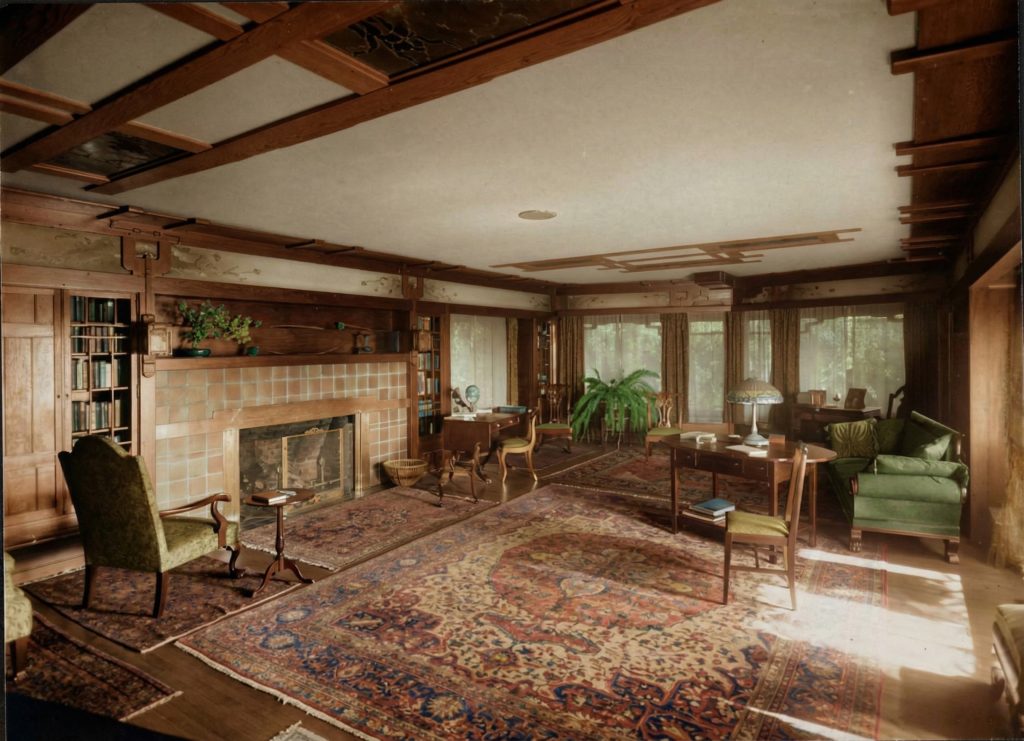
The Thorsen House was finished in 1910, the last of the five great commissions, and its living and dining rooms are paneled in Honduras mahogany set with square ebony plugs that cap the brass screws beneath them. It is a dark, deliberate room, and the furniture made for it had to hold its own against woodwork that misses nothing. Most of that furniture is plainly Charles’s — the same vocabulary of rounded edges, ebony splines, and the lift in the rail that runs through every house he touched. The library table is the odd one.
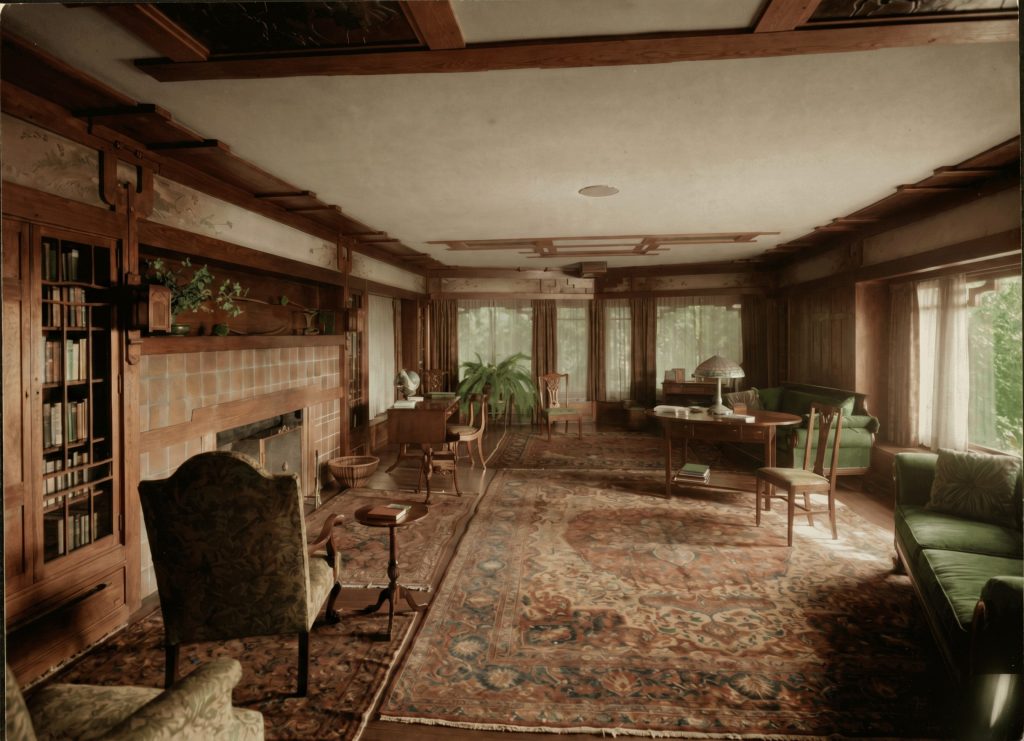
To see why anyone hesitates over it, you have to know what the rest of the room’s furniture does. The Greene vocabulary, as Charles ran it, is a small set of moves repeated with obsessive consistency: every hard corner softened to a hand-rounded edge, every structural junction confessed rather than hidden, ebony splines and square ebony pegs marking the joints like punctuation, and the cloud-lift — that gentle stepped rise in a horizontal rail — turning up wherever a straight line would otherwise run. The pieces in the Thorsen living room speak this language fluently. They are unmistakably of a set. The library table speaks it too, but with a faint accent. The reveal between its top and its base is a touch deeper, the inlay scaled a degree larger, the whole thing carrying itself with a squareness that is a half-tone graver than its neighbors. None of these are mistakes. They are choices, and they are not quite the choices made everywhere else in the room — which is exactly the kind of evidence that makes a careful eye stop and look twice.
It was a late addition to the scheme — not part of the original furnishing campaign but worked out after the room had taken shape — and its character is different in ways that are easier to feel than to prove. The materials read a shade differently. The dimension of the inlay and the depth of the structural reveal, the gap the makers left between the top and the base so that the eye can see how the piece is put together, are not quite calibrated the way Charles calibrated them elsewhere. Something in the table is a half-step off the familiar music, and that half-step is what has led more than one careful observer to wonder whether the design came from Henry rather than from his brother.
The suggestion is not as strange as it sounds. Henry Mather Greene has come down to us as the practical brother — the one who made Charles’s flights buildable, who ran the office, who stayed in Pasadena and kept the practice alive after Charles drifted north to Carmel. The division of labor is real, but it has been overdrawn into caricature, as if Henry were a draftsman taking dictation. He was an architect in his own right, with his own touch, and toward the end of the partnership, as Charles’s attention wandered, more of the design work fell to him than the legend allows. A piece of furniture conceived by Henry late in the Thorsen job is exactly the kind of thing the caricature would have us overlook.
What the table cannot tell us itself is who drew it. Greene & Greene furniture was rarely signed in any way that settles authorship, and the office drawings that survive do not always name the hand behind a given sheet. The attribution rests on connoisseurship — on the trained sense that this reveal, this inlay, this proportion belongs to one brother and not the other — and connoisseurship is an argument, not a fact. It is worth saying plainly that the Henry attribution is a reasonable speculation and not a documented certainty. But it is a speculation grounded in the object, which is the only honest place to ground one.
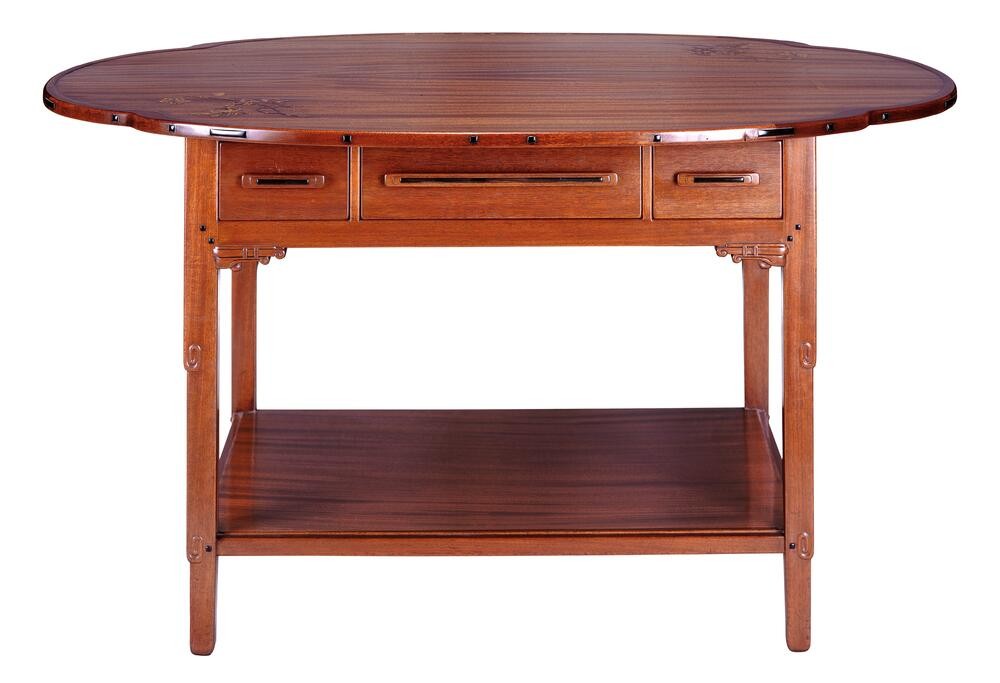
The reason the question matters is that it forces us to look at the table instead of the label. We are so used to reaching for “Charles Greene” the way visitors to the Gamble House reach for “Tiffany” — a famous name applied to an admired thing without checking — that we stop seeing the thing. Stand in front of this table and the half-step becomes the most interesting fact about it. Here is a piece made for a particular wall of a particular room, in the same shop and the same mahogany as everything around it, and yet subtly its own. If Henry drew it, it is a small window into a designer the standard account keeps in the back room. If Charles drew it and simply varied his hand, it is evidence that even his vocabulary had more range than the houses usually let us see.
Whoever drew it, the same hands built it. The Greenes did not make their own furniture; the cabinetwork came out of the Pasadena workshop of the Swedish-born brothers Peter and John Hall, whose shop on Raymond Avenue executed the Blacker, Gamble, and Thorsen pieces to a tolerance that still humbles restorers. That matters to the attribution question, because it means the table’s quality is constant regardless of which Greene conceived it — the Halls would have built a Henry drawing as faithfully as a Charles one. The maker’s hand is not the variable here. The designing hand is. Strip away the flawless execution, which tells you nothing about authorship, and you are left looking only at the choices: the proportion, the reveal, the inlay. Those are where a brother lives.
The timing helps the case without closing it. By 1910 the partnership was under quiet strain. Charles had begun the long pull north that would end with him settled in Carmel, his attention increasingly given to the cliffside house at Carmel and to interests that had little to do with the Pasadena office. The Thorsen House was being finished in exactly this interval, and a table added late in the job — after the room was built, after the main furnishing was drawn — falls precisely in the window when Henry was carrying more of the load. None of that proves Henry drew it. It only means that the moment was right for him to, which is the most a circumstantial argument can honestly claim.
The table is still there. Since 1942 the Thorsen House has belonged to the California Alpha chapter of the Sigma Phi Society, which has kept the house and much of its furniture in place — an unlikely steward that has, on the whole, done right by it. The library table sits where it was meant to sit, in the room it was made for, under the rose frieze and against the mahogany, doing the quiet work of a writing surface. You can go and look. The brothers left no plaque saying which of them drew it, and that absence is the point. The attribution is uncertain. The table is not. It is exact, particular, and slightly unlike its neighbors — which is the only reason anyone thought to ask whose hand it was.