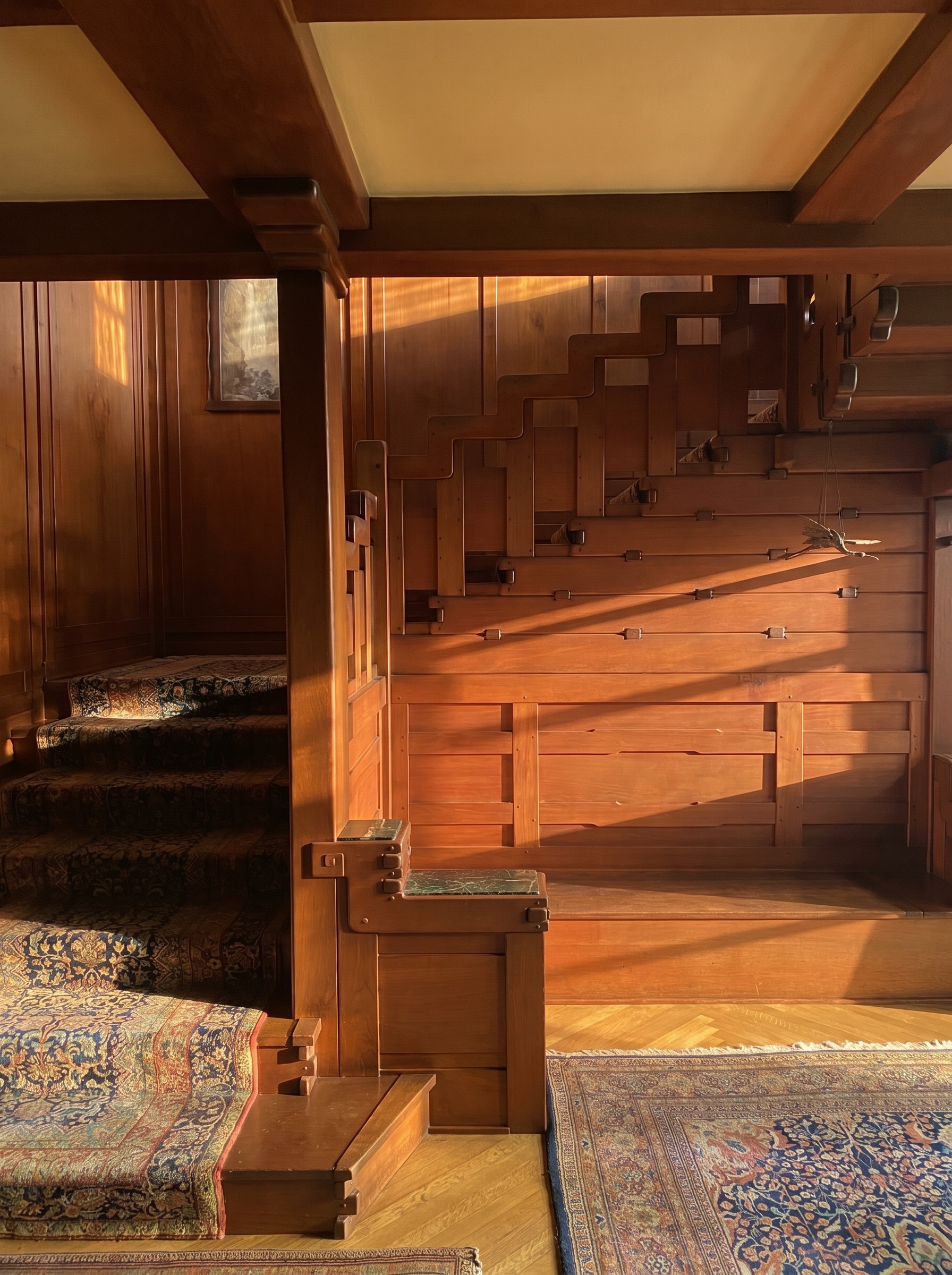
In the entrance hall of the Gamble House, where the teak paneling rises to meet the beams, there is a small piece of wood doing an enormous amount of talking. It is a corbel — a bracket, if you like, though neither word quite earns what the object is — and it does not simply sit under its beam. It climbs to it. Three rounded masses of teak, stacked one atop another, each stepping farther out into the room than the one below, until the topmost shoulder arrives beneath the beam it serves. The profile is not a curve and not a triangle. It is a stair.
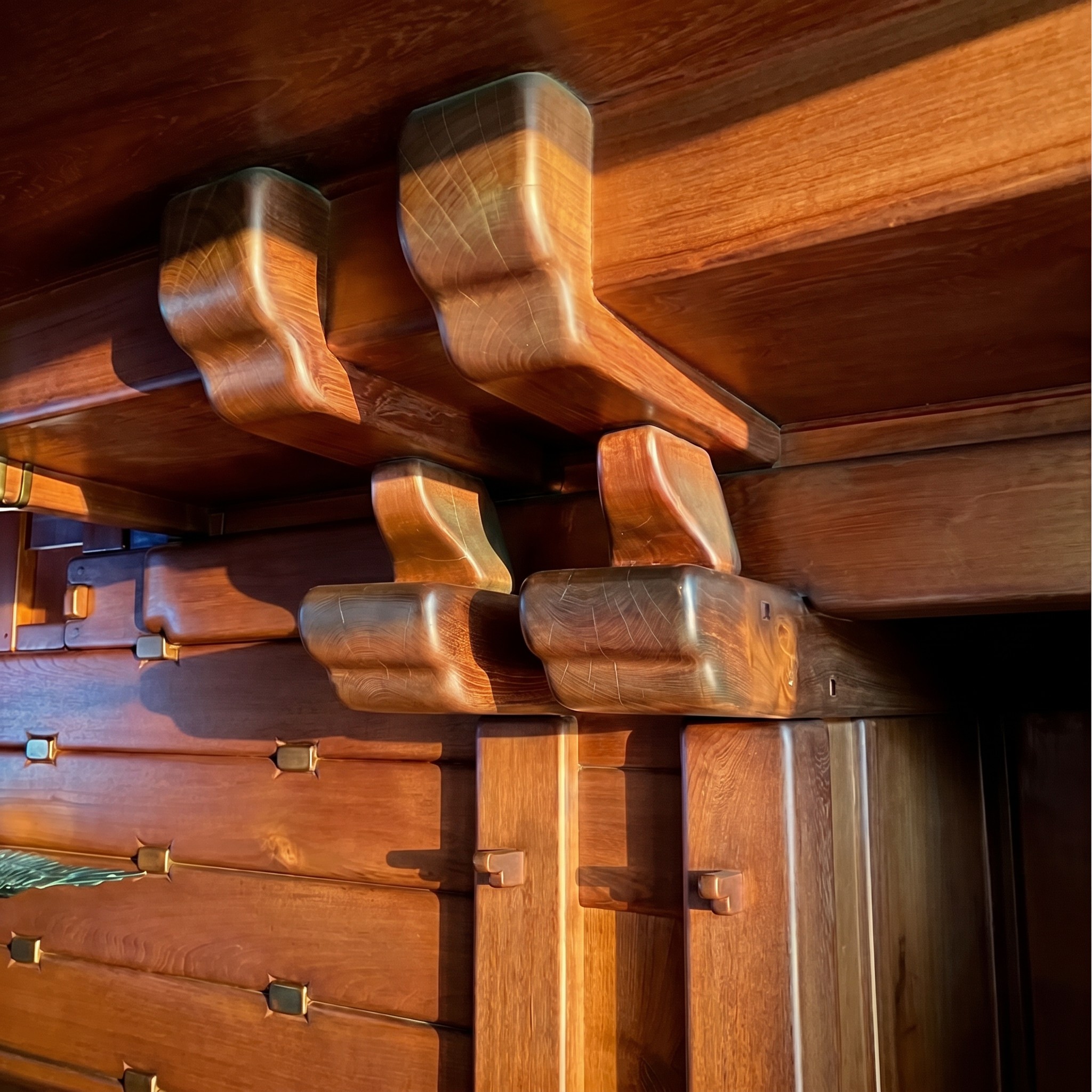
Look closely and the object gets better. The tiers are not carved from one block and made to look stacked; they are built up, piece on piece, the way a mason builds. At the joints sit the small square pegs of ebony that punctuate everything in this house, pillowed and polished, standing just proud of the surface. The 1977 National Historic Landmark documentation for the house notes what those pegs are doing everywhere they appear: covering the brass screws that clinch the joinery. The fastener is real. The peg that hides it is real ebony. What the eye reads as ornament is a construction diary, entry by entry — here it is held, and here, and here.
And every edge has been eased. Not chamfered, not routed to a factory radius — eased, by hand, until each tier of the corbel has the swelling softness of a river stone or a loaf. This is the surface treatment that governs the whole interior, the one that makes visitors want, illegally, to touch the walls. On the corbel it does something specific: it lets light travel around each tier instead of breaking hard at a corner, so that the stacked form reads as a single muscular gesture rather than a pile of blocks. The shadows between the tiers stay crisp; the tiers themselves glow. The Halls’ shop on Raymond Avenue sanded these curves into teak more than a century ago, and the light has been rolling over them ever since.
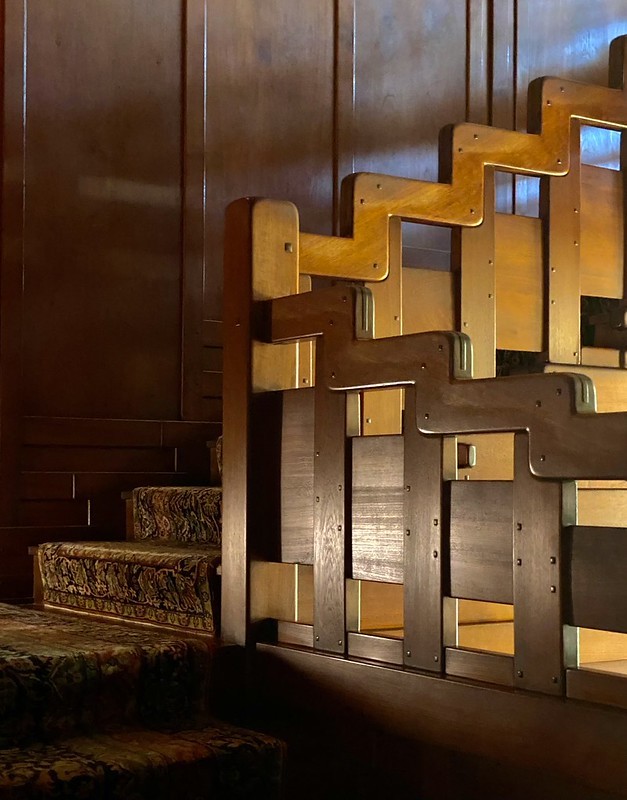
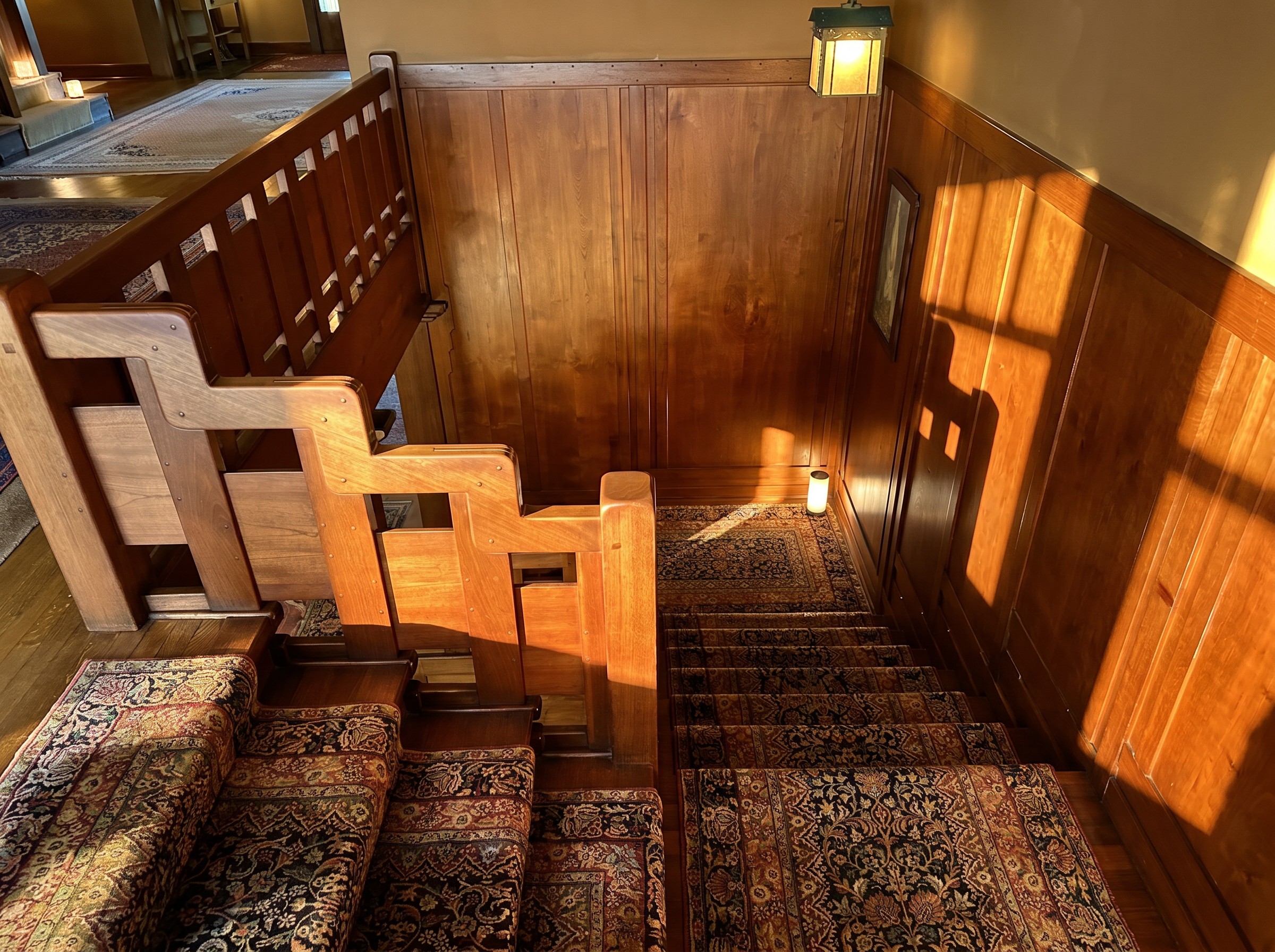
The stepped profile is not a private joke, but it is a rhyme. Ten feet away, the great staircase of the hall performs the same figure at the scale of the body — its rail and stringer stepping down the wall in long banded masses, the most famous piece of stairbuilding in American Arts and Crafts, the one this journal has called the climbed argument. The corbel is that argument in miniature. The stair says: this house rises in honest increments, and you may walk on them. The corbel says the same thing to the beam. Mass accumulates, step by step, until the load is met. Nothing leaps. Nothing pretends to leap. Even the smallest servant of the structure explains, patiently, how it does its work.
Whether the corbel is truly carrying the beam or ceremonially assisting it is, in a sense, the wrong question — it is the question the Greenes’ whole interior vocabulary politely declines to answer. Some of the structure in this hall works for a living; some of it stands beside the working structure and narrates. What matters is that the narration is truthful to how wood actually behaves. A stack of short-grain blocks, each bearing fully on the one below, is a perfectly rational way to bring a load down the face of a wall. The corbel would hold if it had to. In a house built by people who put the fasteners on display, that is the standard: the story told must be a story that could be true.
For the woodworker who wants to make one — and the corbel is among the most approachable of all Greene & Greene details, a weekend’s work rather than a career’s — the construction photograph is the plan. Build it the way it looks built. Work from a straight-grained hardwood; sapele or genuine mahogany takes the eased edges and the finish gracefully, and stands in for teak the way it does everywhere else in modern Greene & Greene work. Cut each tier as a separate block, bandsawing the outer end to its gentle bullnose, and stack them with grain running the same way, glued and screwed from behind or up through the tiers where the next block will hide the fastener.
The easing is the part that cannot be delegated to a router table. A roundover bit can rough in the radius, but the pillowed quality — the swell that makes the block read as risen dough rather than milled stock — comes from a block plane and then sandpaper through the grits, working by eye and thumb until no facet survives and the edge has no single radius anywhere along its length. Slightly too soft is better than slightly too hard. The square pegs go in last: mortise shallow square recesses, and glue in proud plugs of ebony or, if the real wood cannot be had at sane cost, of a dense hardwood dyed black through. Dome each peg’s face before it goes in — sandpaper on a firm pad, a few dozen strokes — so it catches light the way a pillow does, not the way a tile does. Darrell Peart’s Greene & Greene: Design Elements for the Workshop walks through plug-making and eased edges step by step, and is the standard shop reference for exactly this vocabulary.
Finish with something that soaks in and stays thin — an oil, or an oil-varnish blend, rubbed out matte so the wood keeps its skin. Then put the corbel where a beam, a shelf, a mantel needs meeting, and let it do what the originals have done in that Pasadena hall for a hundred years: carry its load in public, one honest step at a time.