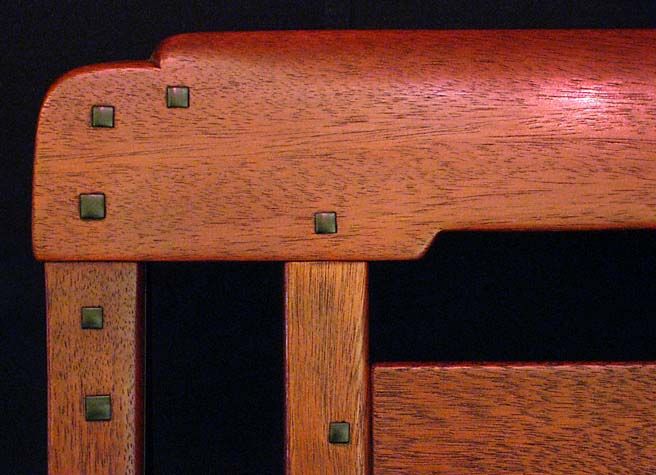
Walk into any Greene & Greene interior and you will see the small black squares. They are on the staircase newel posts of the Gamble House. They are on the dining-room chair backs of the Blacker. They are on the breakfast-room sideboard of the Robinson. They are on the stair rail at the Thorsen in Berkeley. They are on almost every piece of furniture the brothers ever drew, and on most of the major built-in joinery as well — the bookcases, the wainscoting, the lintels, the door surrounds, the cabinet faces. They are the brothers’ most recognizable mark.
They are also not what they appear to be.
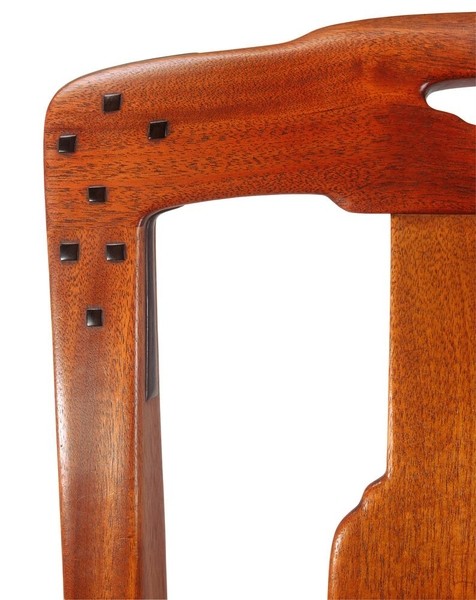
The square ebony peg in a Greene & Greene piece is, in almost every case, not a peg at all. It is a plug — a small block of ebony, usually about three-eighths of an inch on a side, with its top surface raised slightly above the surrounding wood and its four edges chamfered at a soft angle. The plug covers a counter-sunk steel screw. The screw does the structural work. The plug does the moral work.
This is worth saying carefully, because it has been misunderstood for a long time. A peg, in traditional joinery, is a wooden dowel driven through a mortise-and-tenon joint to lock the joint mechanically. The peg has a job to do. It carries shear. If the peg fails, the joint fails. The brothers used pegs of that kind in some of their work — particularly in the larger structural timbers where a true wooden pin made sense — but most of the small black squares you see in a Greene & Greene interior are not doing that job. They are decorative. They cover a screw that is doing the structural job, and they cover it with a deliberate visual mark that says: a craftsman was here.
The squareness is the argument. A round plug would have been easier to make. Round plugs were standard in the late-nineteenth-century furniture trade for exactly this reason — counter-sunk fasteners covered with a turned dowel of matching wood, ideally invisible. The Greenes squared theirs and made them visible. They cut them not to disappear but to be noticed. They proud-set the top surface a sixteenth of an inch above the wood around it so that a finger sliding across the rail would feel the small ridge. They chamfered the edges so that the plug caught light differently from the surrounding plane. They chose ebony — almost the darkest wood available to a Pasadena cabinetmaker — so that the plug would read against the lighter mahogany or teak as a black mark on a brown ground.
Every one of those decisions is a small refusal of standard practice. Standard practice in 1907 was to hide the fastener. The brothers exposed it. Standard practice was to round the cover. The brothers squared it. Standard practice was to match the cover to the surrounding wood. The brothers contrasted it. Standard practice was to flush-fit the cover. The brothers raised it.
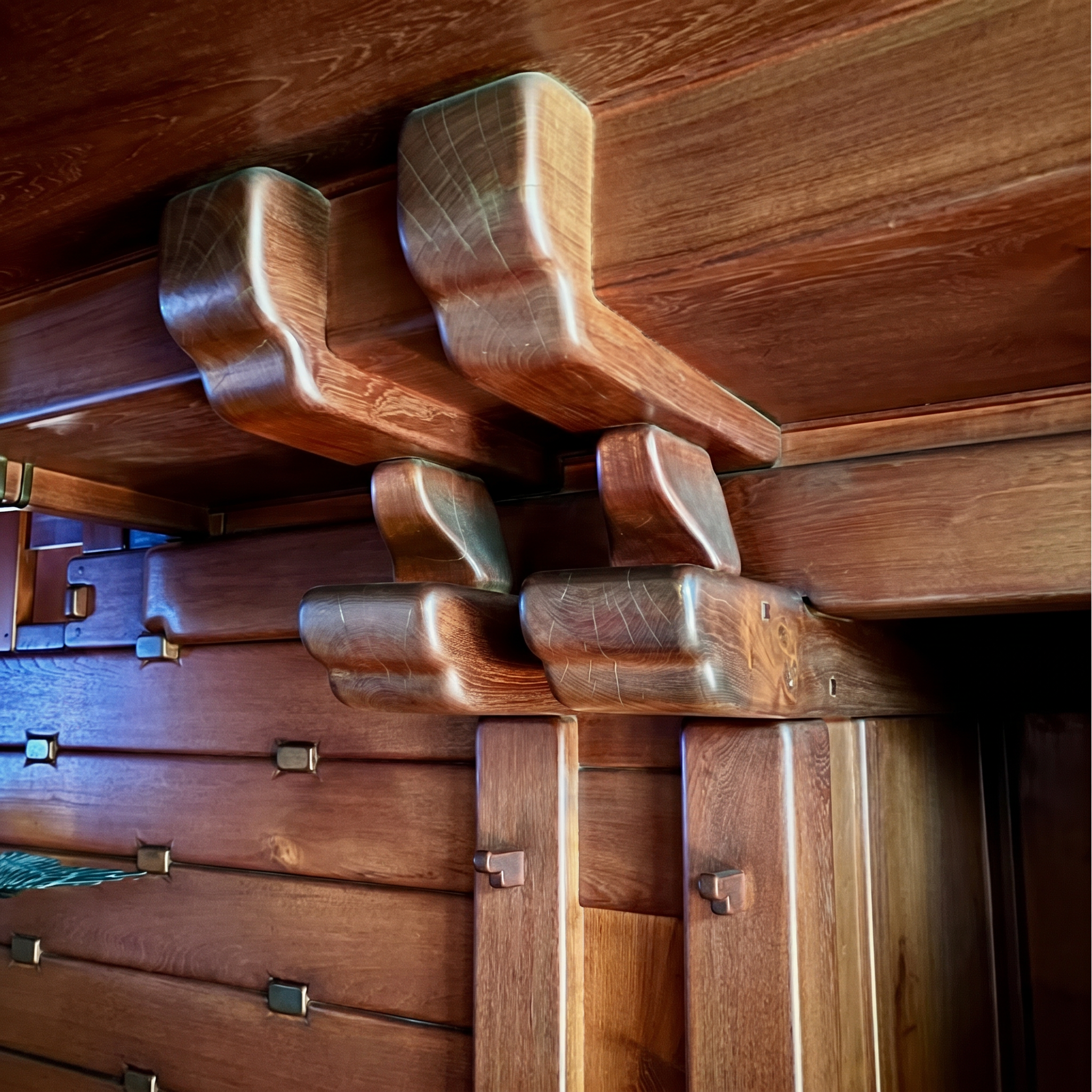
The cumulative effect is the visual signature of the work. A Greene & Greene chair without the small ebony squares is not legibly a Greene & Greene chair. The squares are the chair’s authorship.
They are also a kind of confession. Hand work in 1907 was already, by any honest accounting, a luxury. The brothers were building furniture for the wealthiest industrialists in California, and the wages in Peter and John Hall’s Pasadena cabinet shop were higher than any other shop in the region paid. Even there, the workmen reached for the screw. The mortise-and-tenon held the chair together at the major joints, but a counter-sunk screw was the practical way to secure a rail to a leg, a stretcher to a post, a panel to a frame. The brothers did not pretend otherwise. They put the screw where it was needed, and they put a deliberate visible mark on top of it.
The honesty of that is what woodworkers have always loved about the work. Charles Greene’s argument — and it was Charles’s argument, more than Henry’s — was that decoration which conceals construction is a lie, and decoration which acknowledges construction is the only kind worth having. The square ebony plug is the most economical expression of that argument the brothers ever made. It does not pretend the screw is not there. It marks the screw, makes its presence handsome, and asks the eye to come look at it.
There is one more piece of evidence in favor of reading the plug this way, and it is in the spacing. If the plug were structural, its placement would be dictated by the joint. The pin would go where the tenon goes. The pin would be invisible most of the time, because the tenon is invisible. But the plugs in a Greene & Greene chair are not placed where the joints are. They are placed where the composition wants them to be. Two on the top rail. One on each side stile, near the corner. One on the front of each leg, near the bottom. They march around the chair the way a calligrapher’s brush marks would march around a page. They are typographic, not tectonic.
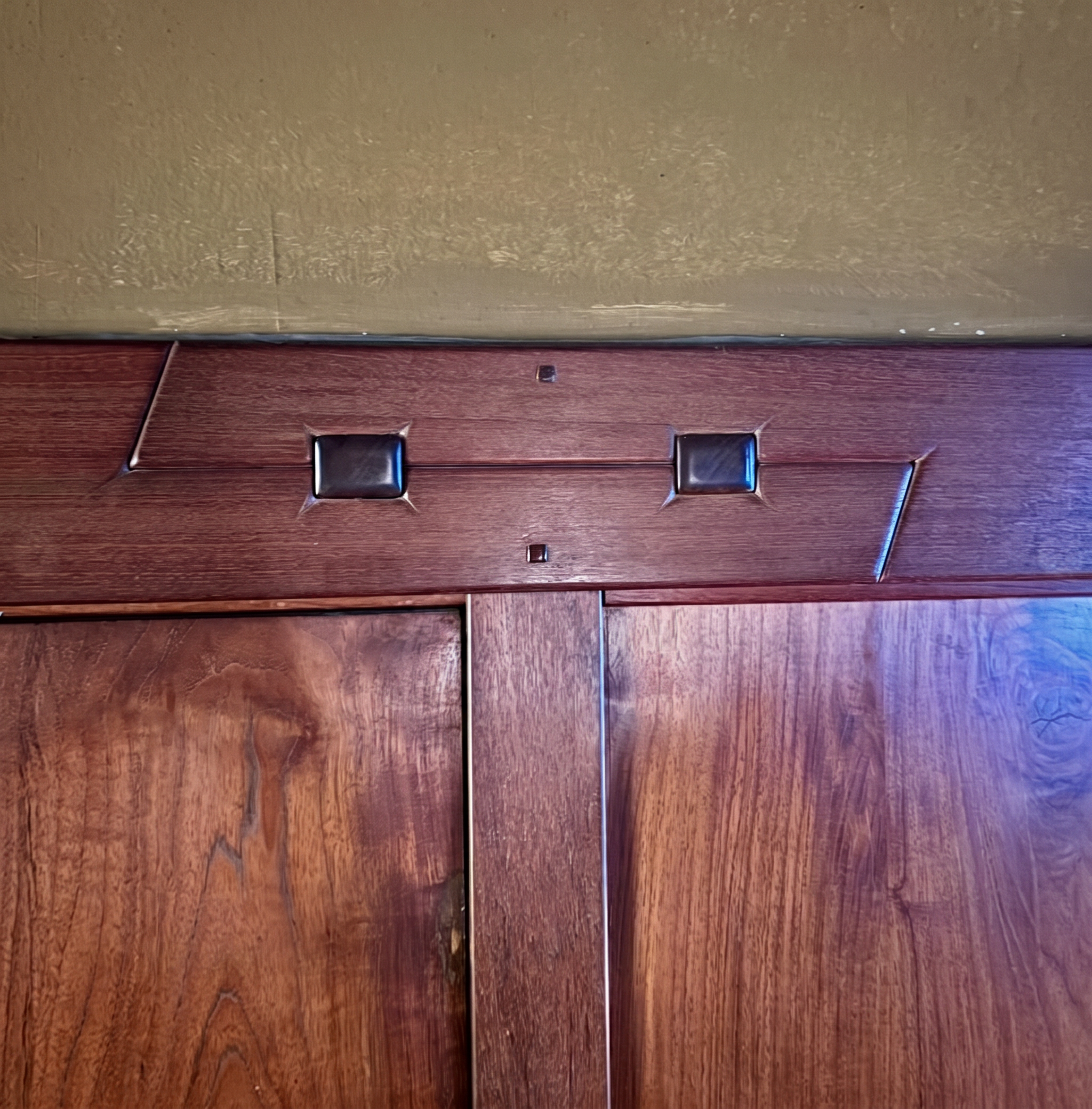
You can see this most clearly on the back of a dining-room chair from the Gamble or the Blacker. The plugs along the top rail are not over screws. They are over nothing. They are over solid wood. Some of them are not even plugs in the strict sense — they are squares of ebony glued or pinned into shallow mortises cut for the purpose. They exist purely to extend the rhythm. The chair would stand without them. The chair would not be a Greene & Greene chair without them.
This is the deepest thing about the small black squares. They started as a piece of practical honesty — a way of admitting that a screw was the right fastener for a particular joint and that the right thing to do with the screw was to acknowledge it rather than hide it. By the time the brothers were finished with the idea, the square had become its own subject. It had developed its own grammar. It had become a thing the eye expected, and the brothers were obliged to keep putting it where the eye expected even when the joint underneath no longer required it.
The shop, in other words, taught the office a vocabulary, and the office then began to compose in that vocabulary independent of what the shop needed.
Most of the small black squares in a Greene & Greene interior are now over a hundred years old. Some have been re-set by conservators. A few have been replaced where the ebony was lost. They survive at a higher rate than almost any other small decorative element in the houses, because the proud-set top surface protects them — a finger sliding along the rail can feel the ridge but a duster cannot snag it, and the chamfered edge sheds dust rather than holding it.
They were meant to be touched. They are touched still. A hundred and twenty years later, in the houses that are open, you can put a fingertip on a small black square and feel exactly what the brothers wanted you to feel: that a workman was here, and that he did not hide what he did.
That is what the peg is, in the end. It is a small black square that is not a peg. It is a maker’s mark.