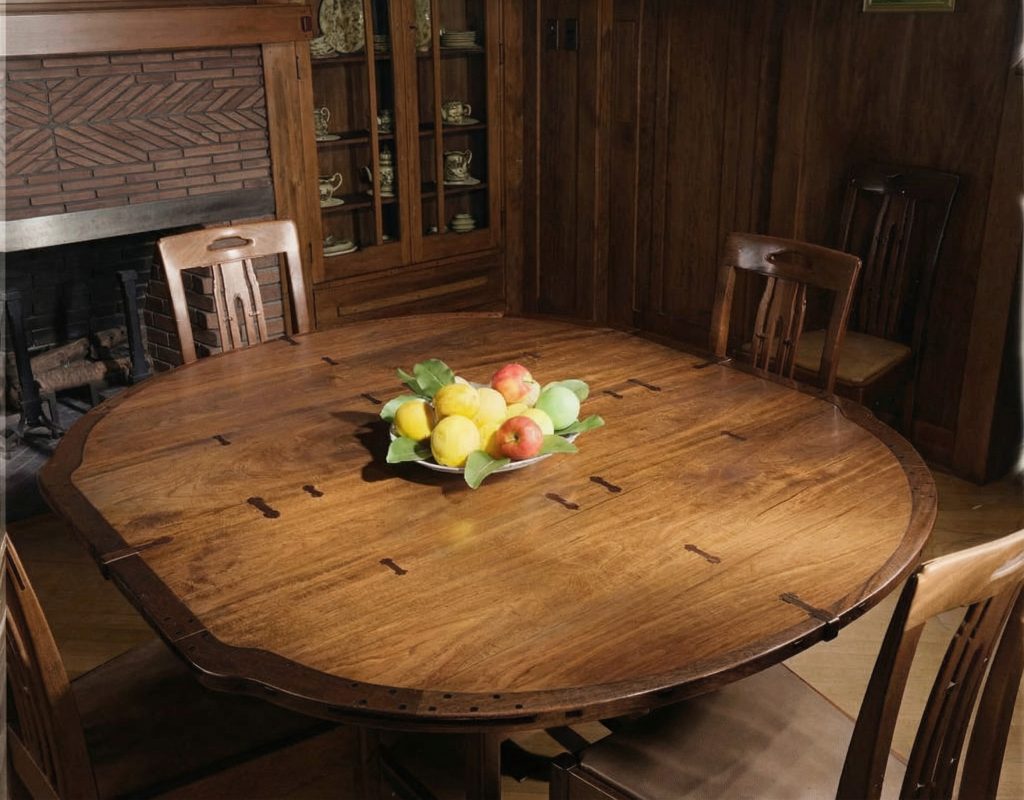
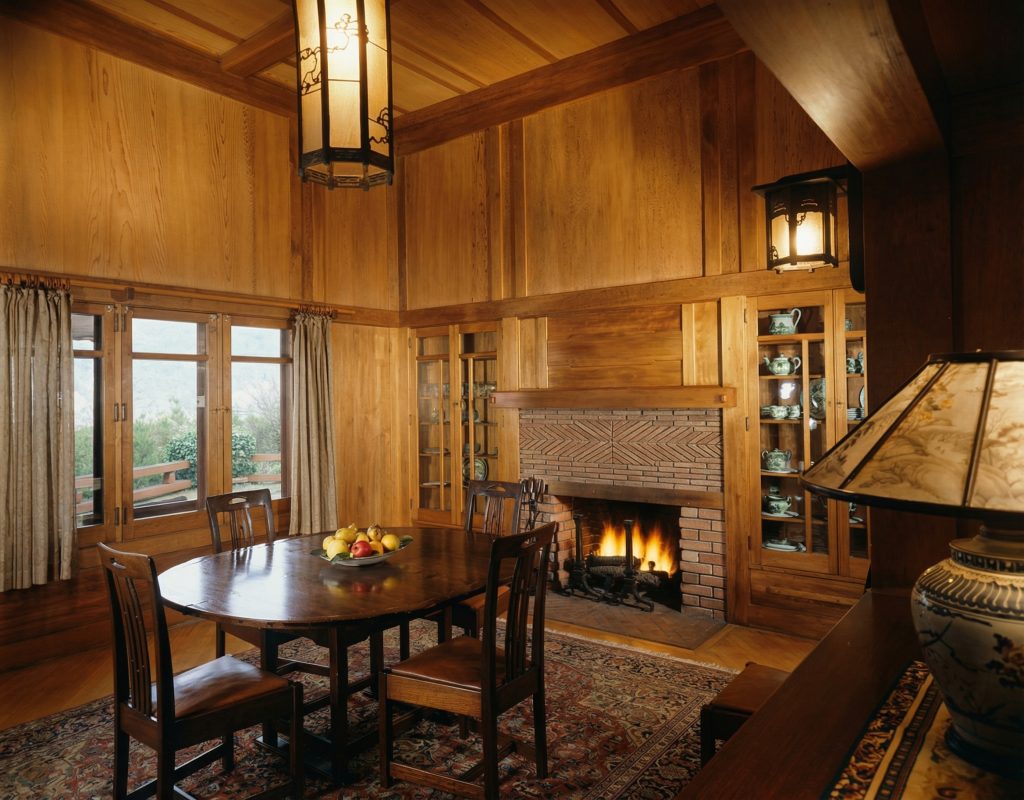
In the dining room of the Charles M. Pratt House near Ojai, the things people photograph are the table and the chairs. This is fair. The dining table is one of the most beautiful objects Greene & Greene ever produced — a great mahogany oval with a scalloped apron, a row of square ebony pegs marching along its edge like stitching, the legs joined low by stretchers and the whole thing standing in the room with the quiet authority of a small ship. It is a piece you remember. The chairs around it are its equals.
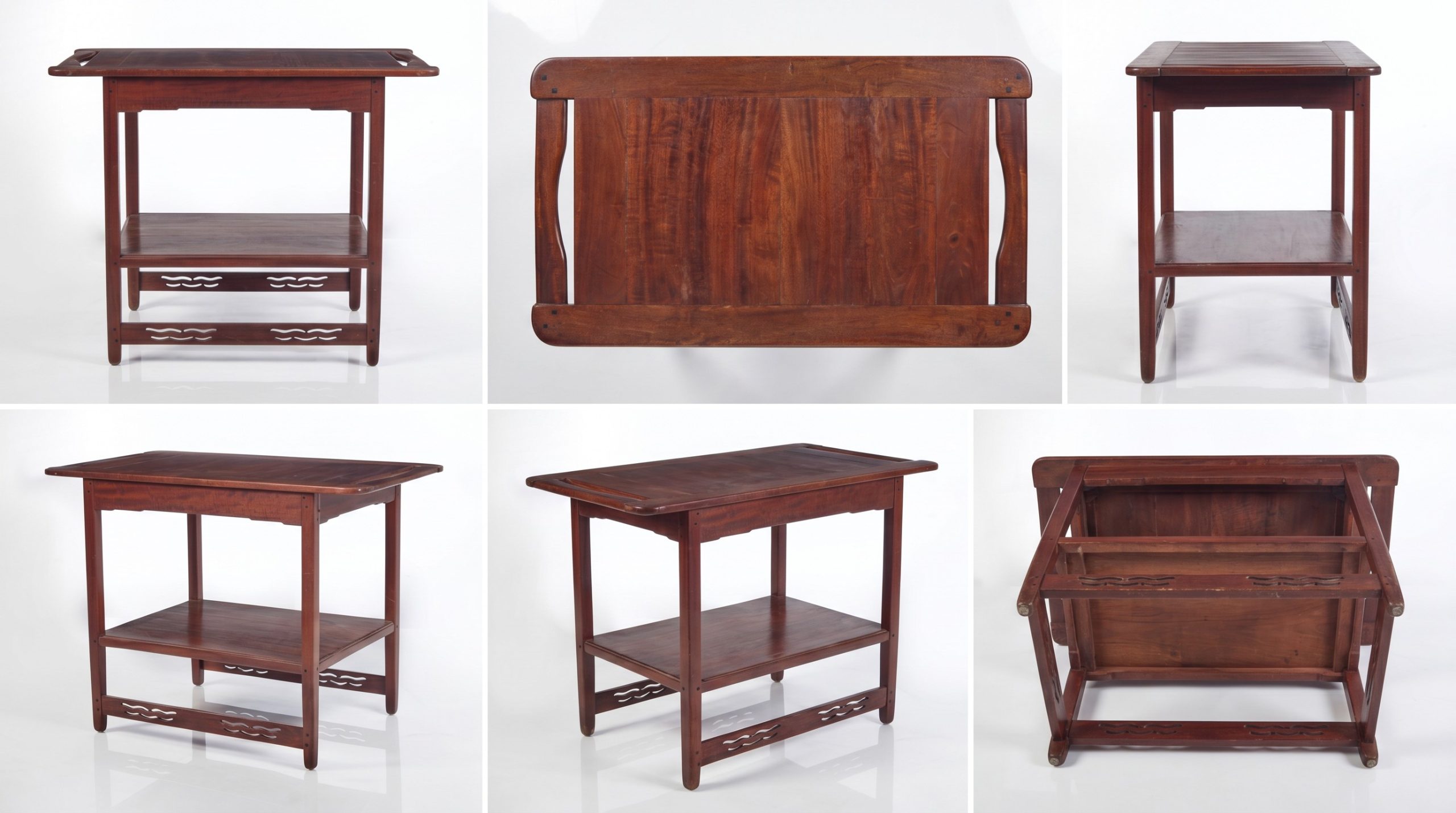
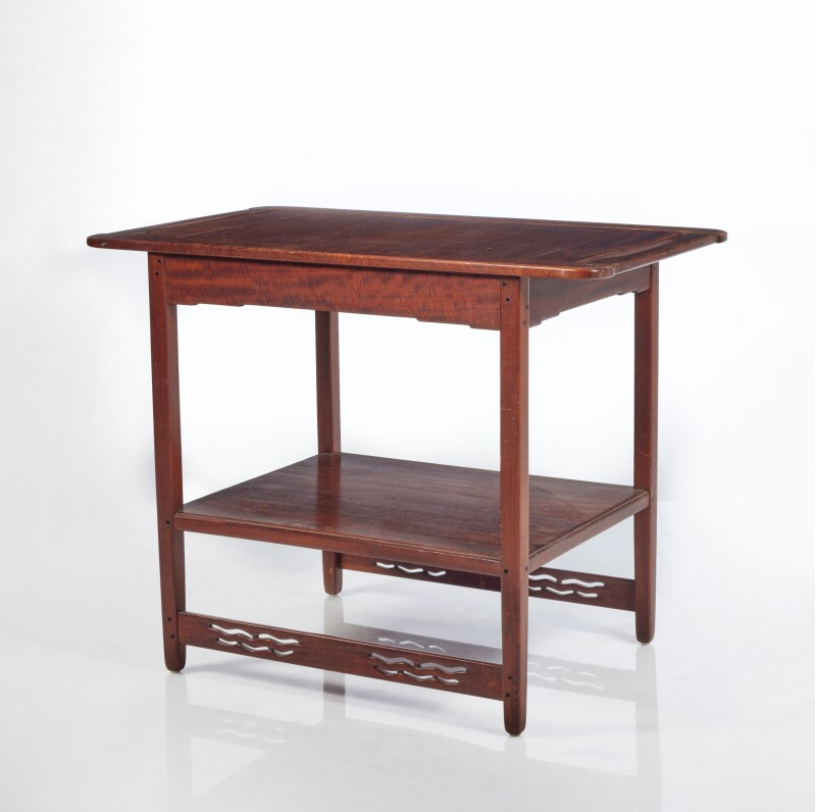
But walk to the wall, to the serving table, and you find where the real test was passed. A dining table is the center of its room. It earns its splendor; everyone expects it to be magnificent and the magnificence is, in a sense, easy to justify. A serving table is a servant. It stands against the wall, holds the dishes between courses, and is looked at by no one. It is exactly the kind of object a busy shop, finishing a large commission, would be tempted to simplify — to give a plain top and square legs and call it done, because no guest is going to crouch down and study the underside of the sideboard.
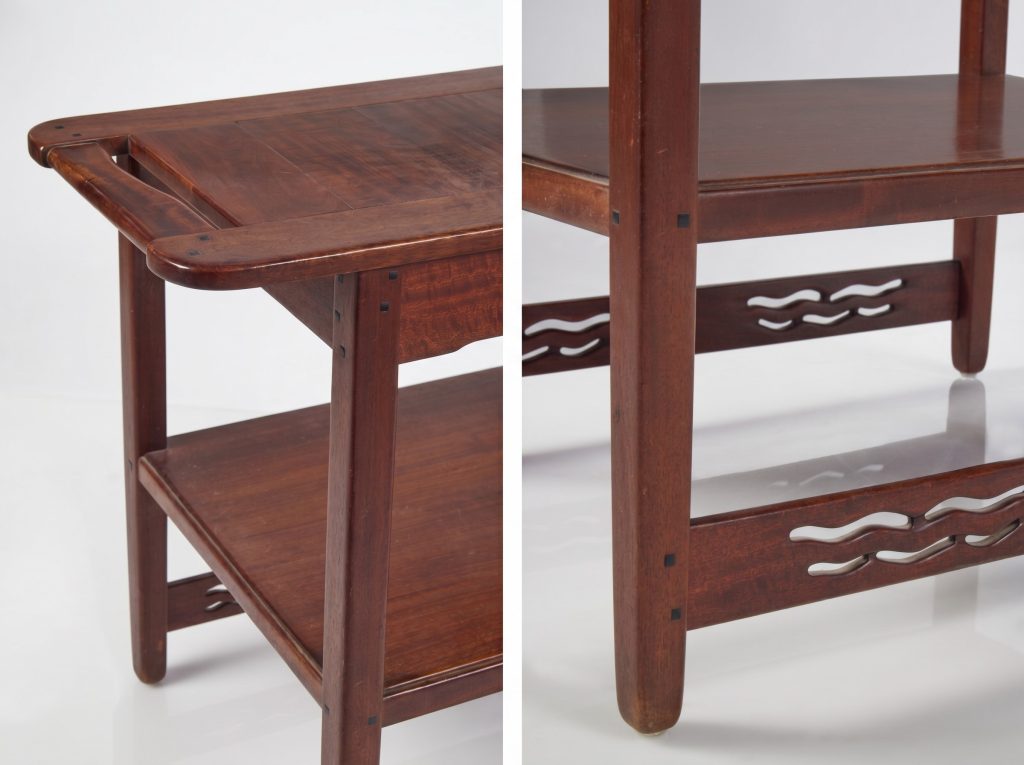
The Pratt serving table was not simplified. Look at the corner. The top does not simply end at an edge; the edge is lifted and rounded, worked by hand into the soft, swelling profile the brothers gave their best work, the profile that makes you want to run a thumb along it. The bracket beneath the top carries a line of square ebony pegs — the same ebony, the same squares, the same exact spacing as the great table in the middle of the room. A lower shelf is carried on a rail that is itself pegged and joined, not nailed and hidden. Every decision that was made for the table was made again, at full strength, for the piece against the wall.
This is the thing about Greene & Greene furniture that is hard to convey until you have looked at a minor piece: there are no minor pieces. The shop did not rank its objects. The serving table received the same teak-and-mahogany discipline, the same softened edges, the same hand-set ebony, as the table that cost ten times the attention to design. That discipline came out of Peter Hall’s Pasadena shop, where the brothers’ drawings were turned into wood by craftsmen who did not appear to know how to do careless work. The Pratt furniture, like the furniture for all the great houses, was built there, and the shop’s refusal to coast is written into every joint of it.
What the serving table also tells you is that the brothers did not draw furniture for a room. They drew a room and its furniture as one thing. The Pratt dining room is paneled, beamed, and lit by a single suspended art-glass lantern, and the furniture was designed to live inside that particular envelope of wood and light — not to be placed in it, but to complete it. The serving table’s height answers the height of the wainscot. Its wood answers the wood of the walls. Its ebony answers the dark accents the brothers set throughout the room. Take it out of the room and it is still a fine object; but it has been orphaned, separated from the half of the design that gave it its full meaning.
You can see the unity of room and furniture even in the architecture itself, where it has nothing to do with furniture at all. Up in the corner of the Pratt House, where the wall paneling meets the ceiling, the trim is finger-jointed — interlocking fingers of wood, pegged, the joint left fully visible. It is the same logic that governs the serving table: a connection made honestly and then shown rather than hidden, the structure offered as the ornament. The house and the table were drawn by the same hands in the same language. The serving table is simply that language applied to a thing you put a gravy boat on.
The Pratt House remains one of the most intact of the brothers’ ultimate bungalows, the subject of its own longer account on this site. But the furniture has had the usual fate of integrated Greene & Greene work: some of it has travelled. Pratt pieces have surfaced in the great public collections and in the auction rooms, and elements of the dining suite have been documented at the Huntington, where so much dispersed Greene furniture has come to rest. Each move is a small, legal, well-intentioned act, and each one takes a piece that was drawn for one wall of one room and sets it down somewhere it was never meant to be.
Which is why the serving table is worth stopping for. It is the piece that proves the rule. When a shop will give its full attention to the object no one was going to examine — the sideboard against the wall, the thing that holds the dishes — you are looking at a practice that did not know how to do less than everything. The table in the center of the room announces the brothers’ ambition. The serving table, quietly, against the wall, is where they kept their promise.