His name appears in the commission records, in the contracts, in the careful ledgers of the most ambitious residential building program in Pasadena’s history. Peter Hall. Master craftsman. Contractor. The man without whom there is no Greene & Greene as we know it — no Gamble House, no Blacker House, no gleaming teak and mahogany interiors that still stop visitors cold more than a century after they were made.

And yet his name is almost never the first one spoken.
This is the particular melancholy of craft history: the designers ascend into legacy, and the makers recede into background. The Greenes are rightly celebrated — Charles with his restless pencil, Henry with his client relationships and organizational precision, both of them together producing drawings of such specificity and beauty that they functioned almost as instructions to the hand. But drawings do not become buildings. They become buildings only when someone of extraordinary skill picks them up and makes them real. In the case of Greene & Greene, that someone was Peter Hall.
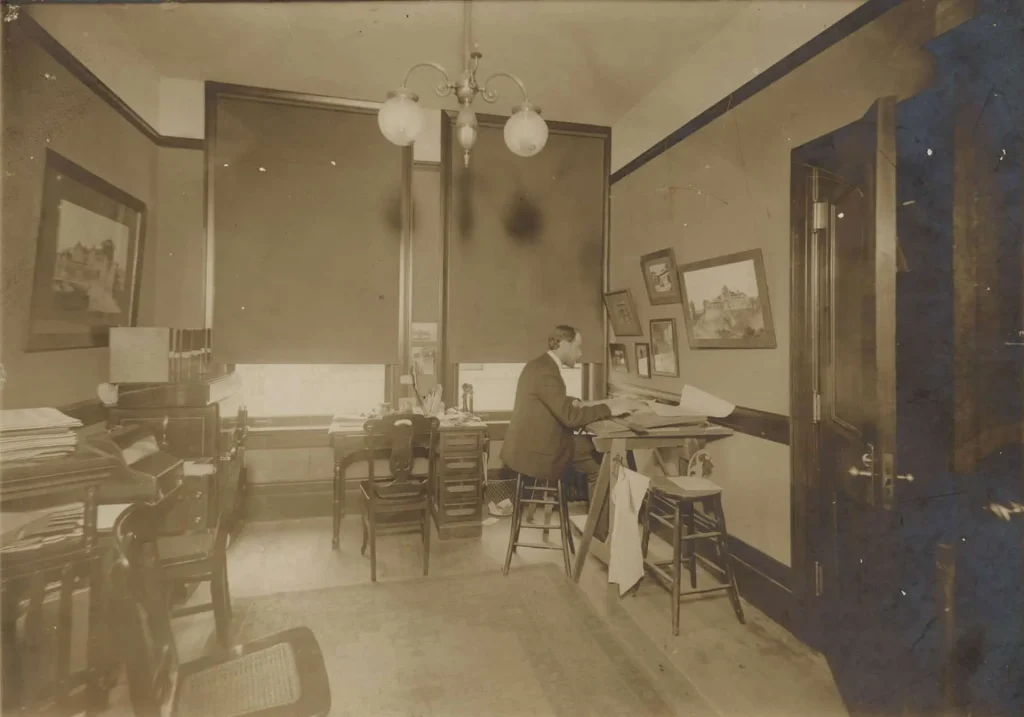
Hall was born in Sweden in 1867, one of the thousands of Scandinavian craftsmen who crossed the Atlantic in the latter half of the nineteenth century carrying trades that American industry was just beginning to forget. He settled in Pasadena in the 1890s, a small city then, still finding its identity between the orange groves and the San Gabriel Mountains, increasingly wealthy and increasingly interested in building. He established a woodworking shop and began taking commissions. He was good. He was, as it turned out, precisely what the Greenes needed.
The two brothers had been struggling with a problem common to architects of genuine ambition: the gap between what they could imagine and what the available labor force could execute. The millwork coming out of standard contractors’ shops was competent but inert. It had no conversation with the drawing. When the Greenes found Hall — or when Hall found the Greenes, the historical record is pleasantly ambiguous on this point — something clicked into place that would define both their careers for the next decade.
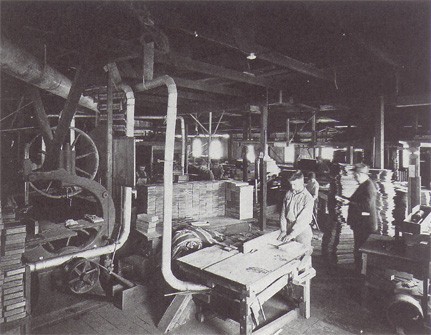
The shop that Hall built, eventually formalized as the Hall Manufacturing Company and run alongside his brother John, became something unusual in the building trades of the time: a place where architectural drawings were not simply followed but interrogated. Hall was not an executor. He was a reader — of drawings, of materials, of the implicit logic of a joint or a beam end or a corbel. When a piece of Honduras mahogany came into the shop with a particular figure in the grain, Hall understood how to orient the cut so the figure became part of the design. When the Greenes’ drawings called for a cloud-lift bracket at a certain scale and Hall’s eye told him the scale was wrong for the actual timber, there was a conversation. The drawings changed, or the timber changed, or something better than either emerged.
This is the collaboration that produced the masterwork commissions. The Thorsen House in Berkeley. The Blacker House on Hillcrest Avenue. Above all the Gamble House on Westmoreland Place, which remains the fullest expression of what happens when an architect’s vision and a craftsman’s hand are in complete sympathy. The staircase alone — the way the teak turns and rises, the way the grain flows across the joined pieces as though the wood were a single organism — represents a level of execution that has no adequate explanation except the word mastery.
Hall employed a team of craftsmen in his shop, many of them fellow Scandinavians, trained in the long tradition of Nordic woodworking that valued precision and patience over speed. The working conditions were by the standards of the time demanding: the Greenes’ specifications were exacting, the tolerances tight, the finishing work — the hand-rubbing, the peg-setting, the final softening of every exposed edge — intensely labor-consuming. Hall held his men to it. He held himself to it. The result was furniture and millwork that functioned not as decoration applied to architecture but as architecture itself, continued into the interior at the same level of seriousness and care.
What is harder to document, but no less real, is what Hall brought to the partnership that the Greenes could not have supplied themselves. The architects understood proportion, precedent, ornament, the relationship of a building to its site. Hall understood wood. He understood it the way you understand something you have worked with every day for thirty years — its seasons and moods, the way it moves with humidity, the way a particular species takes finish, the way a joint that looks right on paper will or will not hold over time. This knowledge was not transferable through drawings. It lived in Hall’s hands and eyes and the accumulated judgment of his career, and the Greenes were wise enough to know it and to trust it.
The great Greene & Greene commissions ended, as all things end. The Arts & Crafts moment passed. Tastes shifted toward stucco and the Spanish Colonial Revival, then toward the stripped geometries of early modernism. The Greenes separated, Charles retreating to Carmel, Henry remaining in Pasadena with a diminished practice. Hall’s shop continued, taking other commissions, adapting. The extraordinary collaboration that had produced the masterwork houses dissolved into the ordinary passage of time.
But the houses remained. They remain still — teak and mahogany and ebony, every peg flush, every edge soft, every joint holding. The drawings that produced them are archived and studied. The craftsman who made them real is less often named.
Say his name anyway. Peter Hall. He held the plane.
The houses Hall built endure: the Gamble House, the Blacker House, and the Thorsen House.