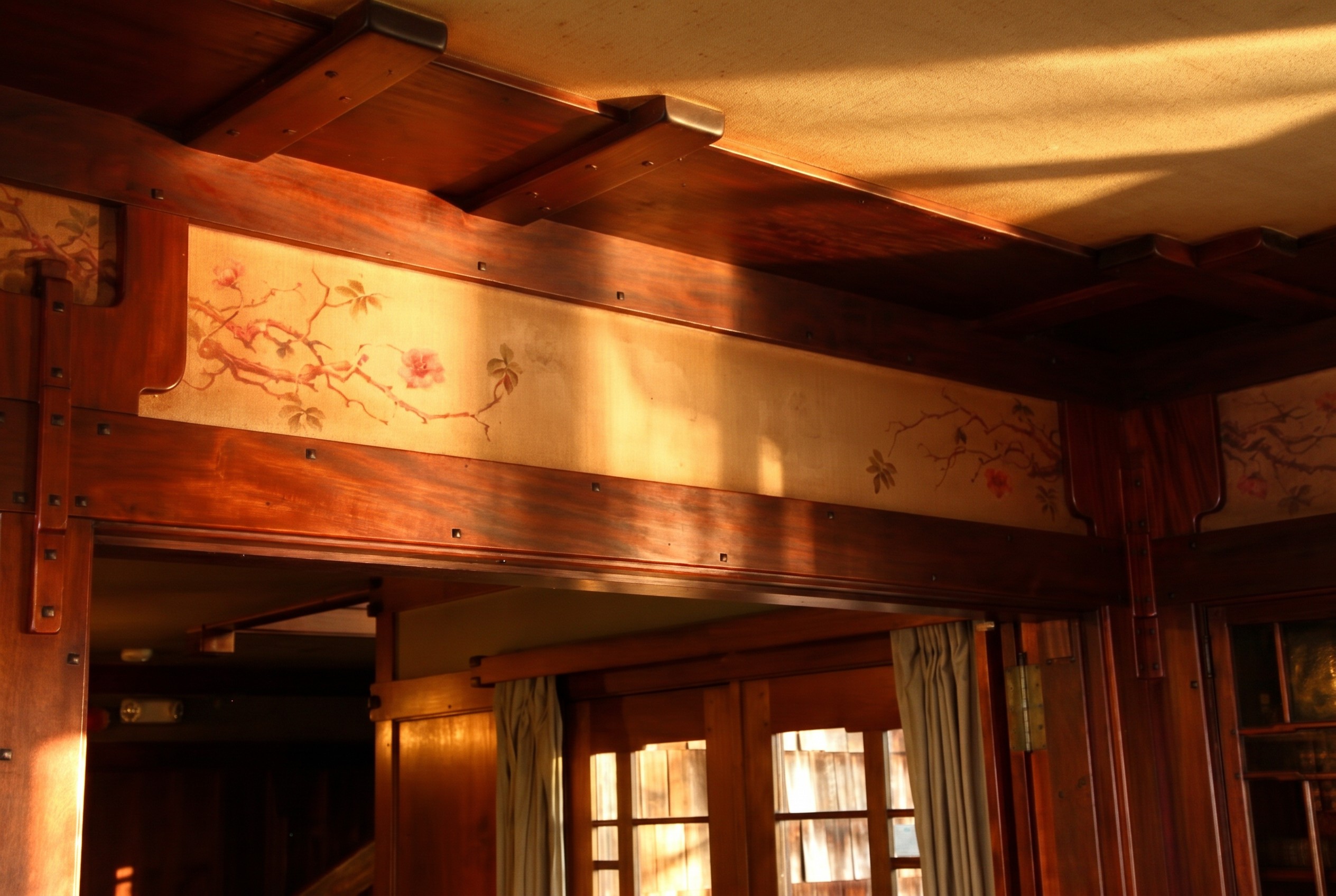
Stand in the living room of the William R. Thorsen House in Berkeley and look up, to the band of wall that runs above the paneling and below the ceiling beams. A vine of roses climbs there, all the way around the room. It is the kind of thing most visitors take in without quite seeing — a soft, warm border of leaves and blossoms, the color gone mellow with a century of light, registered by the eye as ornament and then passed over on the way to the joinery and the art glass and the great view down toward the bay. The frieze is treated as background. It is, in fact, one of the most quietly radical things in the house.
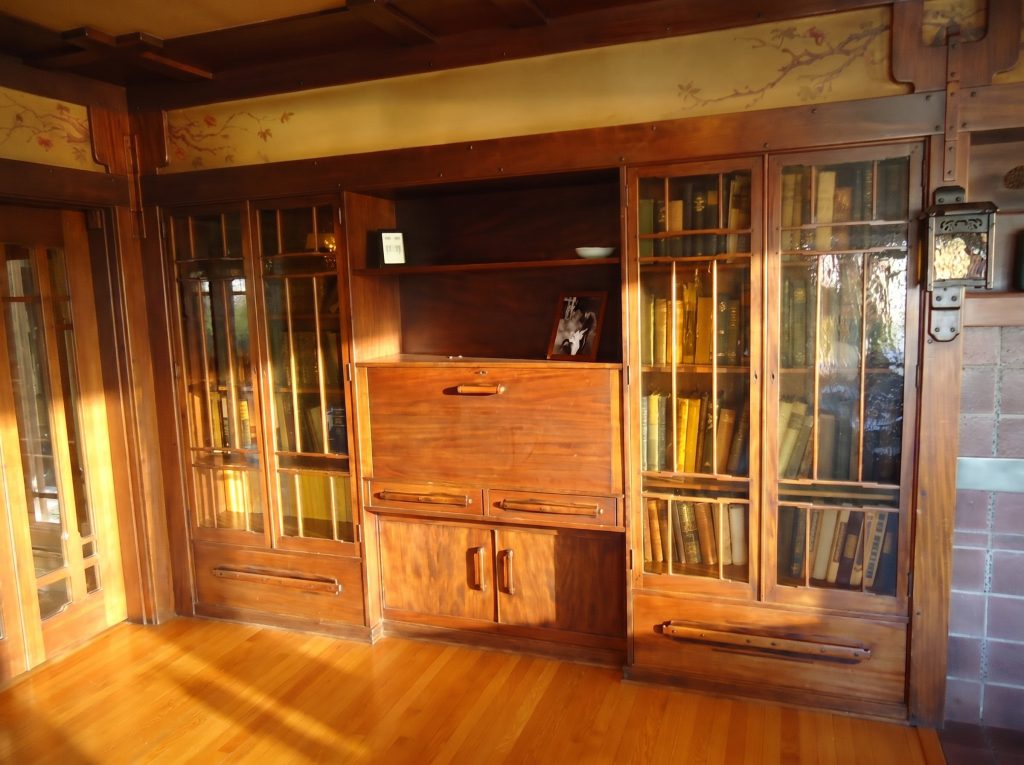
Most people assume it is one of two things. They assume it is carved — that the roses are worked in low relief in the wood, like so much else in a Greene & Greene house, where the ornament is usually the structure made visible. Or they assume it is wallpaper, a printed Arts and Crafts pattern of the kind William Morris had made fashionable, bought by the roll and pasted up.
It is neither. The frieze is hand-painted. The roses are brushed directly onto panels of Belgian linen set into the wall, the design — and by most accounts the brush itself — belonging to Charles Greene. He was a painter as well as an architect, a patient watercolorist who would spend the Carmel decades of his life with a brush in his hand, and here, in one of the last great houses of the partnership, he picked up that brush and painted the top of a room.
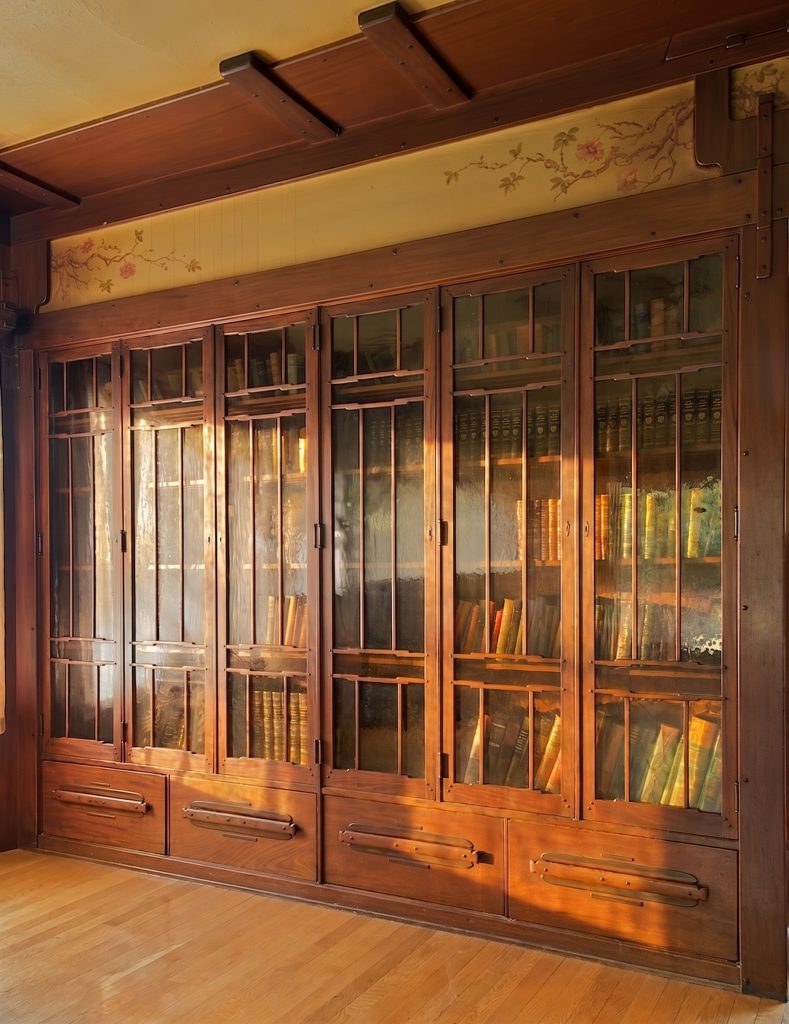
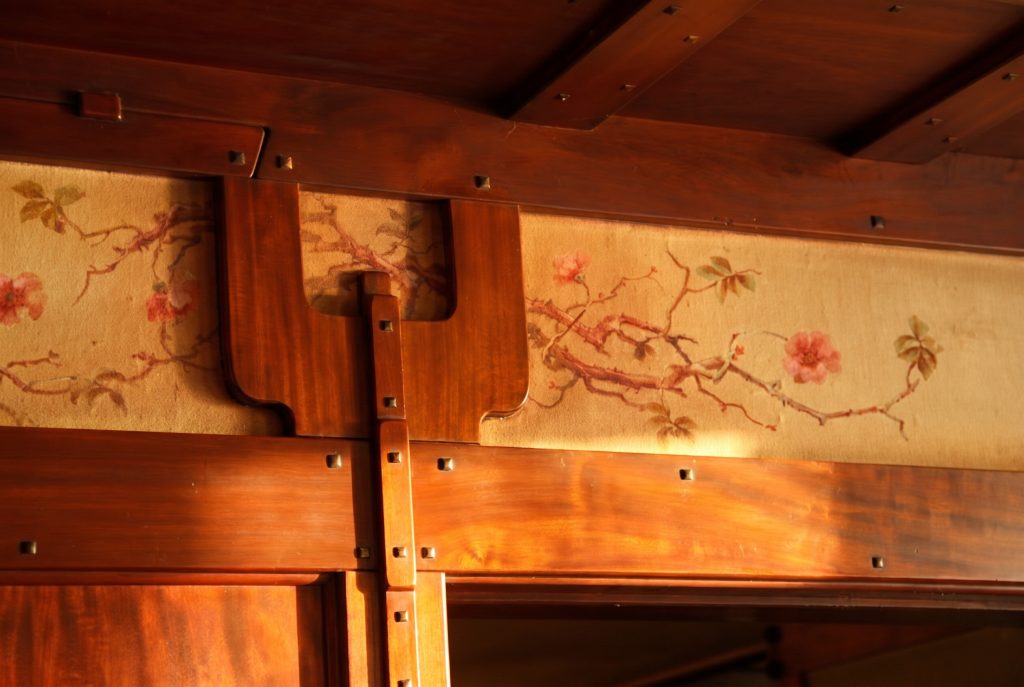
What makes it radical is not the painting itself but where the painting meets the wood. Look at how the vine is composed. The stems do not float on the linen as a pattern would. They rise from below, and they disappear behind the top rail of the paneling, so that the painted roses read as a living plant rooted somewhere behind the woodwork, climbing up and over the rail to flower in the open band above. The architecture and the painting are not layered one in front of the other. They are interlocked. The carpentry pretends the plant grew there, and the painting pretends the rail is a trellis.
That top rail is itself a piece of the Greenes’ usual grammar — the scarf joint, the long diagonal splice that lets two lengths of wood become one continuous line, pegged and shown rather than hidden. We have written about how, for these architects, the joint is the ornament. Here the ornament of the joint and the ornament of the brush are made to belong to the same sentence. The painted vine even bends to accommodate the U-shaped brackets that punctuate the rail at intervals, the ones secured with the small stepped pins that catch the light. The roses go around them, the way a real vine goes around an obstacle. Nothing is allowed to sit on top of anything else as decoration. Everything is woven in.
The choice of plant is worth pausing on. A rose is a humble subject for a house of this seriousness — not a heraldic device, not an exotic import, but the flower of an ordinary garden, the thing growing on a trellis outside half the houses in California. The Greenes did this often. At the Gamble House the front door holds a Japanese black pine; at the Thorsen the climbing motif is a common rose, and a grapevine that picks up the same idea and carries it into the dining room next door, so that the two principal rooms are bound together by a single botanical thought. The brothers took the plants you would actually find on the property and made them the governing image of the interior. The luxury is in the execution, never in the subject.
The Thorsen House was the last of the great houses, built between 1908 and 1910 for William and Caroline Thorsen, and it is the house in which Berkeley got its one full-scale answer to the Pasadena masterpieces — the house whose canyon-edge prow we have described as a bowsprit driven out over the street. By the time the brothers reached it they had nothing left to prove about joinery or art glass. What they were still refining was integration — the binding of every surface into one continuous design — and the painted frieze is integration carried into a medium they rarely used. It is the rare place where the Greenes set down the chisel and the lead came and picked up the brush, and made paint behave exactly the way their wood behaves: structural, honest, woven into the building, never merely applied.
It is the easiest thing in the room to miss, and one of the few things in the room a visitor could, in principle, have made at home with a length of linen and a steady hand. That is the quiet provocation of it. The most reproducible-looking element in the house is in fact the most personal — a band of common roses, painted by the architect’s own hand, climbing a wooden trellis that is also a wall.
For the house itself, see The Bowsprit in Berkeley. For the joinery the painted vine is woven into, see The Joint is the Ornament.