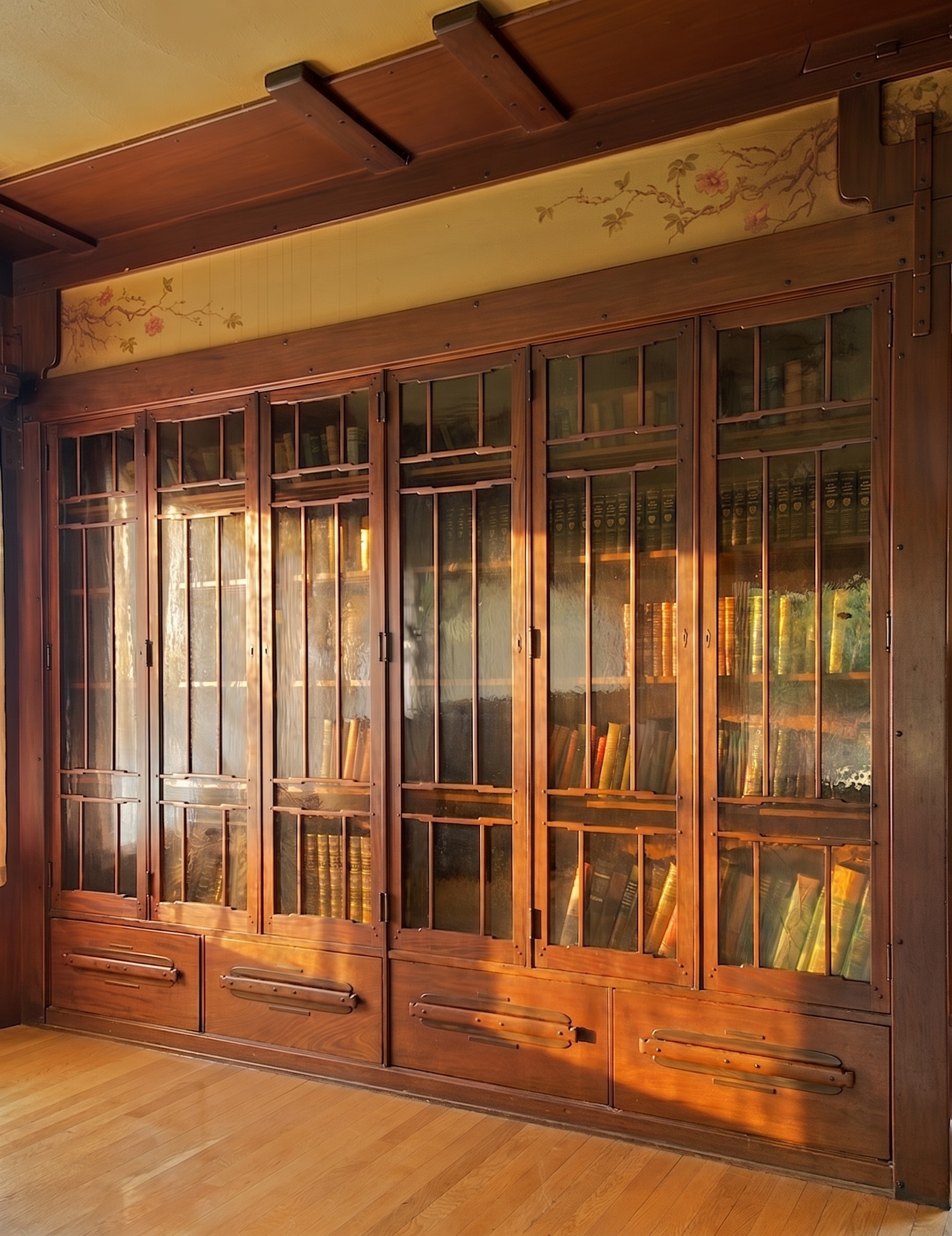
The Thorsen House does something the brothers almost never allowed themselves to do. In the living room, in the band of wall just below the ceiling, above the run of quarter-sawn oak that lines the room, there is a painted picture. Not carved. Not inlaid. Not worked into the structure in any way. Painted, in color, by hand, directly onto the plaster: a vine of climbing roses that runs the full circuit of the room, leaf and stem and open flower, traveling the wall the way a real rose travels a trellis.
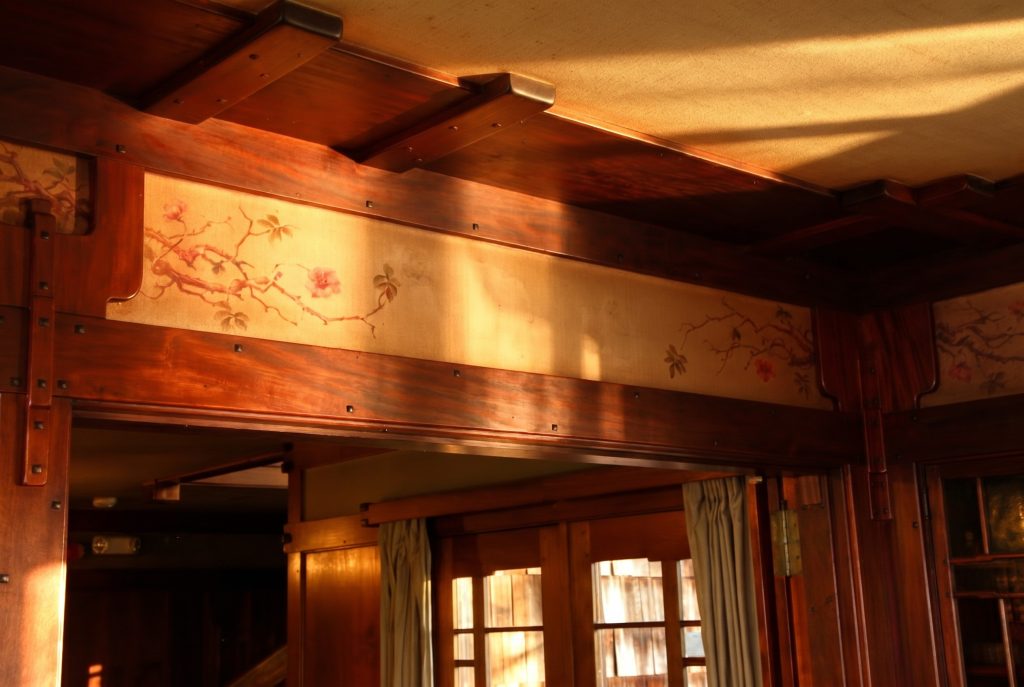
This should not be here, and that is what makes it worth standing under. The whole moral argument of a Greene and Greene interior is that ornament should be structure and structure should be ornament — that the beauty of a room is the visible truth of how it was made. The peg, the bracket, the through-tenon, the softened edge of a board: these are the decorations, because they are also the building. Applied ornament, the kind that is added to a surface after the surface is finished, is exactly the thing the brothers spent their careers refusing. They did not paint pictures on their walls. They let the wood be the picture.
And then, in the last of the five great houses, in Berkeley, in 1909, they painted a picture on the wall.
It is, by the accounts of the people who have studied the house closely, the work of Charles Greene’s own hand — the architect not directing a craftsman but holding the brush himself, working the rose vine around the room flower by flower. That alone sets it apart. The brothers designed almost everything in these houses and made almost none of it; the joinery was the Hall shop, the glass was the Sturdy-Lange studio, the metal was the smiths. The painted frieze is one of the few surfaces in the entire body of work that Charles Greene appears to have executed personally, with his own hands, in color.
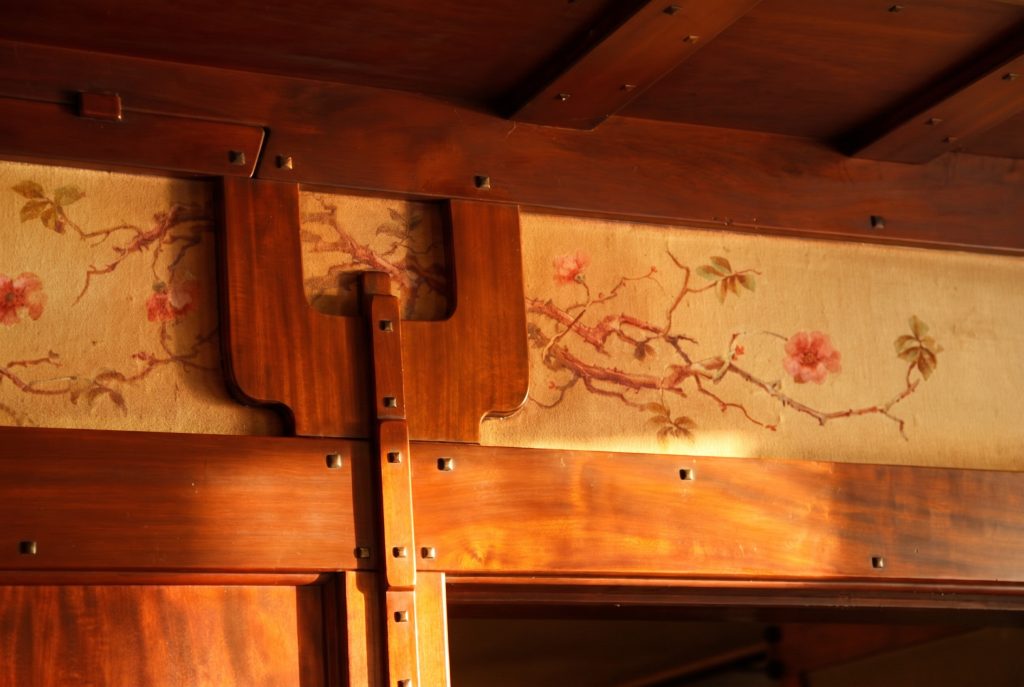
But look at how it is painted, because the how is the whole point, and it is where the apparent contradiction dissolves. The rose vine does not simply float on the plaster as a flat decorative band. It is painted to emerge from behind the wood. The top rail of the oak paneling, broken at intervals by the deep U-shaped brackets that the brothers pinned to it with their stepped ebony fastenings, becomes the trellis the rose is climbing. The flowers appear to grow up out of the joinery, threading between the brackets, rooted in the architecture and reaching into the room. The painting is not added to the structure. It is made to depend on the structure. The wood is the reason the rose can be there at all.
That is the brothers smuggling applied ornament into their own system without breaking its rules. A painted vine on a bare wall would have been a betrayal of everything they believed. A painted vine that grows out of the paneling and treats the rail as a trellis is something else: it is ornament that still answers to the structure, decoration that still depends on the joint. The rose only grows because the wood gives it something to climb. Even here, at the one moment they reach for the painter’s brush, they refuse to let the ornament be free of the building.
It is worth setting beside the other great frieze in the brothers’ work, the carved redwood landscape that circles the living room of the Gamble House a year earlier, the subject of The Bats in the Living Room. At the Gamble the brothers put a landscape on the upper wall by carving it — cutting it into the redwood, so that the ornament and the material are the same thing, and the picture is the wood. At the Thorsen they put a vine on the upper wall by painting it. These are two answers to the same question: how do you bring a living, growing thing into the most formal room in the house without lying about your materials? Carve it, and the wood becomes the garden. Paint it, but root the painting in the wood, and the joinery becomes the trellis. Different methods, the same discipline underneath. The ornament is never allowed to forget the structure it lives on.
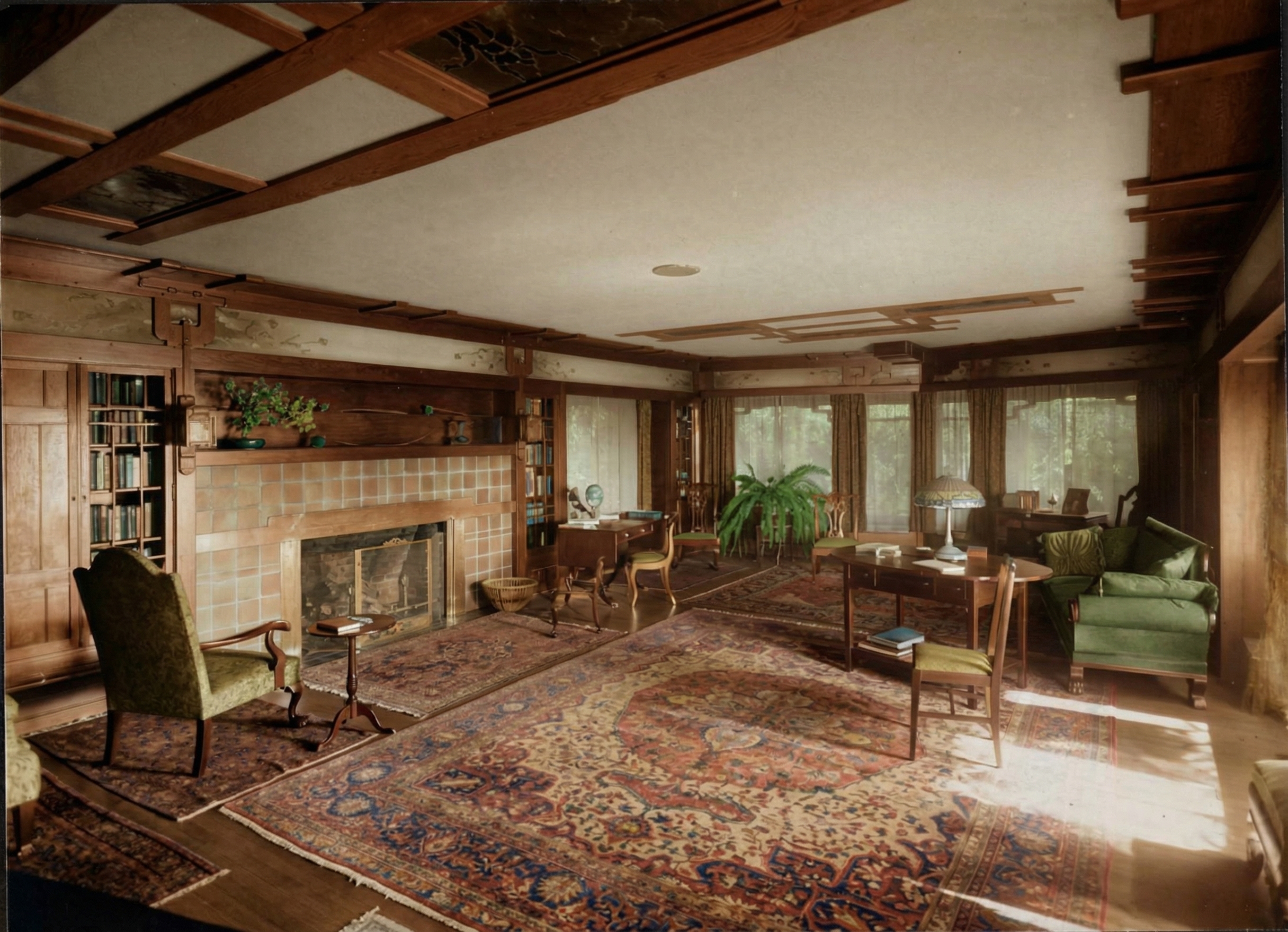
The choice of the rose is not incidental either. The rose and the grapevine run as a quiet theme through the Thorsen House — the rose climbs the living room, the vine appears again in the dining room — and the rose was a flower the brothers returned to across their work, carried even onto the household linens of their other houses. It is a domestic flower, a garden flower, a flower with no grand symbolic program behind it, which is exactly why it suits a room meant to be lived in rather than admired. The Thorsens did not get a frieze of heraldry or myth. They got the flower that grows on the fence of an ordinary California garden, painted as if it had climbed in through the wall.
The Thorsen House was the last of the five so-called ultimate bungalows, the only one built north of Pasadena, finished just as the brothers’ great decade was ending — the house given its full account in The Bowsprit in Berkeley. It is fitting that the last of them holds this one small exception, this single painted surface in a body of work that otherwise let the materials speak for themselves. At the end of the run, in the last great room, Charles Greene picked up a brush and did the thing he had spent a career not doing — and even then, he would not let the rose grow without a trellis to hold it.
The wood is the trellis. The rose climbs the joint. Nothing in this house, not even the one painted thing in it, is allowed to stand on its own.