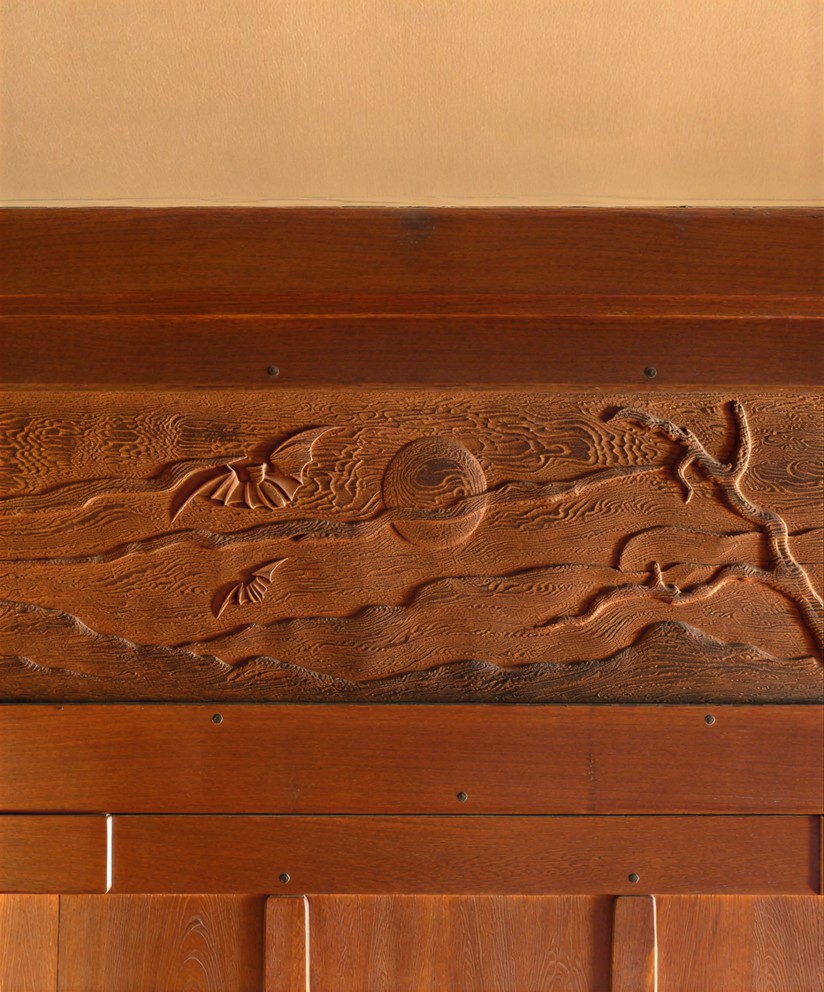
Everyone in the Gamble House living room is looking at the teak. This is reasonable. The paneling is the most expensive surface in the room, the joinery is the most famous, and the docents direct the eye there because that is where the hands of the Hall shop are easiest to see. But the room keeps its strangest decision higher up, in the band of carved redwood that runs around the walls above the paneling, and most visitors leave without ever quite seeing what is carved there.
The band is a frieze of low-relief panels — carved California redwood, designed by Charles Greene and executed in Peter Hall’s Pasadena shop — that circles the room as a single continuous landscape. The usual count is sixteen panels, though the count matters less than the continuity: read in order, they make a panorama of California, mountains descending through trees and clouds, oak branches heavy with acorns, then the shore, waves, gulls riding the wind off the water. It is the state compressed to a ribbon and wrapped around the room, so that the family sitting inside a house of Japanese-inflected timber was also sitting inside California itself, the way a scroll painting seats you inside a valley. That is not a loose analogy. The frieze behaves like a handscroll — a landscape meant to be read in passage, segment by segment, rather than taken in at once — and a room you must turn your head to read is a room that has made you participate in it.

The daylight panels are what you would expect from this office, which never drew a plant it had not looked at. The gulls bank the way gulls bank. The oak is a California live oak, not a generic tree. The waves curl in the stylized, deliberate manner the brothers absorbed from Japanese prints — the crest held a beat longer than nature holds it. It is all daylight, all open air, all the climate the house was built to celebrate.
And then one panel goes dark.
Trees against a night sky. A full moon. And crossing the moon, a flight of bats — not one bat, hidden as a joke for sharp-eyed children, but bats as the subject, given the same compositional care as the gulls two panels away. The moon is carved as a smooth uninterrupted disc, the one place in the frieze where the carver’s gouge goes still, and the bats cross it as silhouettes.
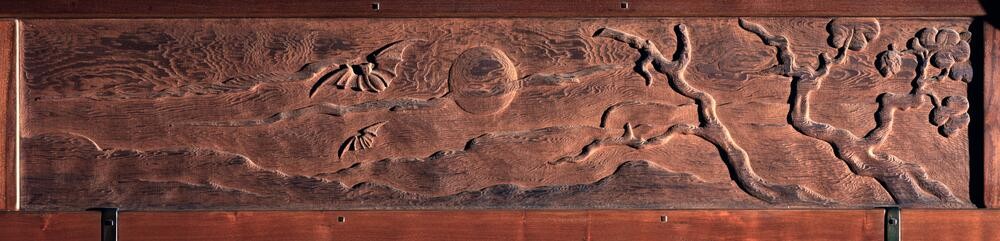
The most formal room in the house keeps a nocturne.
To an American client in 1908, bats were vermin — attic animals, omens, the furniture of ghost stories. To the tradition Charles Greene was actually working from, they were nearly the opposite. In Chinese decorative art the bat is an emblem of good fortune — the word for bat and the word for luck are homophones, and five bats together form a standard blessing — and the motif passed, with so much else, into the Japanese design vocabulary the brothers studied in books, prints, and the import shops. A bat crossing a moon is not a gothic image in that tradition. It is a benediction. Whether the Gambles read it that way, or were ever told, is not recorded; the panel does not explain itself, and nothing in this house explains itself. The explanations are left to us.
What can be said with confidence is that the panel is not a whim, because nothing in this room is a whim. The frieze was designed as a cycle, and a panorama of California that ran only from morning to afternoon would be a lie of omission. The Gambles were winter residents. They used this room in the evening, by the light of the lanterns and the fire — the house’s famous glow is a nighttime fact, not a daytime one. A room that lives at night earned a landscape that admits the night exists. The bats are the honest hour on the frieze’s clock.
Night gets a second witness a few panels on: an owl, upright among carved trees, as composed as a family portrait. Between the owl and the bats, the frieze gives the room’s actual hours a fauna of their own — the animals that begin work when the lamps come on, keeping company with a family doing the same.
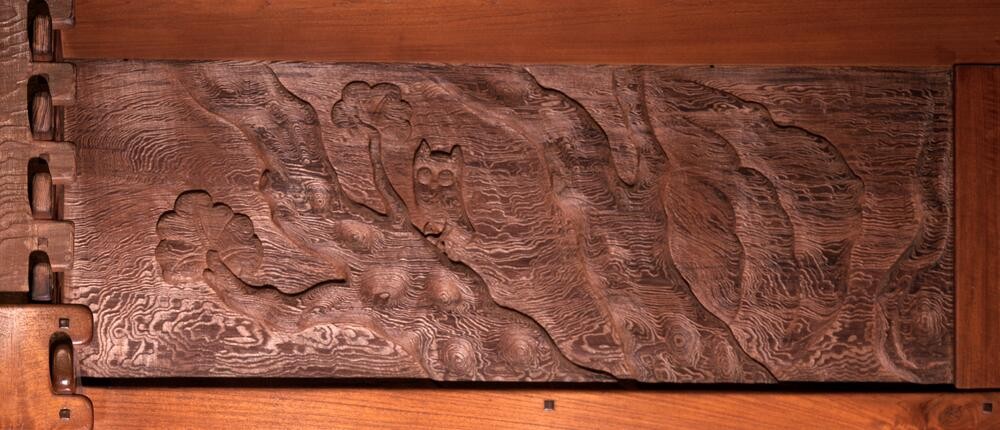
The carving itself is worth a long look, because redwood is a treacherous material for relief work. It is soft, it crushes rather than cuts if the tool is dull, and its grain swallows fine detail. The carvers — the attribution is usually given to the Hall shop, sometimes to John Hall by name; the shop is the safer claim, and the safer claim is enough — solved it by keeping the relief shallow and letting tone do the work the chisel could not. The redwood darkens where it is cut, so depth reads as shadow, and the deepest cuts in the bat panel are the night sky itself. The material’s limitation became the panel’s atmosphere. That is the whole Greene & Greene method in a sentence, executed eleven feet off the floor where almost nobody checks.
There is a tendency, encouraged by a century of photography, to treat the Gamble House as a collection of masterpieces — the door, the stair, the lanterns — each waiting its turn for the lens. The frieze resists this. No single panel is the masterpiece; the cycle is, and a cycle cannot be photographed, only walked. Which may be why the frieze stays half-known while lesser details have their own postcards. It asks for the one thing a tour cannot give: time in the room.
The frieze does not appear on the postcards. The house has more famous woodwork within twenty feet of it in every direction. But stand in the middle of the living room at the end of a winter tour, when the light outside is going amber and the docents are herding the group toward the hall, and look up at the dark panel on its long California ribbon.
The frieze is a map of the state. The bats are its honest clock.