
Spend an hour at the Gamble House and you will hear the phrase before you have finished crossing the terrace. A docent will use it; a visitor will repeat it; it is printed in the guidebooks and on the websites and in the wall text of every museum that holds a piece of the brothers’ work. The Gamble House, you will be told, is an ultimate bungalow. So is the Blacker House. So are three or four others. The phrase is used the way one uses a fact — flatly, with the confidence of something that has always been true.
It has not always been true. The phrase is younger than the houses by the better part of a century, and following it back to its source is a small lesson in how the past gets its names.

Begin with what the record does not contain. In the years Charles and Henry Greene were actually building these houses — roughly 1906 through 1911 — nobody called them ultimate bungalows. The brothers did not. Their clients did not. The period press did not: not the architectural journals, and not Gustav Stickley’s The Craftsman, the magazine that did more than any other to make the brothers visible to the country. The houses were “residences.” They were “the Blacker house,” “a California house,” “a bungalow” in the loose and generous sense the word then carried. They had no collective name because no one had yet stood far enough back to see them as a single group that needed one.
The name has a date, and it has an author. The date is 1977. The author is Randell Makinson — the architect and historian whose long campaign of recovery did more than any single effort to carry the Greenes’ reputation across the decades of their obscurity. Makinson’s 1977 book, Greene & Greene: Architecture as a Fine Art, contains a chapter titled, simply, “The Ultimate Bungalows.” That chapter is where the phrase enters the literature and begins its working life. Before it, the term has no real currency. After it, the term is everywhere. Whatever loose, conversational use it may have had earlier, its career as a category — as the name of a thing — starts on that contents page.
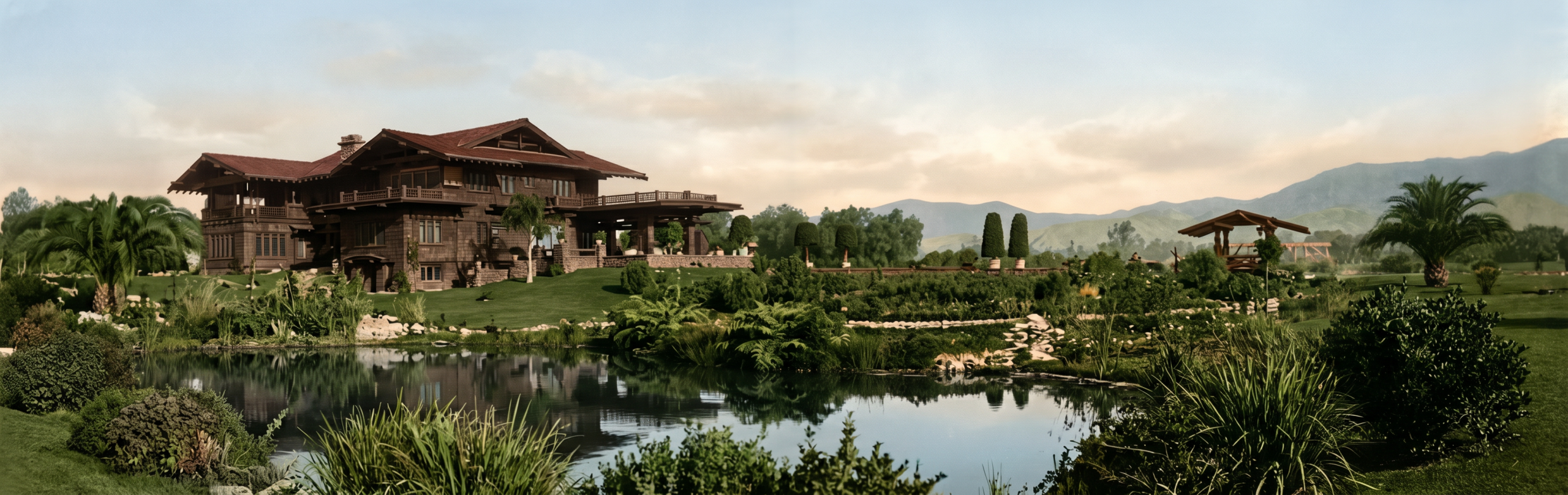
None of this means the houses are not a group. They plainly are. Set the Blacker beside the Gamble beside the Thorsen and the family resemblance is not in question: the same few years, roughly 1907 through 1909; the same kind of client, wealthy enough to hand the brothers an open commission and patient enough to wait on it; the same total method, in which Charles and Henry designed not only the house but the furniture inside it, the leaded glass in its doors, the light fixtures, the garden, the hardware, down to the smallest hinge. The same materials recur — Burmese teak, Honduras mahogany, ebony, with inlays of metal and fruitwood and the cool shimmer of abalone shell. These houses really do belong together, and a careful eye had grouped them long before a careful writer named them. The group was real before the phrase existed. But a group without a name is hard to think about, harder to teach, and nearly impossible to argue for. What Makinson supplied in 1977 was not the houses, and not even the observation that they cohere. It was the handle. For a body of work that had spent decades being forgotten, a handle is not a small thing to be given.
It is worth saying what the word means, because it is usually heard wrong. To a modern ear “ultimate” carries a sense of best, supreme, the finest of its kind. That meaning is real, and Makinson’s phrase certainly trades on it. But the older and root sense of the word, from the Latin ultimus, is last, farthest, final — and that is the sense that does the real work. The ultimate bungalows are not simply the best bungalows the Greenes built. They are the last bungalows: the point at which the form had been carried as far as it could be carried and still be called a bungalow at all. The word names a terminus.
Read it that way and the category turns exact. What the brothers built after this short run of houses — the Cordelia Culbertson house, the cliffbound D.L. James house at Carmel, the long water gardens of Green Gables — were not bungalows in any sense the word can bear. The form had been pushed to its edge, and then the Greenes walked off the edge. “Ultimate” is the right word precisely because it is not only praise. It is a location. These houses are where the bungalow ends.
This is also why the name could only have come late. A peak is invisible from the peak. While the brothers were alive and working — and through the long middle years when their work had slid out of fashion and very nearly out of memory — there was no vantage from which the handful of great houses could be seen as a closed set, a thing with a beginning and a summit and an end. That vantage is what the passage of time supplies. By 1977 the whole arc stood finished and visible: the rise through the early Pasadena houses, the few astonishing years, the long falling away. Makinson was not so much inventing a category as reporting one the years had finally made legible. The houses had to become history before they could be named.
There is a second thing the phrase quietly conceals. Ask which houses are the ultimate bungalows and you will usually be told five — the Gamble, the Blacker, the Thorsen, the Pratt, and the Ford. The number has the ring of a settled fact. But Makinson’s own 1977 chapter was not a list of five. It gathered nine: the Blacker, the Gamble, the Pratt, the Ford and the Thorsen, and alongside them the houses built for Earle C. Anthony, for Dr. Crow, for William Spinks, and for William Lawless. The tidy “five” is a later distillation — the houses that survived best, that were photographed most, that became a museum or a protected landmark and so stayed in front of the public eye. The four that slipped off the list did not become less ultimate. They became less famous. The category, looked at closely, is softer at its edges than the phrase admits.
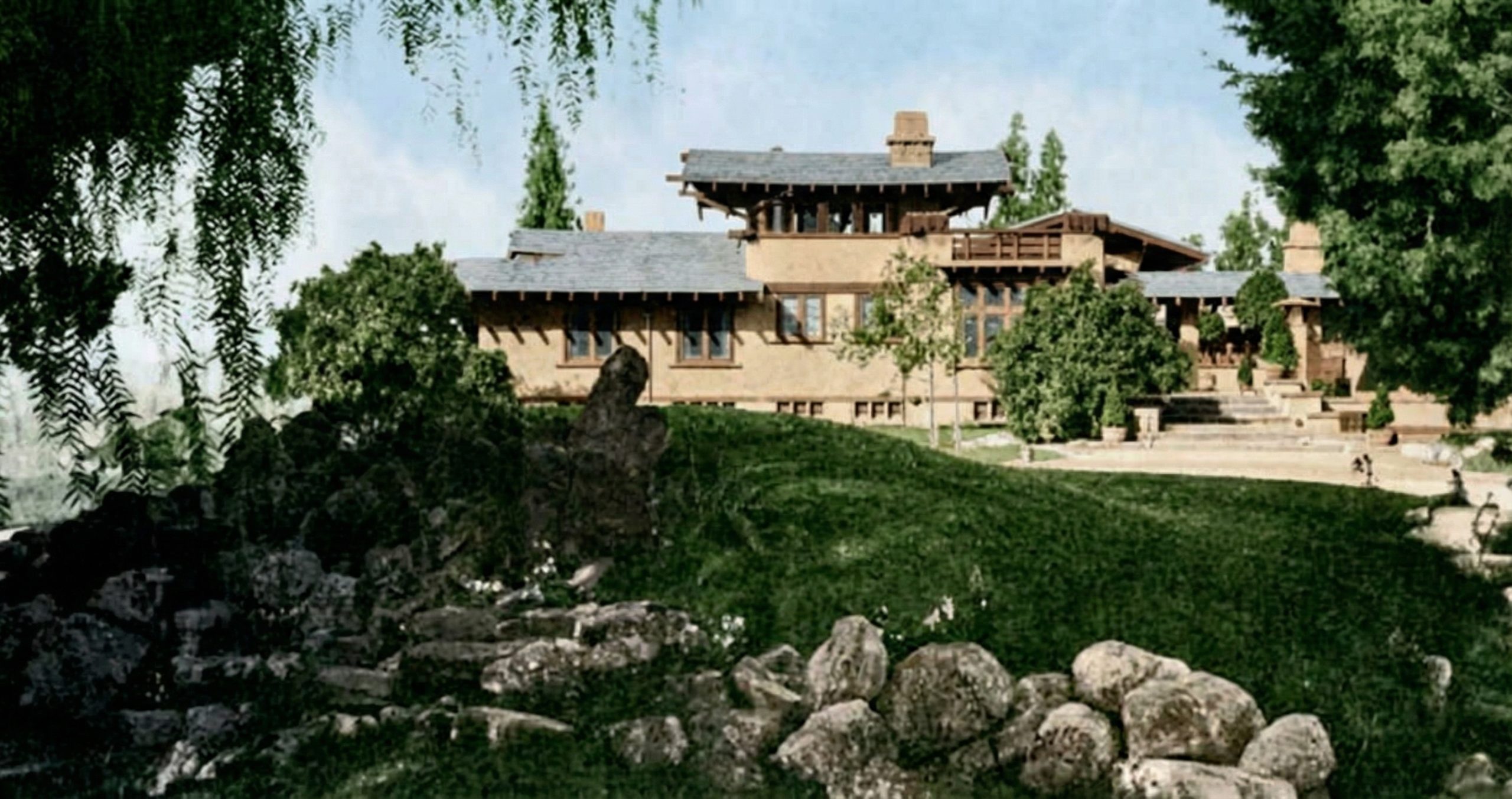
So the term is, strictly, an anachronism. It was fixed in print some seventy years after the houses were finished; it names a group the builders themselves never grouped; and the canonical five is a convenience that postdates even the term. By the standard this journal usually applies to language about the Greenes — that words be exact, and earn their place — “ultimate bungalow” ought to be a phrase to retire.
It is not. It is the right phrase, and it should be kept, because it does something true that no period term could have done. It says, in two words, that these houses are a summit and an ending at once — that the form had a peak, and that the peak was also a cliff. Nobody in 1908 could have said that, because nobody in 1908 could see 1908 from far enough away. It took Makinson, and the distance of seventy years, to look back and name what the houses had been.
The houses are older than their name. The brothers built the houses. It took another man, half a century on, to tell us where they ended. The name came late. It came right.
For more on the long work of recovering the Greenes, see The Long Apprenticeship. For one of the ultimate bungalows read closely, see The Silent Grammar of the Ultimate Bungalow.