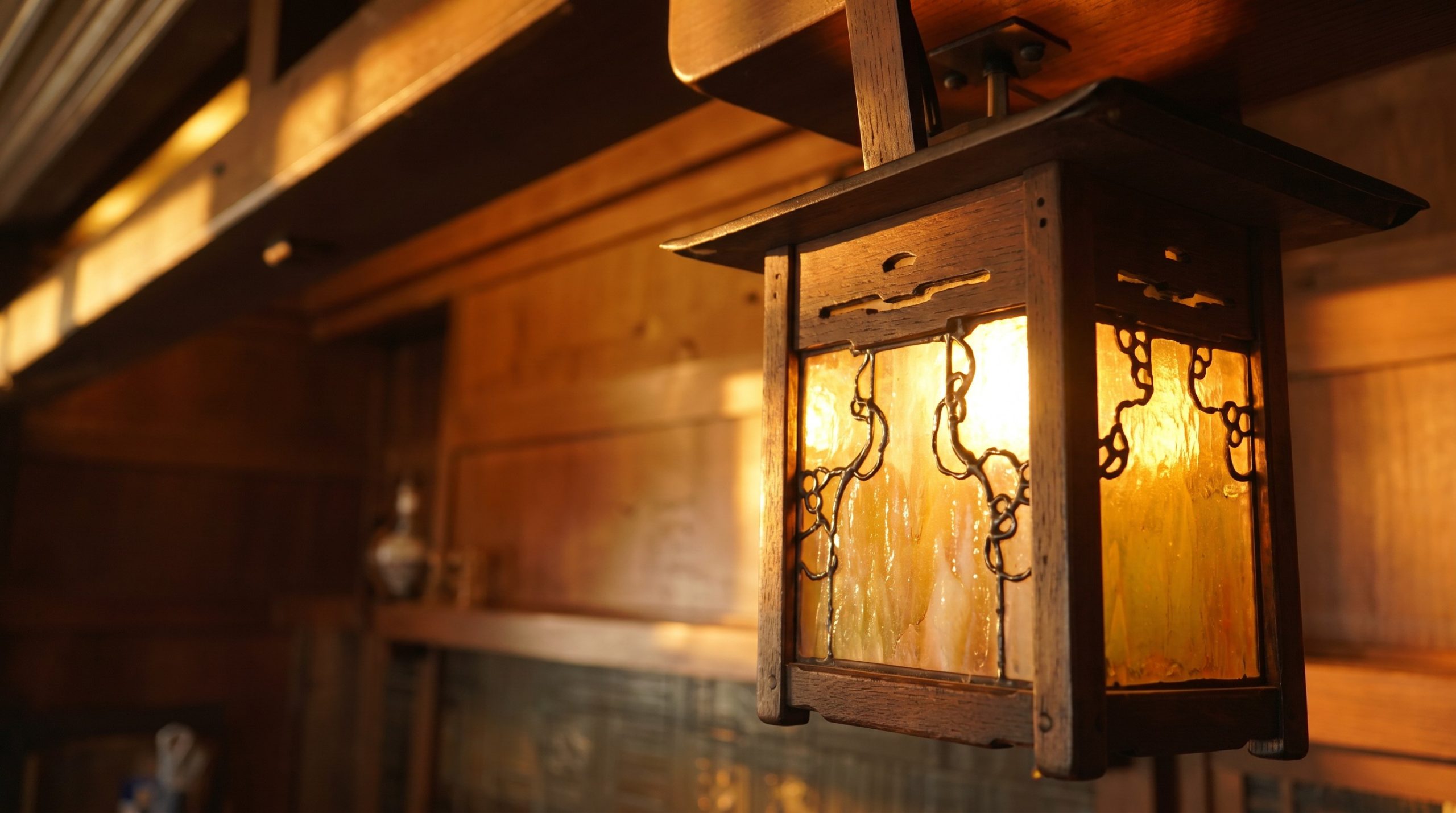
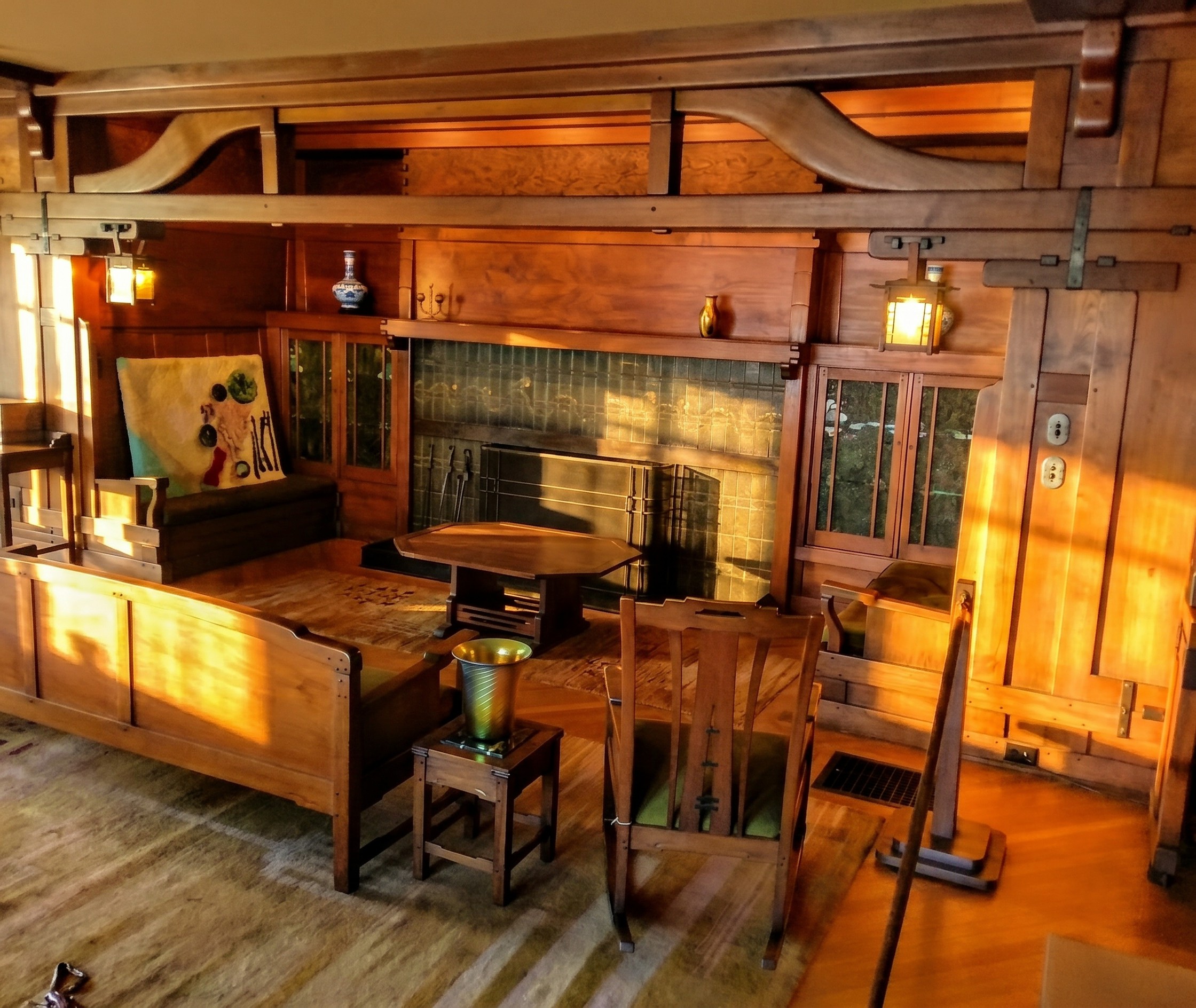
In the living room of the Gamble House, on either side of the inglenook, a lantern hangs from a strap of leather. You can miss it for a long time. The eye goes first to the broad green field of the fireplace tile, then up to the carved frieze of cloud-lifts running along the overmantel, then out to the leaded cabinets that flank the hearth like the wings of a small altar. The lanterns themselves are modest — square boxes of metal and amber art glass, the size of a loaf of bread — and they hang at shoulder height where you would expect a sconce. It is only when you follow the lantern upward to see how it is held that the detail announces itself. There is no chain. There is no rod. There is a band of leather, looped over a forged iron bracket that projects from the post, carrying the whole weight of the light.
It is a small thing and a deliberate one. By 1908, when Charles and Henry Greene finished the house, electric light was no longer a novelty in a wealthy Pasadena home, but it was still new enough to be awkward — a raw technology with no settled manners. The ordinary solution was to dress the new wiring in old costumes: to hang the bulb inside a fixture that imitated a gas jet, or a candle, or a Renaissance chandelier, so that the modern thing could pretend to be an older one. The Greenes refused the pretense and refused the apology. They treated the electric lantern as exactly what it was, a box that made light, and then they asked the most Greene & Greene of questions: how should such a thing be carried?
Their answer was leather. Not because leather was the obvious material for hanging a light — it was not, and almost no one else was doing it — but because leather was the material that, in the brothers’ moral universe, was honest about the job of bearing a load. Leather is the stuff of harness and saddlery and the strap that holds a trunk closed. It bends, it takes a buckle, it shows its grain, it ages visibly and well. Where a brass chain would have asserted machine precision and a wooden bracket would have made the light look built-in and permanent, the leather strap says something gentler and more exact: this object is hung here, by hand, the way you would sling a satchel over a peg. It can be lifted down. It is carried, not fixed.
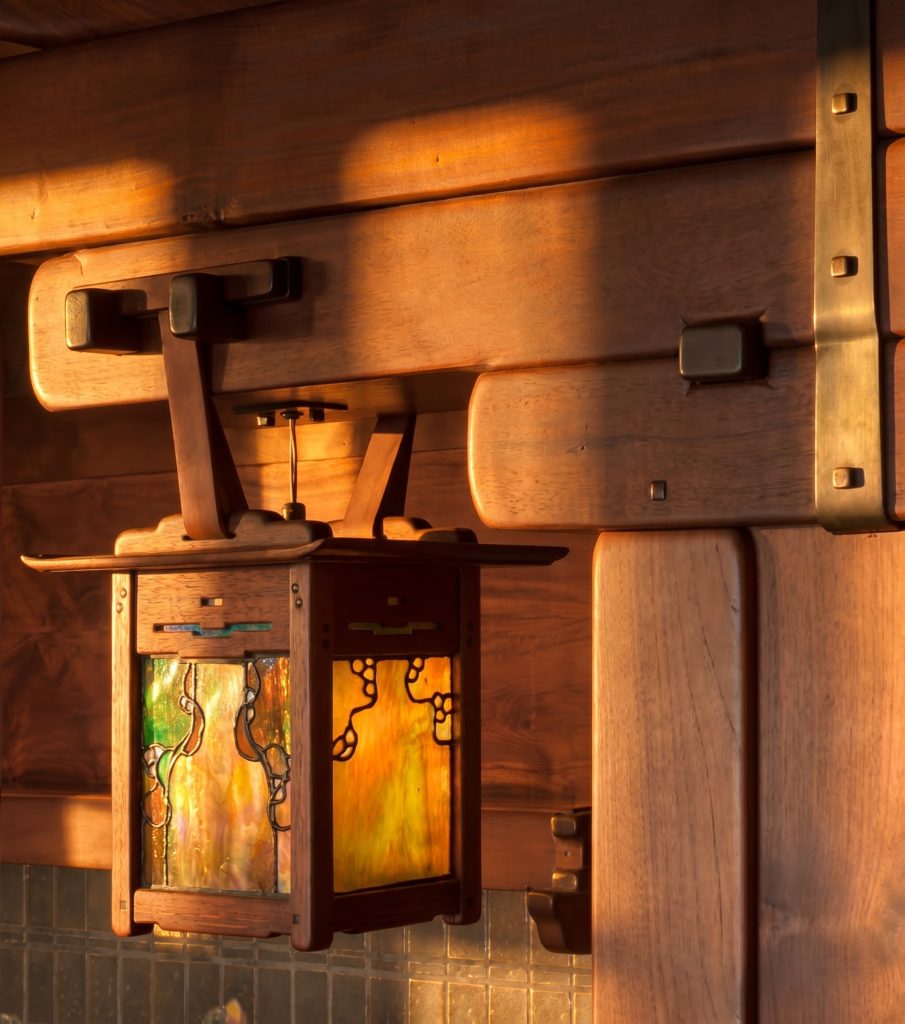
This is the same instinct that runs through the whole house, and through the whole body of the brothers’ work — the instinct to make the means of holding something a visible part of its beauty rather than a thing to be hidden. It is the logic of the exposed peg and the proud-standing spline, of the ebony plugs set over the screws in the staircase, of the iron straps that lash the timbers of the sleeping-porch rails. The Greenes did not separate the question of how a thing works from the question of how it looks. The leather strap is structural and it is ornamental, and the point is that it is both at once, in the same gesture. You are meant to see the load being carried.
There is a fair question to ask here, and honesty requires asking it: is the leather actually doing the work? It is reasonable to wonder whether, behind or within the strap, there is a discreet length of chain or rod taking the real weight while the leather merely dresses it — the very pretense the brothers seemed to be refusing. I do not think the record settles it absolutely, and a careful writer should not pretend otherwise. But the distinction matters less than it first appears. Whether or not a hidden support shares the burden, the brothers chose to make leather the thing you see bearing the lantern, and that choice is the design. They could have hung the light a hundred conventional ways and shown you a chain or shown you nothing. They showed you a strap. The expressive truth — that a soft, worked, animal material is presented as the thing that holds the light — is the same either way, and it is the truth they wanted in the room.
What the leather holds is worth a moment too. The lantern’s glass is the warm amber and gold that the brothers favored for artificial light, the same family of glass that Emil Lange selected and leaded for the great fixtures of the house, chosen so that the electric bulb behind it would read not as a glaring point but as a low, steady, candle-colored glow. Hung at shoulder height beside the inglenook, the lanterns do not light the room from above the way a chandelier would. They light it the way a reading lamp does, at the level of a seated person, so that the inglenook — already the warmest, most enclosed corner of the house, with its built-in bench and its green-tiled hearth and its hand-wrought andirons — becomes a pocket of low gold light you settle into rather than a room you simply illuminate.

It is easy, walking through a house this famous, to treat the leather strap as a charming flourish — a designer’s signature, applied because it looks handmade. That reading is too small. The strap is an argument about how a new and slightly alien thing, electric light, should be admitted into a home: not disguised as something older, and not displayed as a proud machine, but quietly domesticated, hung from the oldest worked material there is, at the height of a human shoulder, in the corner where people sit. The Greenes were not nostalgic about technology. They were exacting about manners. They asked what it would mean to live graciously with the electric light, and they answered, in part, with a band of leather looped over an iron hook.
Stand in the inglenook on a late afternoon, when the low sun comes across the room and the lantern is not yet lit, and you can see the whole idea at rest. The strap holds its small weight. The grain of the leather catches the light. The lantern waits to be needed. It is the least monumental detail in a monumental house, and it may be the most honest. The brothers spent their best years insisting that nothing in a building should hide the work it does. Here, in the warmest corner of their warmest house, even the act of hanging a lamp was made visible, and made kind.