
If you stand in the living room of the David B. Gamble House for long enough, you stop seeing the furniture. The eye is overloaded; there are too many things to look at; the room defeats the visitor’s attempt to inventory it. The leaded glass at the front door has its own mythology. The teak inlay on the desk has its own. The lanterns are their own subject and the rugs are their own subject and the carved sun above the chimney is its own subject. After half an hour the docent’s voice arrives at the fireplace and the visitor, slightly fatigued, looks down.
What is at the bottom of the fireplace is two cast bronze andirons and a crossbar. They are easy to miss. They are the smallest furniture-grade objects in the house. They are also, if you stay with them, the room’s quiet thesis.
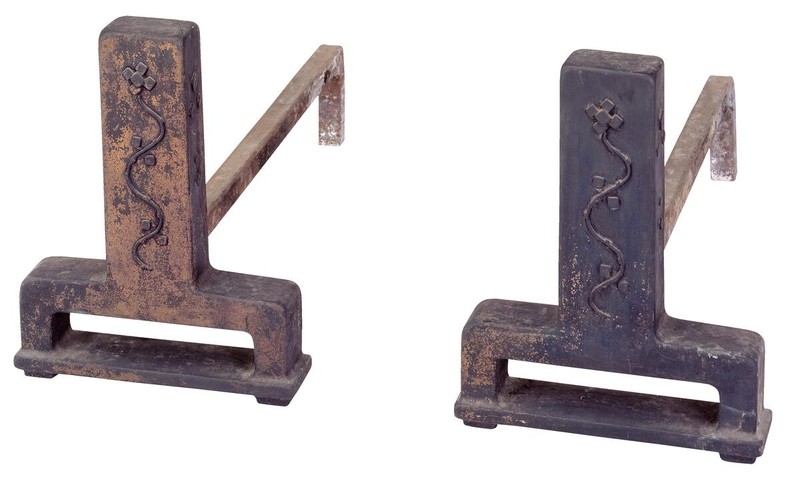
The Greenes had been designing andirons since 1906, when the firm produced its first set for the Henry M. Robinson House on the Arroyo. By the time the Gamble commission arrived in 1908, the brothers had stopped treating fireplace furniture as an off-the-shelf afterthought. At the Blacker House, the Gamble House, and the Thorsen House — the three Ultimate Bungalows whose budgets could absorb the labor — the firm designed andirons, fire screens, fenders, tools, and (at Gamble) a hammered copper hood for the kitchen range, all as continuous pieces of the architecture. The metalwork came from the small Pasadena shops the brothers cultivated and, for cast pieces of any scale, from local foundries who would pour to Charles’s drawings.
The Gamble living-room andirons are bronze, cast, dark-patinated, and small. Each one is essentially a foot — a sculptural support whose front face stands roughly nine inches high and whose horizontal billet bar runs back into the firebox to carry the log. The andirons are paired and crossed by a horizontal crossbar that locks them at the front of the hearth, which a less considered design would have left as a plain stretcher. In the Gamble pair the crossbar is itself an object. It is rectangular in section, its corners chamfered to the same gentle angle the carpentry uses everywhere in the house, and where the bar joins each upright it does so with a visible joint — not concealed, not soldered out of sight, but expressed at the meeting place as a small step in the bronze, the way an exposed mortise expresses itself in the woodwork upstairs.
That last detail is the field-note point. The andirons are not abstractly Japanese in influence, not loosely Arts-and-Crafts, not generically Greene & Greene. They are a piece of the joinery vocabulary of the rest of the house, translated into metal. The visible joint where the crossbar enters the upright is the iron equivalent of the square ebony peg on a chair leg. It tells you, in the smallest object in the room, exactly the same thing the largest beam-end tells you in the porch outside: this thing is held together, and the holding is part of what you are looking at.
The cross-guard of a samurai sword — the tsuba, the small plate of metal between handle and blade — is the form most often credited as the underlying motif for the brothers’ metalwork at Gamble. It appears as the shape of the dining-room table, as the silhouette of the light-switch plates, as the outline of metal corner brackets throughout the house. The connection to the andirons is suggestive rather than direct: the andirons are too small and too structural to be a clean tsuba quotation. But the family resemblance is there, and what it shares with the larger tsuba-influenced objects in the house is a respect for the function of the form. A tsuba protects the hand. An andiron lifts a log off the floor of a firebox so that air can pass under it. Each is a piece of equipment first and an ornament second, and the brothers liked metalwork that admitted as much.
The bronze itself has aged into the house. Andirons in a working fireplace spend half their lives at red heat and half their lives cold; the patina darkens, oxidizes, picks up flecks of soot, and eventually settles into a brown-black that no foundry can replicate on a new casting. The Gamble pair, used for nearly six decades by the Gamble family before the house passed to the City of Pasadena and the University of Southern California in 1966, have the color of long use. They sit on the same red brick hearth Charles laid out in 1908, in front of the same redwood-paneled inglenook, under the same leather-strapped iron lantern the brothers hung from the ceiling beams. The lantern, the bricks, the andirons, and the crossbar are the four objects whose combined silhouette is what a Gamble House visitor remembers, even if she cannot, after the tour, name what she saw.

What is finally striking about the andirons is how little of the room they occupy and how much of the room’s argument they carry. Greene & Greene’s reputation rests, fairly, on the showpiece objects: the front door, the inglenook, the master staircase, the dining-room chandelier. Those are the objects that brought the tourists in 1966 when the house first opened to the public, and they are the objects on the website now. But the front door is a public claim and the chandelier is a public claim, and the andirons are not. The andirons are functional bronze at the bottom of a firebox, designed by an architect who refused to believe that the smallest hardware in a house deserved less care than the largest.
That refusal is the Arts and Crafts position the brothers had received through Charles’s reading of William Morris and Ruskin and through their long attention to Gustav Stickley’s Craftsman magazine. The argument is that there is no such thing as a minor piece of equipment in a well-made house. The log lifter and the chandelier are the same problem at different scales. To design the chandelier with the attention it deserves and to leave the andirons to a catalog supplier is to make a building in which only the parts that show are honest.
The Gamble House does not have that problem. The smallest objects in the building are made with the same care as the largest, and the proof is at the bottom of the living-room fireplace, where two cast bronze feet hold a crossbar a few inches off a brick hearth.
The proof is in the joint at the crossbar.
It is the argument of the whole house, hidden where almost no one looks.