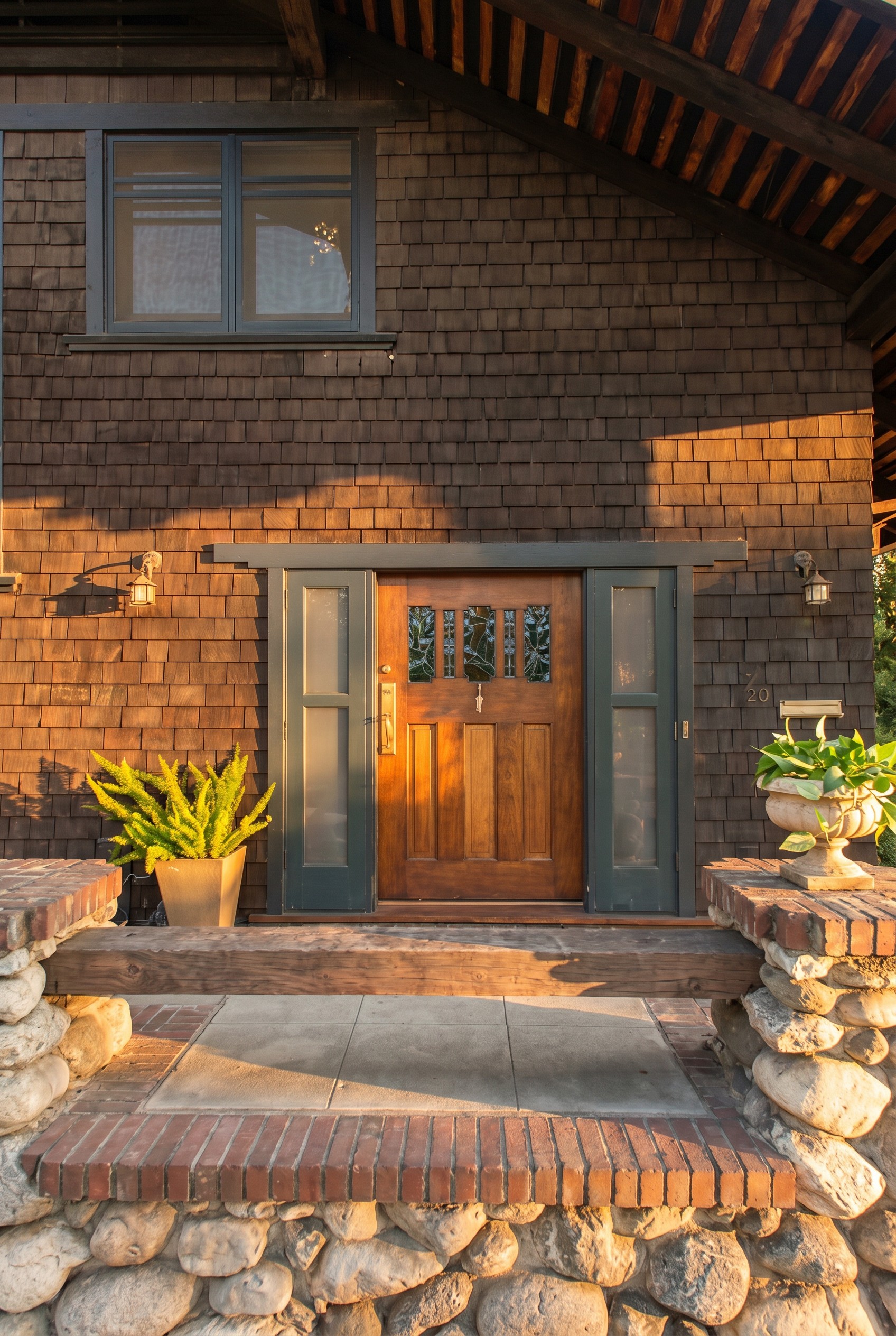
The front door of the Mrs. Louise T. Halsted House is not famous, and it should be. It belongs to a small house — the seventh Greene & Greene commission in the Park Place tract, built in the winter of 1905 for a family of comfortable but not extravagant means. S. Hazard Halsted ran the Pasadena Ice Company. His was not the fortune of a Gamble or a Blacker, and the house the brothers gave him is correspondingly modest: a story and a half, shingled, settled low under a deep eave, the kind of bungalow a successful local businessman could actually afford. It is exactly the sort of house where you would expect the architects to economize. And so the door tells you something, because it is the place where they did not.
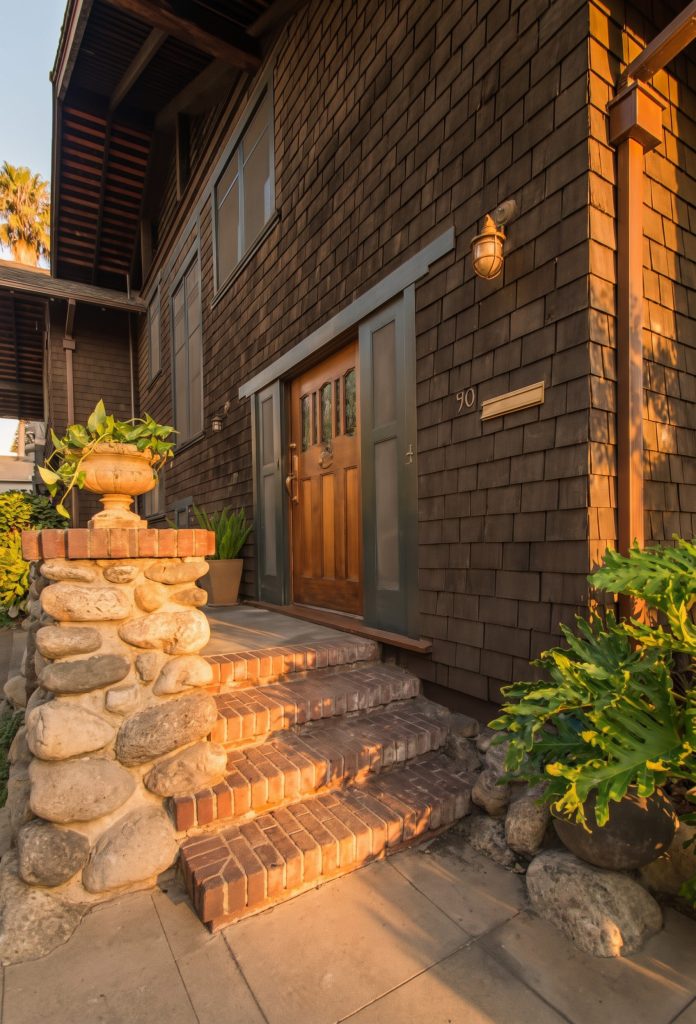
Consider what a builder’s-budget bungalow of 1905 would normally have at its entrance: a stock door from a millwork catalog, a pair of plain steps, a porch light bought by the gross. The Halsted entrance is none of these things. You come up brick steps to a terrace held in deep shadow by the overhang of the roof, and the architecture has already begun to work on you before you reach the door. The eave pulls the eye down and forward. The shade cools the threshold. The brick underfoot changes the sound of your own footsteps. By the time you stand at the door you have been, quietly, prepared.
This is the thing the brothers understood that a catalog never could. A door is not a hole in a wall with a slab in it. It is the one piece of a house that every person who enters must touch with a hand and pass through with a body. It is the house’s only universal experience. You may never sit in the inglenook or eat in the dining room, but you will put your hand on the door. So the door is where a small budget, spent wisely, buys the most. A dollar laid out at the threshold is felt by everyone; the same dollar spent on a remote gable is felt by no one. The Halsted House is a lesson in that arithmetic.
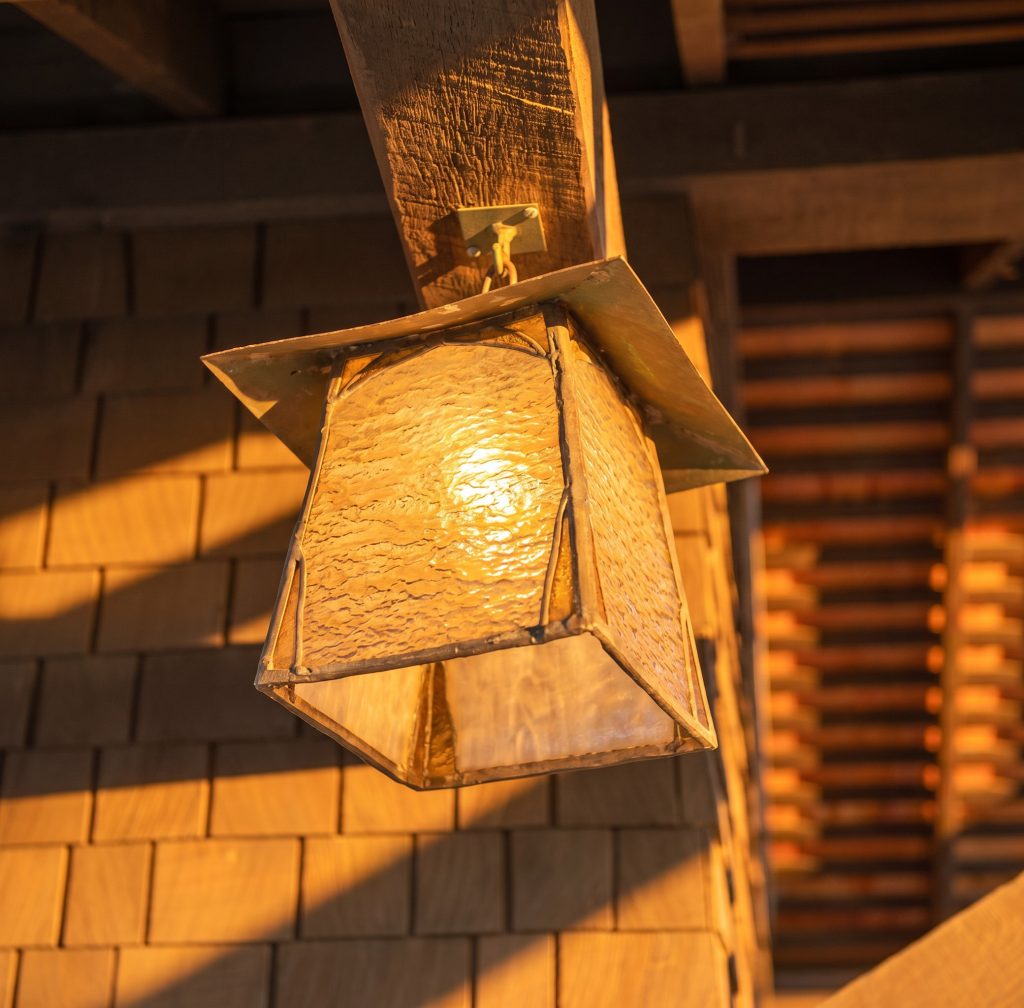
Look up from the door and there is the lantern. It is a custom fixture — not catalog stock — its glass faintly iridescent, the metal frame made for this porch and no other. On the great houses the entrance lanterns are justly celebrated; the leaded fixtures and the light they hold have a literature of their own, and the craftsmen who made them are remembered by name. What is remarkable here is that the same impulse reached down to a modest Park Place bungalow. The Halsteds got a one-off lantern over their door. Someone designed it, someone built it, and it has hung there throwing a particular quality of light onto the threshold for more than a century.
The door itself is broad and plainly built, its strength in proportion rather than carving. There is no ornament fighting for attention. What gives it away as a Greene & Greene door is the restraint — the sense that every line is the line it needs to be and no more. The brothers’ celebrated doors elsewhere are loaded with meaning: the leaded tree that climbs the entrance at Pasadena’s most famous bungalow, the subject of a long study of a single misidentified species in the glass, or the heavy doors a fraternity later inherited and kept at Berkeley. The Halsted door does not try to be those doors. It is the same intelligence working in a lower register, on a smaller budget, with nothing to prove. That, if anything, makes it the purer demonstration of the principle. Strip away the wealth and the spectacle, and the care is still there.
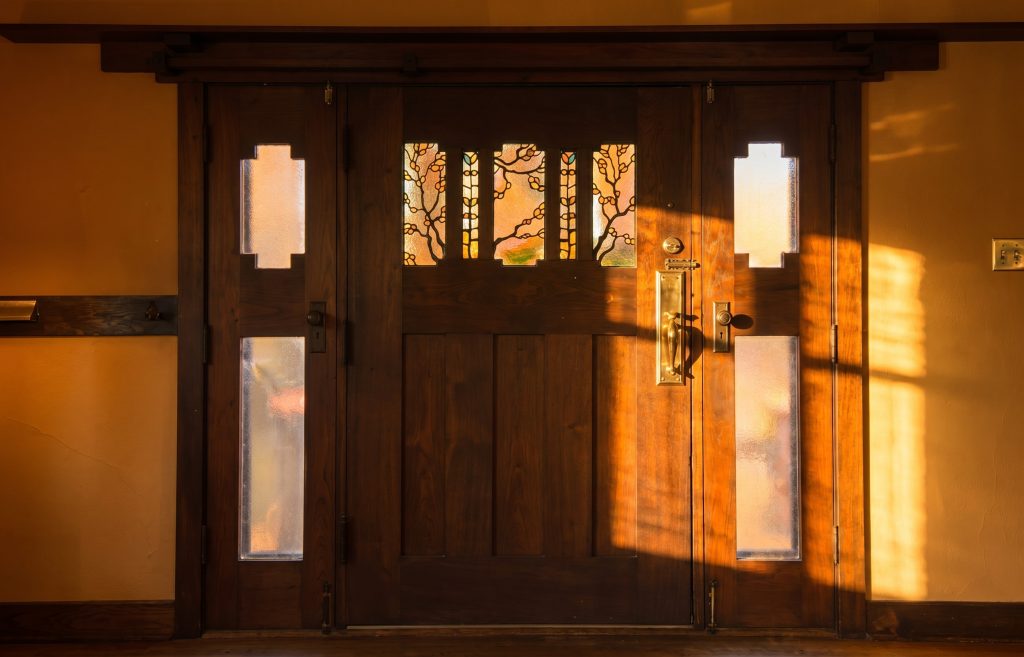
The proof is on the inside. Turn and look at the door from within the entry, and there is a panel of leaded art glass set into it — a small, deliberate piece of color and pattern positioned exactly where the morning light will come through it and exactly where someone leaving the house will see it last. From the street the door is sober. From the inside it glows. The brothers spent their glass not where it would impress a passing stranger but where it would reward the people who actually lived there, every day, coming and going. That is a moral choice as much as an aesthetic one. The most beautiful face of the door is turned toward the family, not the public.
There is a tendency to treat the small Greene & Greene houses as warm-ups for the ultimate bungalows, the rough drafts before the masterpieces. The Halsted door argues against that. It is not a rough draft of anything. It is a complete idea executed at the scale a particular family could afford, and the idea is whole at that scale. The brothers did not have one architecture for the rich and a cheaper architecture for everyone else. They had a single set of convictions about how a building should meet a human being, and they applied those convictions wherever they were allowed to — at the cliff’s edge and at the ice company manager’s modest lot in equal seriousness.
The house has not had an easy century. It was altered within five years of completion, added to in 1912, given a garage by the Greenes themselves in 1914, and changed again in 1915. Park Place filled in and aged and was rediscovered. Through all of it the door stayed where it was, doing the one thing it was made to do, which is to be touched. The brick steps still slow you down. The lantern still hangs. The glass still catches the morning. You can spend a great deal of money on a house and not buy what this small door gives away for free to anyone who walks up to it: the feeling, in the hand and under the foot, that someone thought carefully about your arrival.
That is where the budget went. Not into size, not into spectacle, but into the few square feet a person actually touches. It is the most honest place to spend, and the brothers spent there first.