There is a brass plate screwed to the front door of the William R. Thorsen House. It reads SIGMA PHI. It is mounted at eye level on a door designed by Charles and Henry Greene in 1909, in the upper third of which is a band of leaded art glass that Emil Lange built by hand, and the plate is the most informative object on the entire façade — not because of what it says, but because of what its presence means. This is a Greene & Greene front door that you are allowed to use.
That is rarer than it sounds. The great surviving works of the firm have mostly become something other than houses. The Gamble House is a museum, its rooms roped and its hardware behind glass. The Blacker House is a guarded private residence. The D.L. James House at Carmel is seen, when it is seen at all, from the highway shoulder. The Thorsen House, alone among the Ultimate Bungalows, survived by becoming a building that students walk in and out of every day. Since 1942 it has belonged to the California chapter of the Sigma Phi Society, and the undergraduates who live there open this door — by the long brass pull, with a backpack on one shoulder — thousands of times a year.
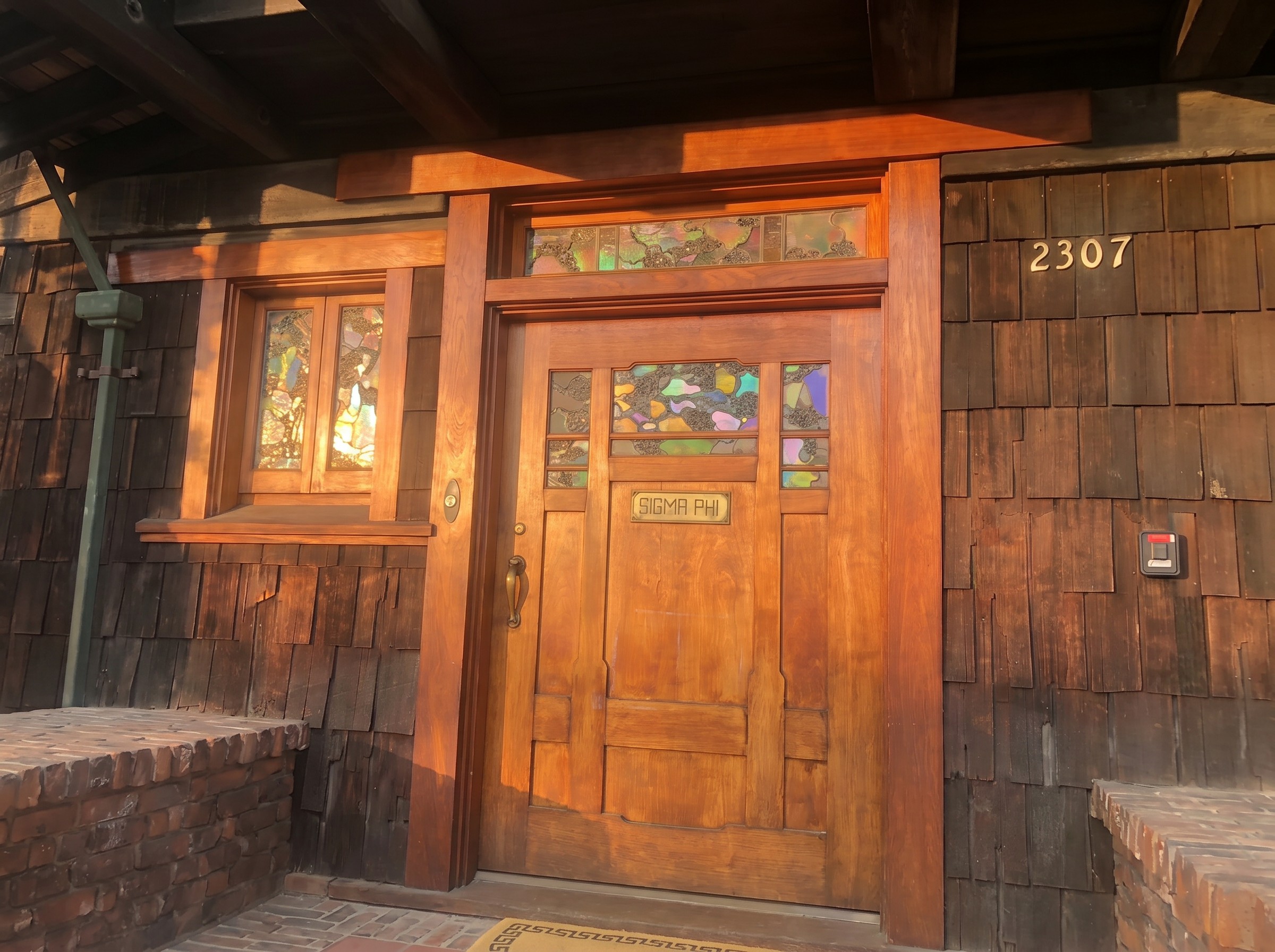
Look at the door itself. It is a single broad leaf of figured hardwood, its lower two-thirds given over to flat raised panels with the soft chamfered edges the firm used everywhere, the corners eased so that no line is quite sharp. Across the upper third runs the glass: small, irregular pieces of caramel, amber, deep green, and a few notes of violet, leaded into a stylized pattern of spreading, gnarled branches. The same motif continues in the transom above the door and in the slender sidelight to its left, so that the whole opening reads as one continuous field of foliage caught in lead. It is not a picture of a tree so much as the idea of one — branch and leaf abstracted to the point where the design is doing two jobs at once, admitting light and composing it.
This is the work of Emil Lange, the glassmaker whose shop translated nearly all of the brothers’ leaded glass from drawing into fact. The Thorsen commission of 1909 came at the height of that collaboration, and the front door is one of its quieter triumphs — quieter than the famous tree-of-life door at the Gamble House, but built to the same standard and by the same hand. Lange was not a fabricator filling in someone else’s outlines. He was, in every working sense, the man who made the light in a Greene & Greene house, and the glow that comes through this door in the late afternoon is his as much as the architects’.
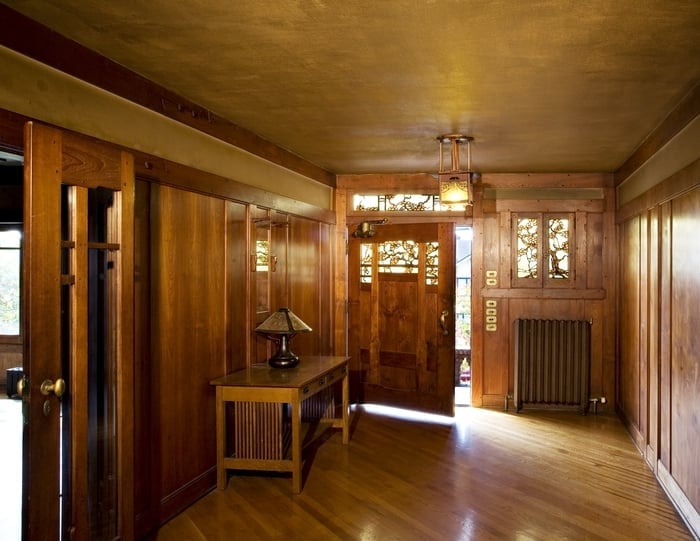
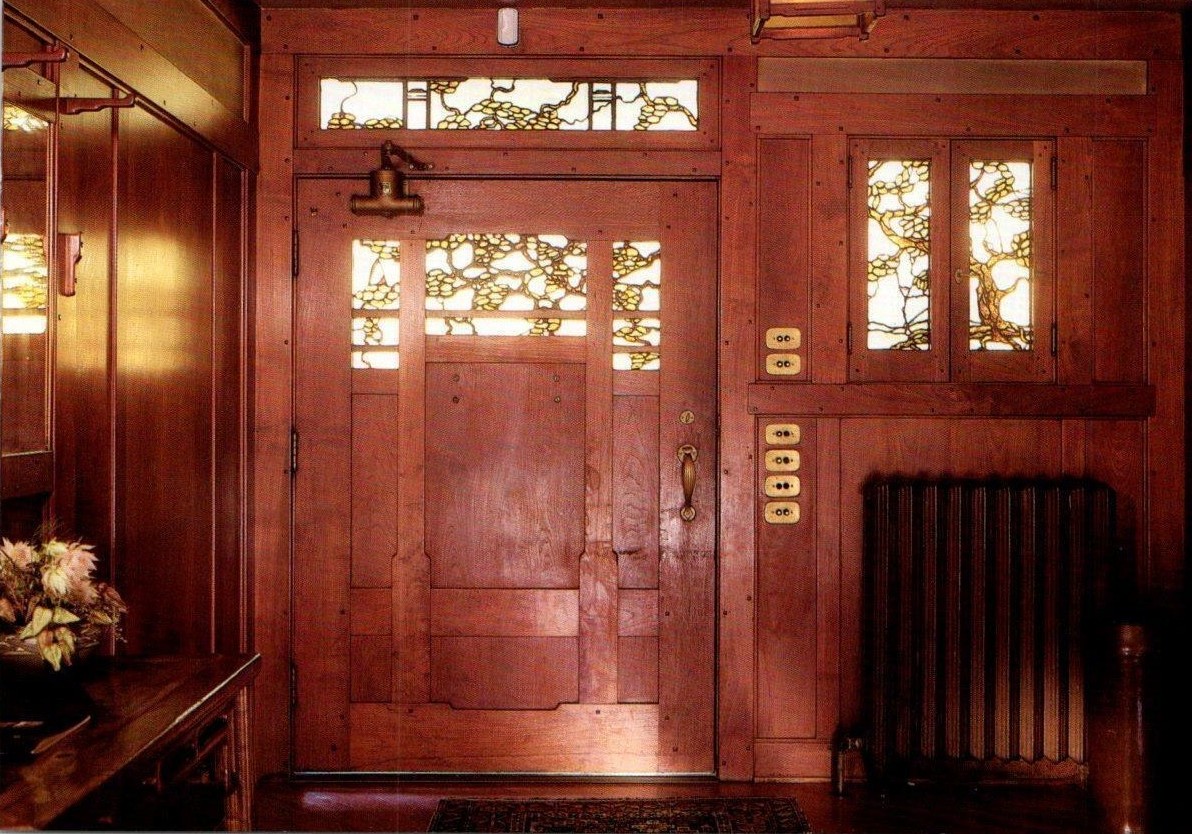
From the inside the door is a different object. The entrance hall is paneled in warm Honduras mahogany, and against that darkness the glass band reads not as pattern but as light — a horizontal seam of amber suspended at head height, brightest in the afternoon when the sun comes across the front garden. The Greenes designed the hall to receive a body arriving from the street: the eye adjusts from daylight to wood, and the glass is placed exactly where it eases that transition. Beside the door hang the brass push-plates and bell-plates in the firm’s tsuba form, the rounded-rectangle silhouette borrowed from the guard of a Japanese sword. Below them, frankly, sits a cast-iron radiator. The radiator is the tell. This is not a period room arranged for viewing. It is a hallway that has to be heated because people stand in it.
That distinction is the whole point of the door, and it is worth being precise about why. A museum preserves an object by removing it from use. The risk it manages is wear; the price it pays is that the object stops being what it was. A Greene & Greene door was made to be opened — the pull was shaped for a hand, the panels proportioned to a person, the glass set at the height of an arriving face. Roped off, it becomes a specimen of a door. Used, it remains a door. The Thorsen House has paid the other price. There is honest wear on the brass, the finish has eighty years of palms in it, and the glass has survived a building full of undergraduates for longer than most museum pieces have been catalogued. The wear is not damage. It is the evidence that the thing is still doing its job.
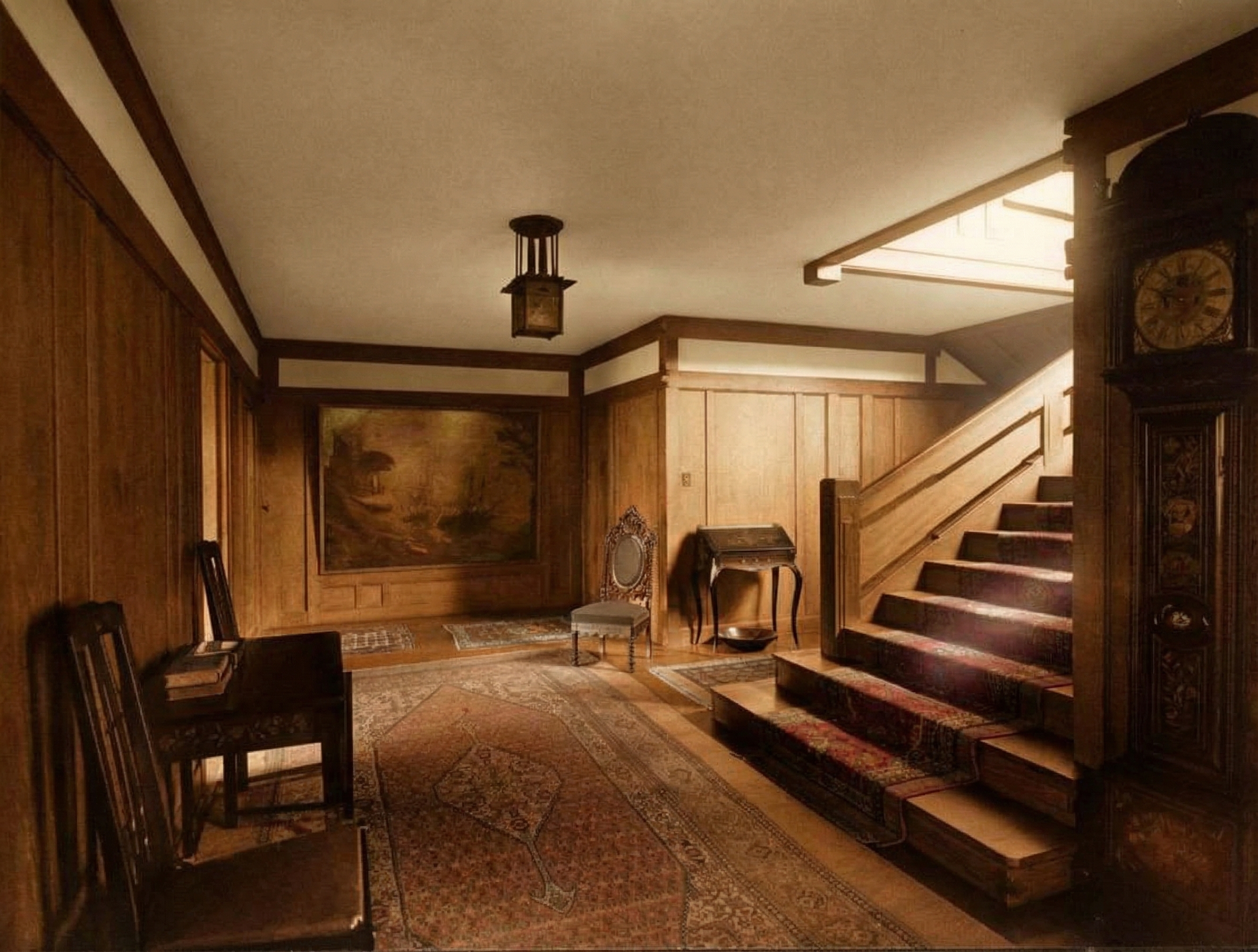
It is tempting to find the brass fraternity plate incongruous, a frat-house intrusion on a masterpiece. The opposite is closer to true. The Thorsen House came onto the market in 1942, at a moment when nobody was building a market for Greene & Greene and a large, elaborate, hard-to-heat 1909 house was a liability rather than a prize. The firm had not yet been rediscovered; Jean Murray Bangs’s articles, which would begin restoring the brothers’ reputation, were still six years away. A student society bought the house to live in it, and in living in it kept it standing, heated, occupied, and largely intact through the very decades when other Greene & Greene interiors were being stripped and sold. The plate is not vandalism. It is the name of the reason the door is still here.
The society has grown into the role. The house is a National Historic Landmark and a California state landmark; it is maintained, its glass is cared for, and it is opened for tours and for dinners and small concerts, so that the rooms are used the way rooms are meant to be used rather than only looked at. None of that changes the basic, slightly miraculous fact that meets you at the threshold. The most fragile thing the Greenes ever made — leaded glass, which is to say a picture assembled from pieces that want to fall apart — is set into the one part of a house that gets handled most, the front door, of a building that has been full of twenty-year-olds for eight decades. And it has survived.
Stand on the brick stoop at 2307 Piedmont in the late afternoon and the branches in the glass are lit from within, amber against the shadowed shingles, exactly as Lange intended. Then someone comes home, takes the brass pull, and opens the whole composition on its hinges to go inside. That is the part you cannot get at the Gamble House. The door still works. It has never stopped being a door.