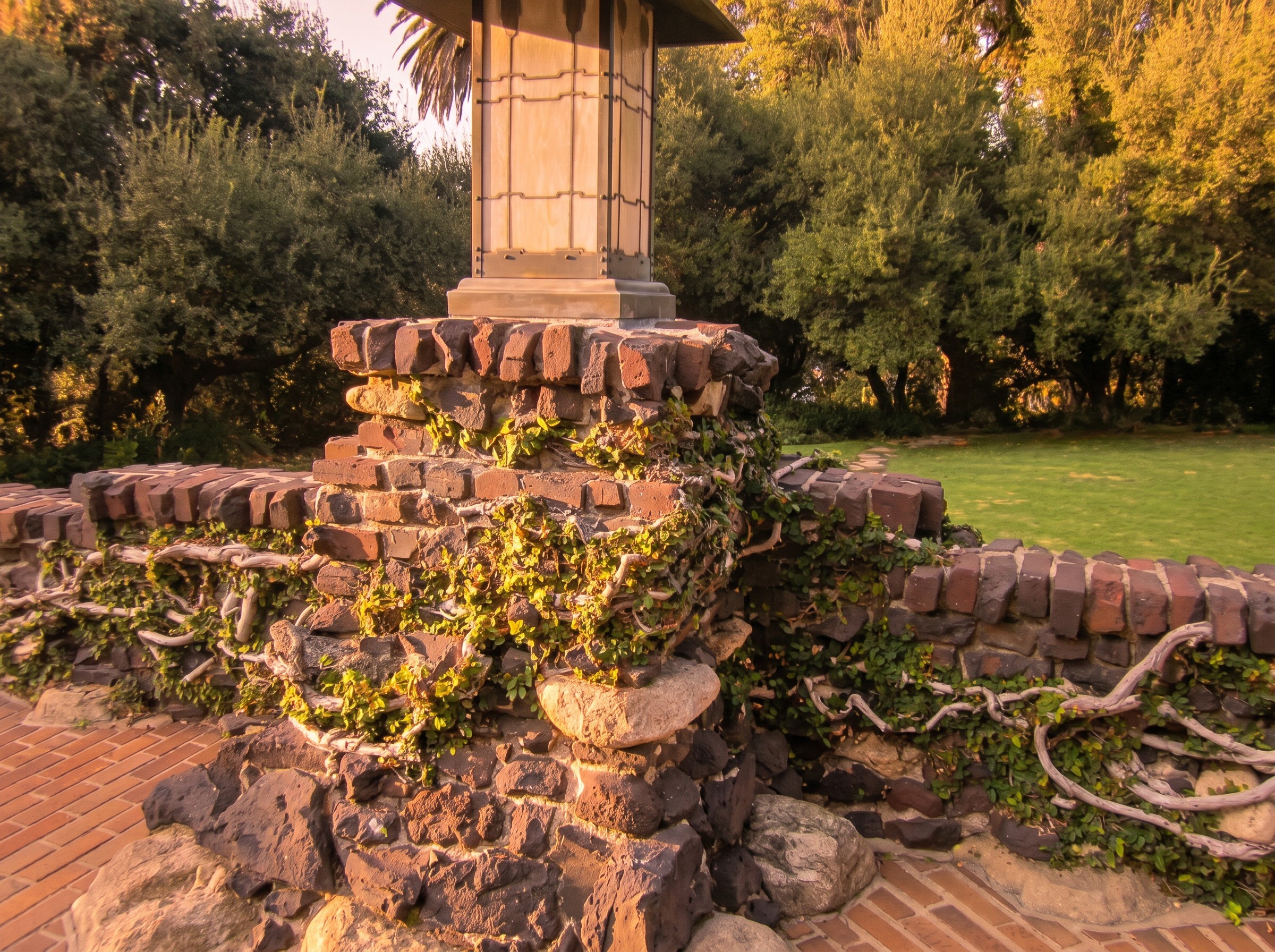
Stand at the northwest corner of the Gamble House, where the terrace meets the lawn, and look down rather than up. Everyone looks up at the Gamble House — at the great overhanging eaves, the sleeping porches, the rafter tails carved like the ends of sentences. Look down instead, at the few low courses of brick that carry the terrace and the foundation, and you are looking at something stranger than the famous roof. You are looking at a wall built, deliberately, out of failure.
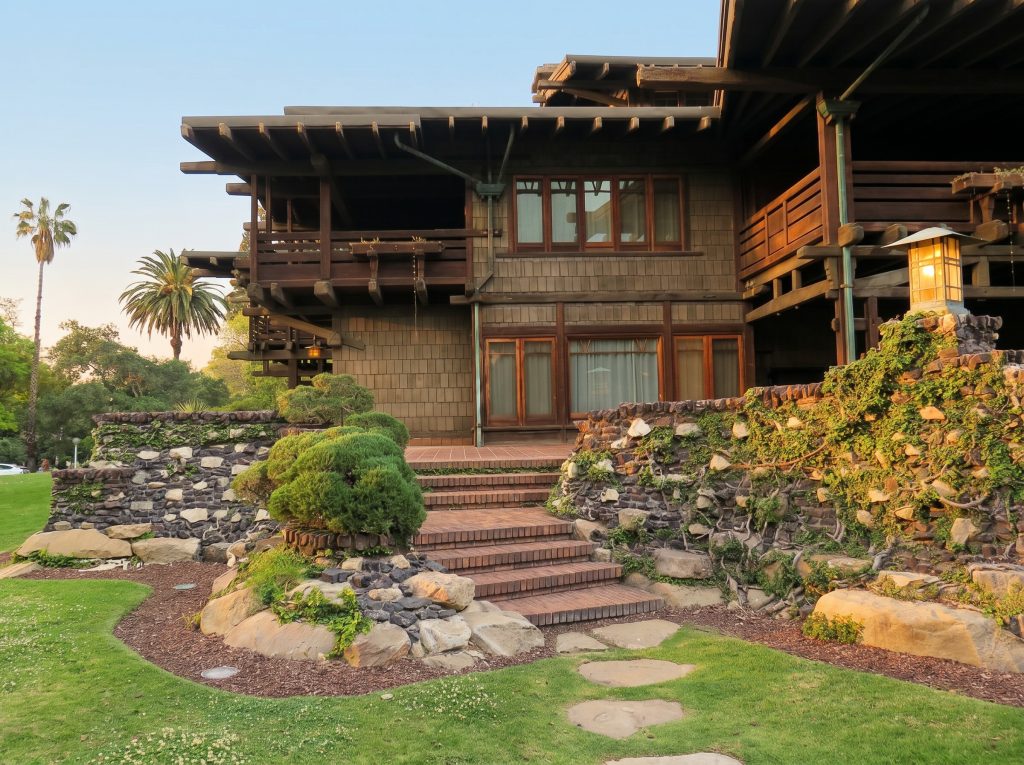
The brick is dark — oxblood, aubergine, the brown-black of a char. No two units are the same shape. Some have slumped and sagged out of true; some have blistered; some have fused bodily to their neighbors; some carry a glassy, almost wet-looking skin where the surface vitrified in the heat. These are clinker bricks, and by the standard of the brickyard that made them, every one of them is ruined.
A clinker is a brick that sat too close to the fire. In a wood- or coal-fired kiln the bricks nearest the firebox take far more heat than the maker intends. The clay slumps. The silica in it begins, at the edges, to turn to glass. The brick warps, darkens, swells, sometimes welds itself to whatever it is touching. The name is the sound the thing makes: a fully vitrified brick, struck, rings with a hard metallic clink instead of the dull, sound knock of a good one. For most of the long history of brickmaking, clinkers were simply the waste of the kiln — pulled out, thrown on a pile, sold off cheap for road fill and rough paving if they were sold at all. A brickyard measured its skill partly by how few of them it produced.
Then, in the years around the turn of the twentieth century, builders in Pasadena and across Arts and Crafts California began to walk the reject pile with a different eye. And no one looked harder at it, or built more beautifully out of what they found there, than Charles and Henry Greene.
It is worth correcting a small assumption here, because it is a common one. Clinker brick looks expensive, and people tend to assume it was — a specialty product, a costly order placed for effect. It was the opposite. The clinker pile was the cheap pile, the discard heap, the brick nobody wanted. What cost money at the Gamble House was never the brick. It was the eye that went through the heap and selected these particular ruined units, and the bricklayer’s slow patience in coursing up a wall whose every component is a different size and shape and refuses to lie down in a tidy row. The material was waste. The labor and the judgment were the luxury.
What the clinker has, that the good brick does not, is everything the good brick gives up in order to be good. A sound brick is uniform — that is its whole virtue and its whole limitation. The clinker is the uniform brick’s failure, and the failure is crowded with things the success never had. Color, first: the over-firing drives the iron in the clay through a range an ordinary brick never reaches — deep purple, bottle-green, slate, the blue-black of a banked fire, often three or four of these crossing a single brick. And form: every clinker is a separate event, a one-off record of exactly where it sat in the kiln and how the fire happened to reach it. A pallet of good brick is a thousand copies of one idea. A pile of clinkers is a thousand different accidents.
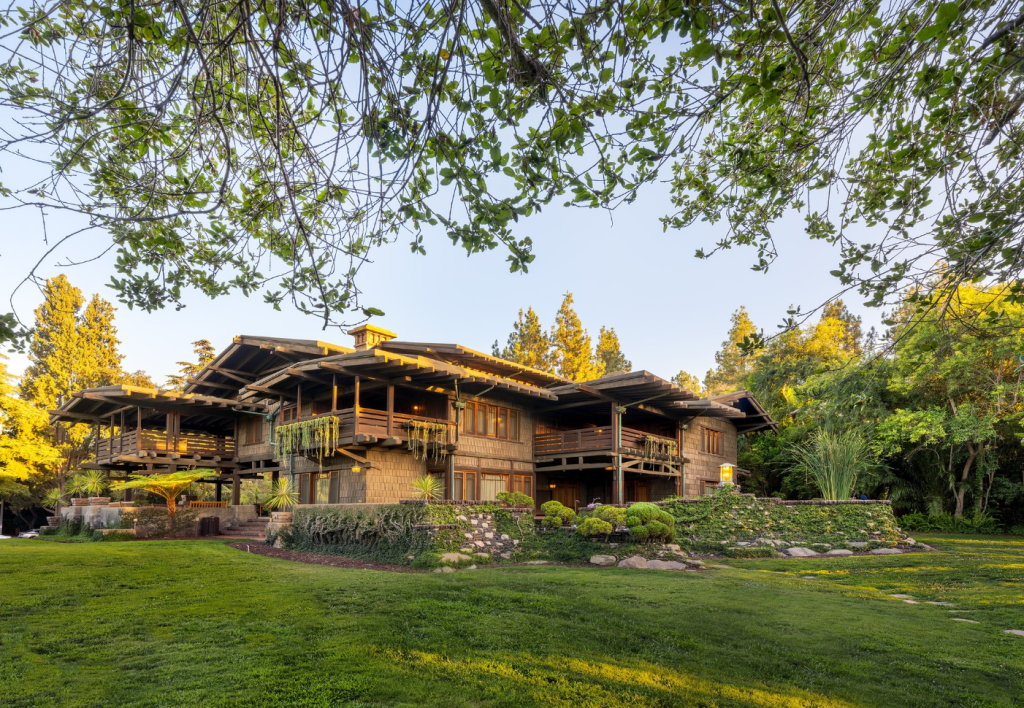
At the Gamble House the clinker is kept low. It builds the foundation, the terraces, the broad low garden walls, the piers of the porch — and it is allowed to be nothing but the base. The brothers very often laid it up together with smooth rounded boulders carried from the bed of the Arroyo Seco a short walk away: clinker brick and river stone in the same wall, two different kinds of roughness, the mortar pushed and oozing between them. That dark, irregular, earth-toned mass along the ground is the thing the pale and precise wooden house rises out of.
And that placement is the whole point. The clinker grounds the timber. It is the house’s handshake with the earth — the part of the building that looks as though it was not built so much as dug. The bungalow’s central argument is the honesty of its materials: show what a thing is, and show what it is doing. The clinker brick carries that argument somewhere nothing else in the house can follow it. The teak is honest about being fine teak. The clinker is honest about being a mistake. It does not disguise that it failed in the kiln. It sets the failure at the foundation of one of the most celebrated houses in America and asks it, plainly, to hold the weight.
It was not only the Gamble House. The brothers carried the clinker from commission to commission, the way a writer carries a word he trusts. It builds gate piers and garden walls at house after house — and it travels: the same rejected brick turns up, the same deliberate choice, hundreds of miles north at the Thorsen House in Berkeley, holding the gate.
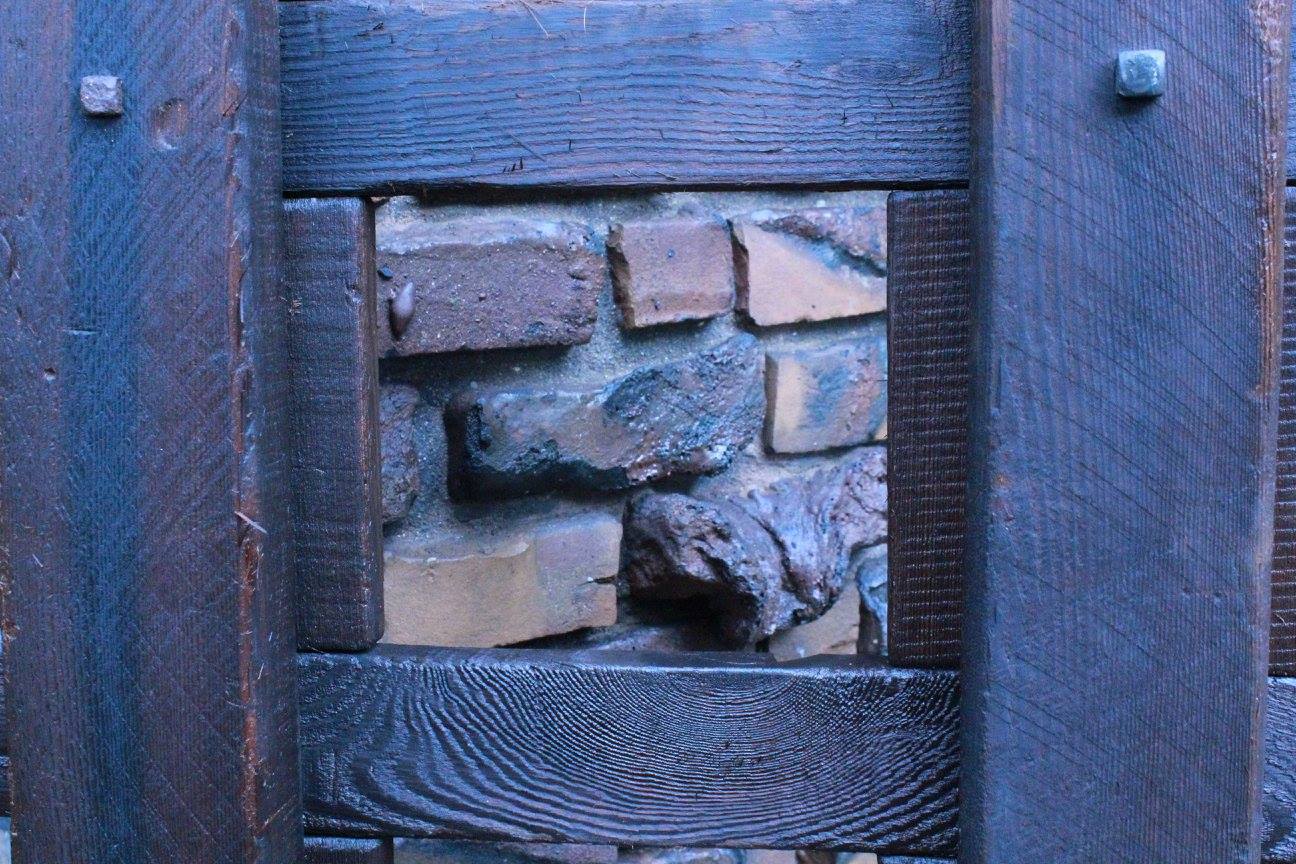
Held in the hand, a single clinker is the Arts and Crafts movement compressed into one fist-sized object. The machine age had sorted the world into two heaps: good, uniform, repeatable output on one side, and waste on the other, with the line between them sharp and final. The whole Arts and Crafts position was a refusal of that sorting — a defense of the knot in the board, the wobble in the hand-thrown pot, the irregular hand-cut joint, the evidence that a human being and not a machine had made the thing. The clinker brick is that refusal in fired clay. It is the kiln’s reject, gathered up, given a name, and set in the place of honor — the place that carries the house.
The clinker is a brick that failed at being a brick. The Greenes gathered the failures, set them at the bottom of the wall, and asked them to hold everything up. A century later, they still do.
It is worth looking down.
For more on the brothers’ insistence that a material be shown for what it is, see The Joint is the Ornament. For the clinker brick at work higher up the house, see The Stack That Anchors the Roof.