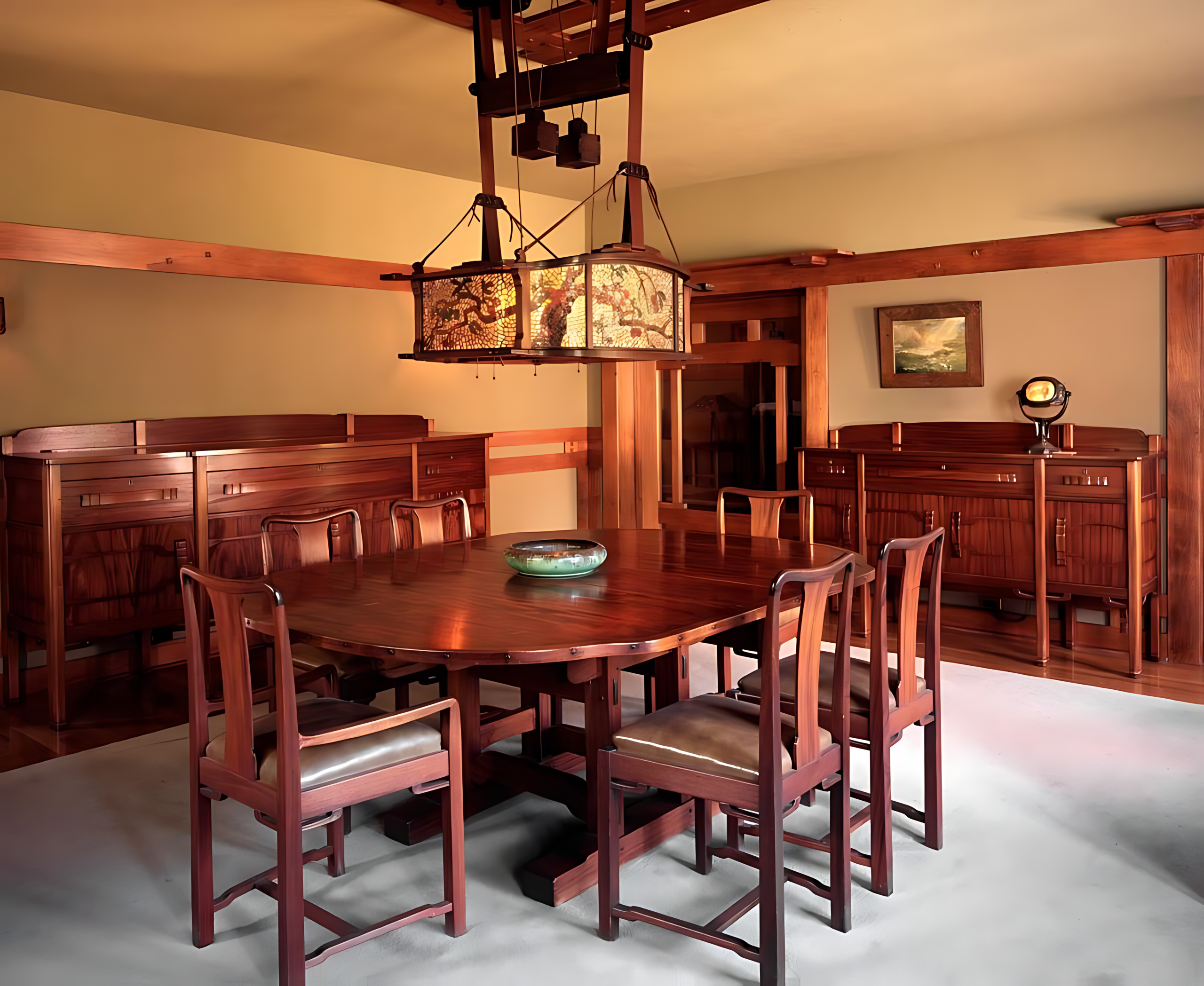
Walk into the Dorothy Collins Brown Wing of the Scott Gallery at the Huntington, in San Marino, and you can step into a Greene & Greene dining room. The table is there, long and low, its surface the warm red-brown of mahogany rubbed to a soft, deep sheen. Two sideboards stand against the walls. The chairs are drawn up, tall-backed, their joints pegged and exact. A leaded-glass chandelier hangs above the table and throws the kind of low, even light it was built to throw. The label tells you that you are standing in the dining room of the Robinson House.
You are, and you are not. The distinction is the whole of this note, and it is worth getting exactly right.
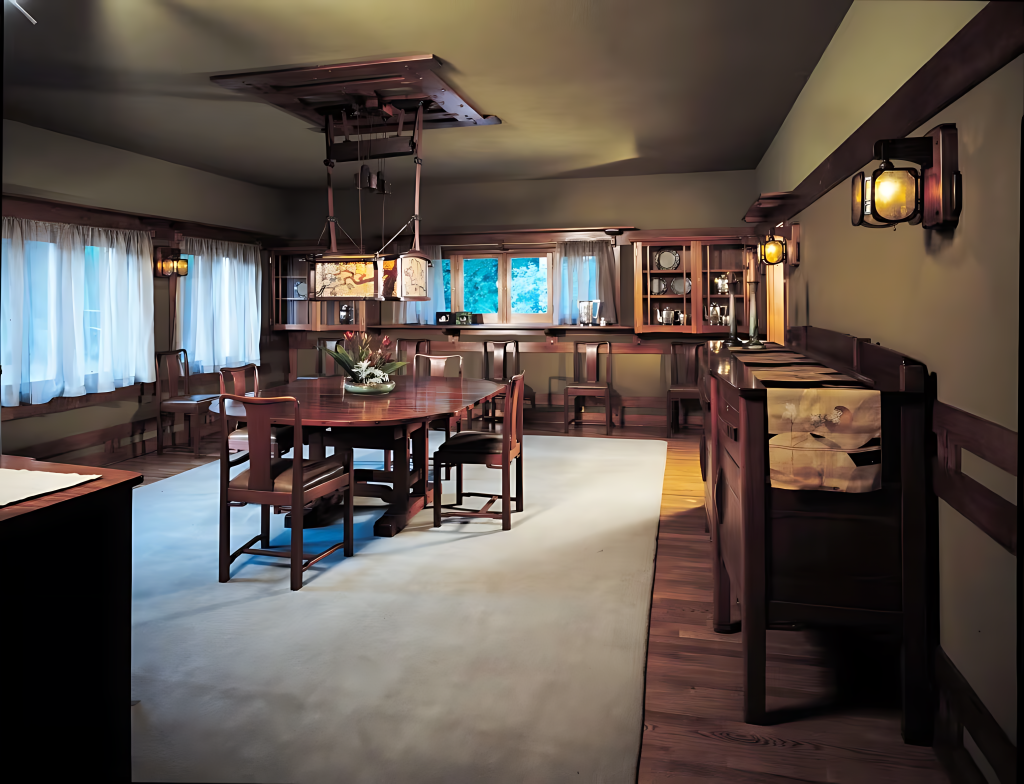
The furniture is real. Every piece of it is the original suite, designed by Charles and Henry Greene and built in 1906 for the Pasadena house of Mrs. Laurabelle A. Robinson — the table, the chairs, the two sideboards, the chandelier overhead. The room around the furniture is not real, or not original. It is a recreation, a space the Huntington built decades later to hold the suite in something close to its first setting. The walls you stand between were never in Pasadena. The proportions are studied from the record, not salvaged from the house. The room is the museum’s; the furniture is the Greenes’. To walk in and feel that you are inside the Robinson dining room is to be told a careful, half-true thing, and the half that is false is the room itself.
This matters more than a museum technicality, because of what the suite was when it was new. The Robinson dining room was the first fully realized collaboration between the brothers and the cabinetmakers Peter and John Hall — the partnership of one pair of brothers with another that would go on to produce the great interiors of the Gamble and Blacker houses. This was the beginning of it. The table, chairs, and sideboards in that Huntington room are not just early Greene & Greene furniture; they are the first place the brothers’ drawings met the Halls’ hands at full strength. The hand that would shape the brothers’ finest joinery is already visible in the pegs and the rubbed surfaces. An origin, sitting in a gallery, looking like an end.
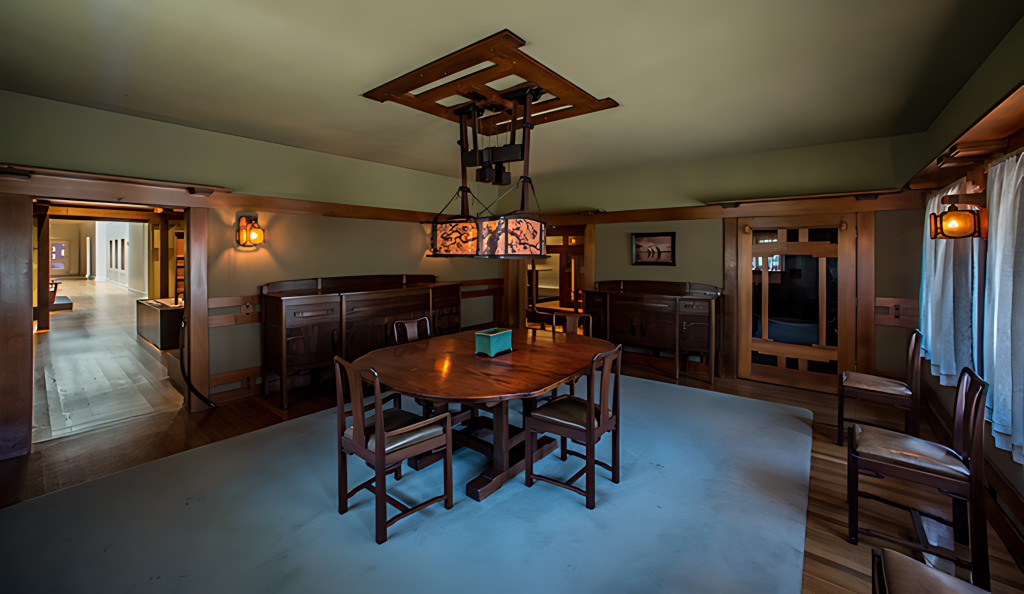
The path the furniture took to get to that gallery is its own quiet history of how Greene & Greene survives at all. The suite left the Robinson House and came to the Huntington, where for a stretch of the mid-century it served, of all things, as furniture in the trustees’ dining room — used, sat at, eaten on, an original Greene & Greene suite doing the daily work of ordinary furniture. Only later, perhaps half a century after the pieces were made, did the institution build a recreation of the original room around them and put the ensemble on public view, where it has stood in the Scott Gallery for more than thirty years now. The suite was orphaned, then used, then finally given a room again.
That arc is familiar to anyone who has followed where the brothers’ work went after the houses passed out of the first families’ hands. Furniture was sold off, separated, scattered to museums and collectors; whole interiors were broken up and dispersed. The record of the brothers’ practice was itself scattered and slowly gathered back, and the furniture followed the same pattern of loss and partial recovery. The Robinson dining suite is one of the recoveries. It is intact, it is together, and it is on view. The cost of that recovery is the small, honest fiction of the walls.
What the Greenes believed makes the fiction worth examining rather than ignoring. They did not design furniture and then a room to put it in. They designed the room and the furniture as one act — the suite conceived for that space, the space conceived around that suite, the chandelier sized to that table, the sideboards placed for those walls. The leaded glass of the dining-room fixtures answered the leaded glass elsewhere in the house, the way the lantern at the Robinson stair answered the rooms around it. To separate the furniture from the room, as happened when the suite became anonymous trustees’ furniture, was to break a single work in half and keep only one piece.
The recreation is an attempt to mend that break — to give the half that survived its missing half back, in replica. And the thing to admire about it is that it does not lie. It does not pretend the walls are old. It does not dress the reconstruction up as salvage. It admits, in its labels and in its very existence, that the room is new and the furniture is original. That admission is itself deeply in keeping with the brothers, who built their whole reputation on refusing to disguise what a thing was made of or how it was made. A recreation that announces itself as a recreation is, in a strange way, the most Greene & Greene thing a museum could have built around their work.
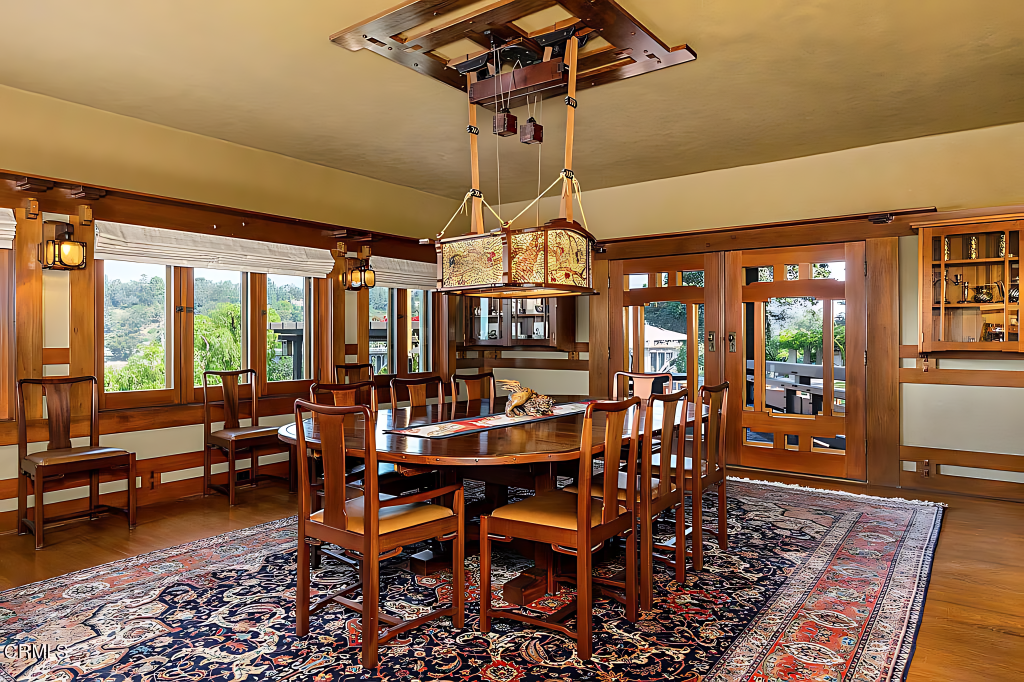
So stand in the room and read it correctly. The table, the chairs, the sideboards, the chandelier: 1906, the real thing, the first sentence of a long conversation between the brothers and the Halls. The walls: a careful reconstruction, honest about being one. The gap between the two is the exact measure of what was lost when the house was emptied and what was saved when the suite was kept together. The furniture survived. Its room did not. The Huntington gave it a room back, and told the truth about having done so.
The suite is real. The room is a faithful copy. The honesty about which is which is the most authentic thing in the gallery.