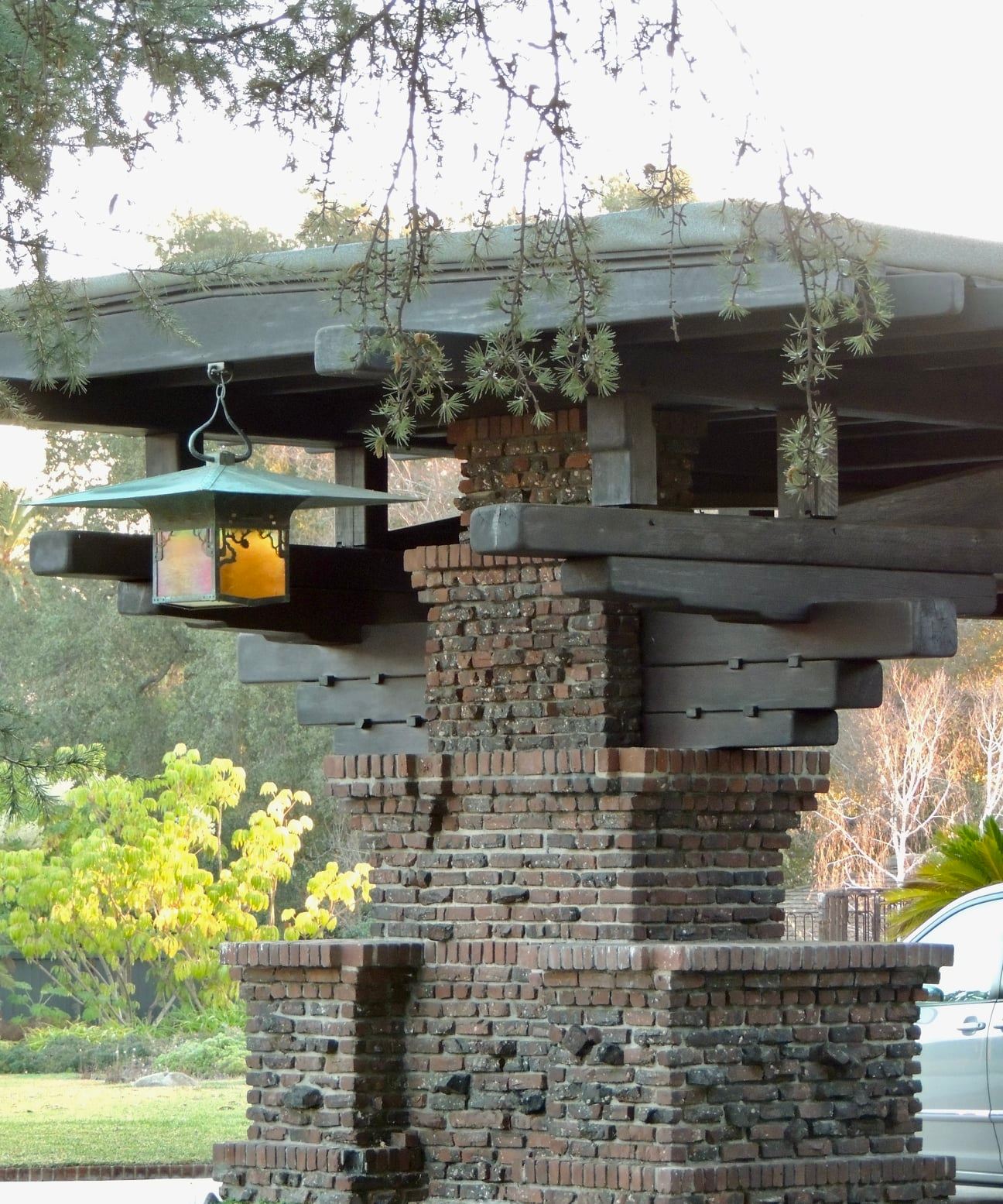
The first thing a guest at the Robert R. Blacker House ever saw was not the front door. It was a lantern. Carriages and, later, automobiles arrived under the porte-cochère — the roofed extension that reached out over the driveway from the side of the house — and there, hung at the prow of that projecting roof, where it stretched farthest out over the lawn, was a single great light. It was the most prominent fixture on the most prominent part of the building. Before you crossed any threshold, before you saw the entrance hall or the lily pond or the pergola, you passed beneath this lantern. It was the house clearing its throat.

It deserved the position. The lantern is four feet on each side — not a fixture so much as a small architecture of its own, a cube of patinated metal and iridescent glass large enough to read as a room rather than a lamp. Charles Greene treated it as a piece of the building, not an accessory hung onto it. Its frame is green-patinated metal, the openwork pierced and bracketed at the corners; its glass is the milky, shifting, iridescent kind the brothers favored over clear panes, so that even unlit it holds color. The whole thing was built to the scale of the porte-cochère it hung from, which is to say to the scale of arrival.
The decoration is the part worth slowing down for. The principal motif is a vine — a climbing, curling plant form that rises up the faces of the lantern and gathers into the bracketed corners where the metal turns. It is not a random ornament. The same vine runs in the leaded art glass of the Blacker House front doors, a few steps away beyond the entrance hall. Greene drew the two together on purpose. The lantern at the driveway and the glass at the door are speaking the same sentence; the motif you meet first, in metal and colored glass over the carriage, you meet again, in leaded glass, at the moment you are admitted. The house rhymes with itself, and the lantern is the opening line of the rhyme.
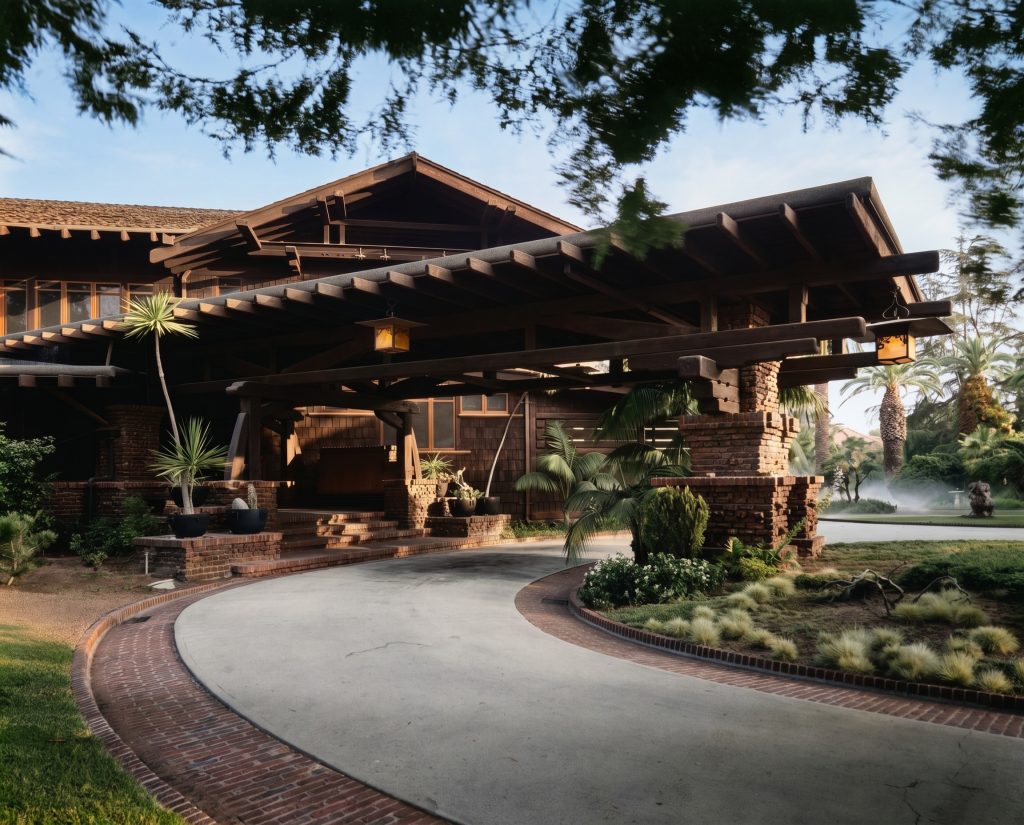
This is the deeper logic of the lantern, and of the brothers’ lighting generally. A Greene & Greene fixture is rarely just a source of light. It is a way of telling you where you are standing. The porte-cochère lantern marks a threshold — the edge between the public world of the street and the private world of the house — exactly the way the roofed gate at another of their houses marked the edge of a garden. Light, for the brothers, was a kind of punctuation in the experience of moving through a building. The biggest lamp went where the most important crossing happened, and at the Blacker House the most important crossing happened under the porte-cochère, in the moment of getting down from the carriage and becoming a guest.
The mounting mattered as much as the light. The porte-cochère at the Blacker House does not simply project; it comes to a point, a low timber prow reaching out over the driveway and onto the front lawn, its broad pagoda-like roof carried on heavy exposed brackets. The brothers loved this gesture — the roof that floats forward and tapers, the structure that visibly does its own work — and they put their largest exterior lantern at the very tip of it, where the timber reaches farthest from the house. The effect was to make the light the head of the prow. The whole long arm of the porte-cochère pointed at it. You did not happen upon the lantern; the architecture aimed you at it, then set you down directly beneath it. Few fixtures in American architecture have ever been given a better entrance than the one the Blacker House gave its own front light.
Which makes what happened to it the bitter joke of the whole object. The most public fixture on the house turned out to be the most portable. The Blacker House passed out of the Blacker family in 1944, after Nellie Blacker’s death, and through a series of later owners. In 1985 a new owner stripped the house of its fixtures and sold them off — the lanterns, the art glass, the hardware, the integrated soul of the place — in the most notorious dismantling in the brothers’ history, a story told in full elsewhere on this site. The porte-cochère lantern came down from its prow and began a second life as a collectible. It moved into a private Texas collection from 1985 to 1995, passed through the New York dealers Cathers & Dembrosky around 1995, was acquired by another collector in 1999, and surfaced again in 2022 in a Sotheby’s “Important Design” sale, catalogued as a unique and monumental object — which it is.
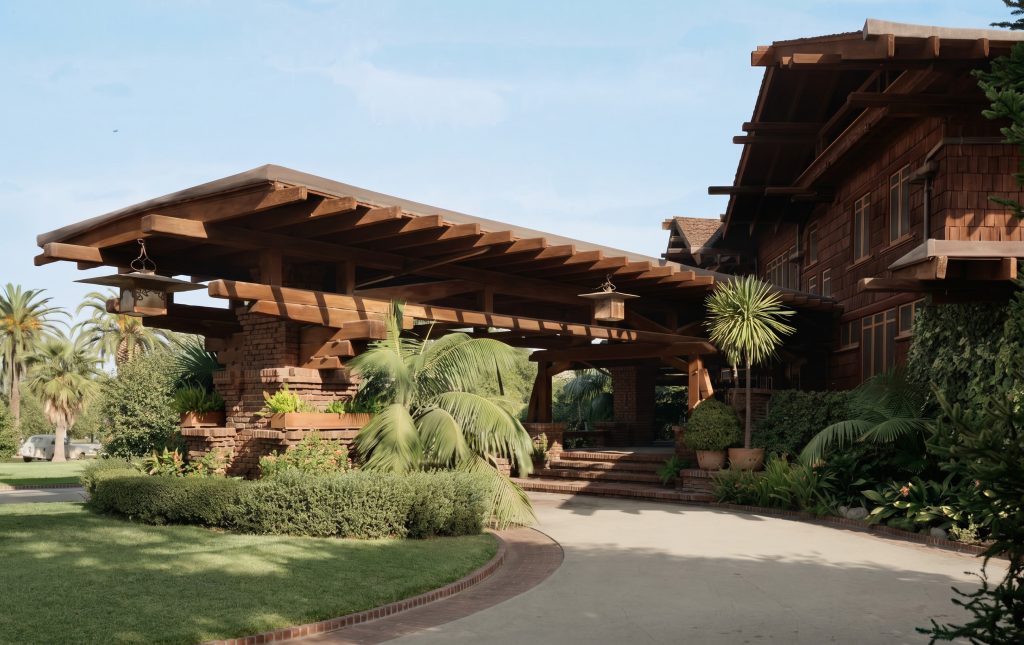
To call it a unique and monumental object is true, and it is also exactly the problem. The lantern was never meant to be an object. It was meant to be a fixed point in an experience — the light you passed under to enter a specific house, rhyming with a specific door, hung at the end of a specific timber roof over a specific patch of Pasadena driveway. Detached from all of that and lit in an auction room, it becomes a magnificent orphan: four feet of patinated metal and iridescent glass that can be admired from every side and means a fraction of what it meant when you could only meet it from below, in motion, on your way in. The vine still climbs. It just no longer climbs toward anything.
That is the thing to hold onto about the brothers’ work, and the porte-cochère lantern holds it as well as any single piece they made. Their genius was never in the individual object. It was in the relationships between objects — the way a lantern answered a door, the way a threshold was lit, the way arrival was staged. Take any one piece out of the composition and you can sell it for a great deal of money. You simply cannot put it back. The lantern at the prow was the first word of a sentence the Blacker House spent thirty rooms completing. Someone, for a price, now owns the word.