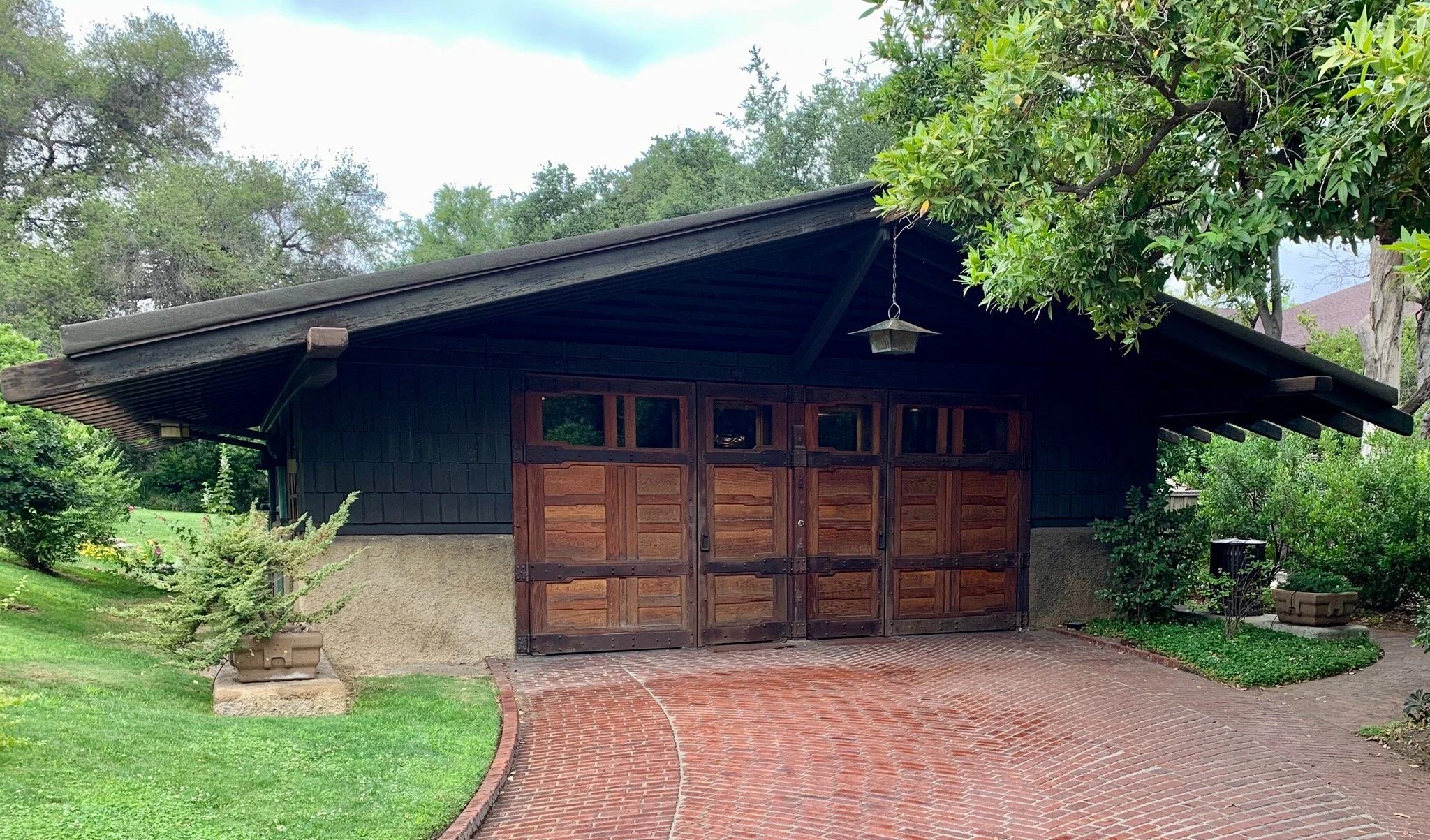
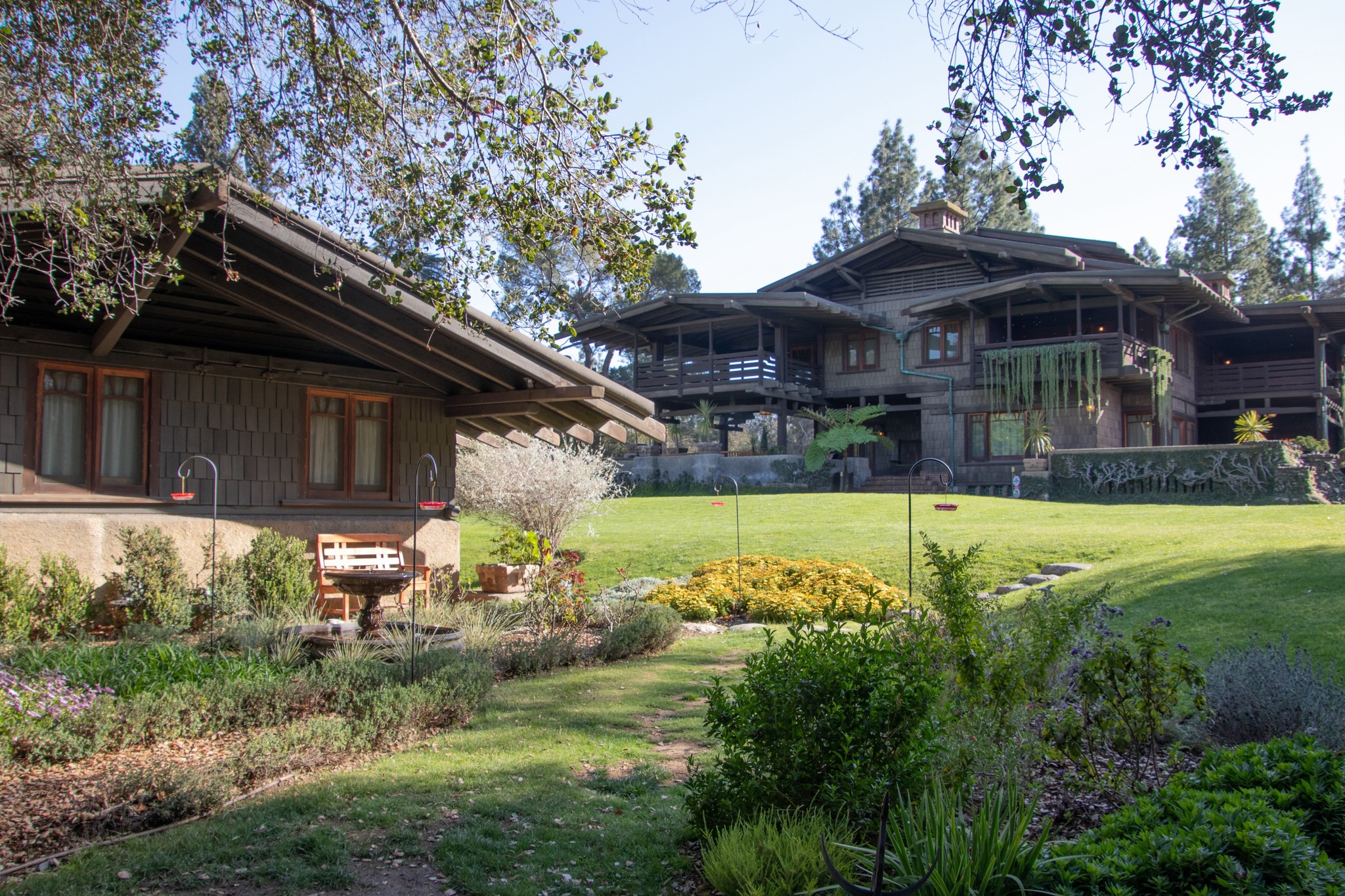
Walk past the Gamble House, around the north side, and follow the brick paving toward the rose garden. The building waiting there is a garage, and it does not apologize for it. Same shingles as the house, dipped in the same stain. Same broad roof floating on exposed timber, the rafters running out past the wall to their shaped ends. And across its face, a bank of wooden doors — frame-and-panel below, a row of glazed lights above, hung on long dark strap hinges — built with the kind of attention most architects of 1908 reserved for a front entry, if they used it anywhere at all.
That is the joke, if you want it to be one. This house famously has a front door worth a workman’s annual wages, a door the clients spent on as a matter of principle. Then you come around back and find that the service building got doors with the same bones: proper rails and stiles, real panels, glass set high to let daylight into the work bay, ironwork sized to the timber it moves. The Greenes did not have a front-of-house voice and a back-of-house voice. The garage is on the tour of the argument whether the visitor knows it or not.
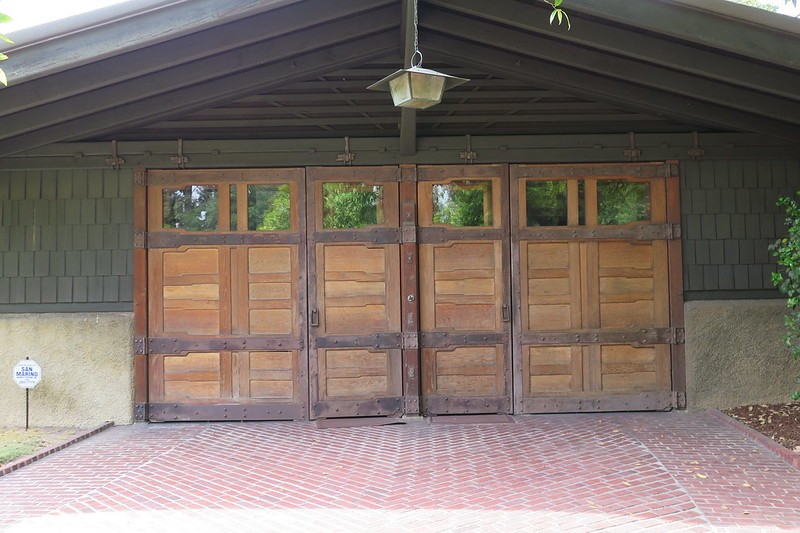
What stood behind those doors is the better story. We tend to imagine every early garage sheltering some snorting brass-radiator machine, but the Gambles drove electric. In 1909, itemizing his assets, David Gamble listed one “Electric” — an electric automobile, parked here within months of the family moving in. By 1912 Mary Gamble was writing about the “new” electric coming in January, a Rauch and Lang, the Cleveland-built brougham that steered with a tiller like a small boat and moved in near silence on its cache of batteries. David wanted the model that seated three across the back, and waited for it. The record of all this survives in the family’s own papers, summarized in an account on the Gamble House’s site.
So the picture to hold in your head is this: Pasadena, before the First World War, and behind these wooden doors a battery-powered car sits charging overnight. A household running on an electric vehicle, garaged in a building of hand-shaped timber. We think of that pairing as a collision of centuries. In 1912 it was simply Tuesday.
The electrics were favored by women drivers, the histories say, being clean, quiet, and free of the crank handle that broke wrists on gasoline cars — which is a period way of saying they were better machines for actually living with. Mary Gamble kept hers for a decade. When the family finally let it go, in the summer of 1922, she wrote a sentence that deserves to outlive every horsepower figure of the era: “We sent off the little old electric yesterday and only shabbiness reconciled us to its departure.” Affection, thrift, and a little embarrassment, in eighteen words. The Gambles kept things until keeping them stopped making sense — the house itself would later be saved by exactly that instinct.
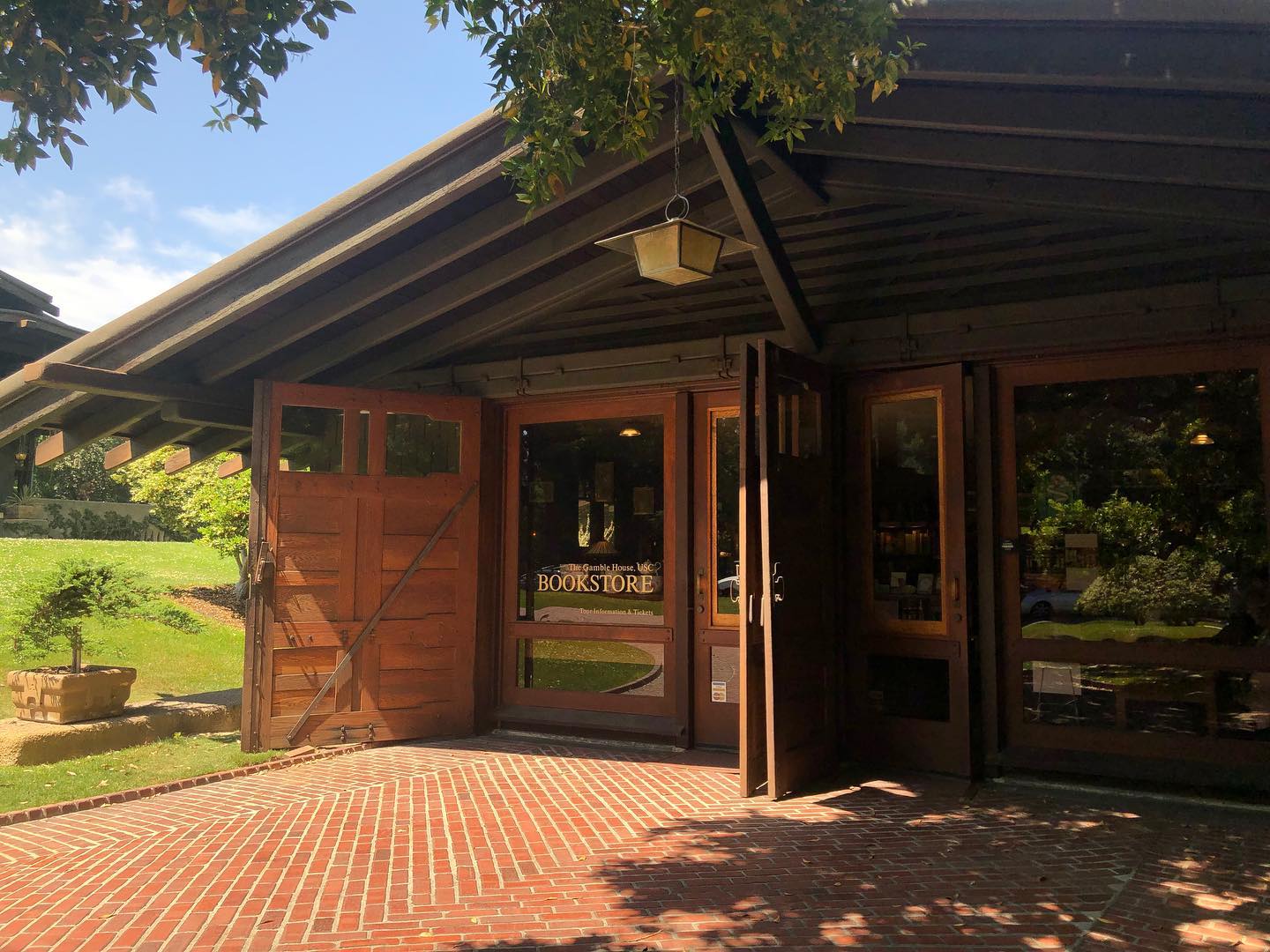
The building never stopped earning its keep. After the house passed to the city and USC in 1966, the garage became the shop and, for years, shared its bay with the Greene & Greene Library — bookstore on the right, archives on the left, a partition between them, and a table from the Robinson House doing duty as retail furniture until the collection moved to the Huntington. Today it is the Gamble House bookstore outright, and on open days the doors stand folded back on their hinges, doing exactly what they were designed to do in 1908: open the whole face of the building to the drive. Stand there long enough and you notice visitors photographing the doors themselves, not the books. The service building has admirers. The Greenes would not have been surprised; they were the ones who decided it deserved them.
Notice, before you leave, what makes the elevation work, because none of it is exotic. The doors read as one continuous composition, not a row of separate holes: the band of glazing runs unbroken across the top, the panel lines carry through from leaf to leaf, and the dark straps of the hinges repeat at an even rhythm like beats in a bar. The glass is high, where light is useful and privacy is cheap. And the whole assembly sits under a deep eave that shades it, sheds rain past it, and makes the doors read as furniture inside a sheltered opening rather than as weather-wall. Proportion, rhythm, shelter. That is the entire recipe.
Which is why this detail, of all the details on the property, is one a modern builder can honestly have. Nobody is reproducing the Gamble entry door for a subdivision. But a garage door is a purchase every homeowner eventually makes, and the market’s default — a ribbed steel curtain with plastic hardware glued on — is the exact opposite of everything this elevation teaches. The honest route is a true carriage-style door: frame-and-panel construction in a clear vertical-grain softwood such as Douglas fir, or a stable mahogany-family hardwood like sapele, with flat panels rather than raised colonial ones, and the glazing confined to a single row of lights across the top. Several shops build such doors as outswing pairs, the historically true form; the practical compromise most households land on is a sectional door faced to look like one, which preserves the composition if the panel lines and glass band are kept continuous across the full width.
Two warnings from the original. First, hardware: the Gamble straps are long, dark, and real — they carry the door. If your door is sectional and the straps are decorative, choose plain black steel of honest thickness, mount it where a working hinge would actually sit, and stop there; a bolted-on fake clavos-and-scrollwork kit announces itself instantly. Second, finish: nothing on this garage shines. A penetrating exterior oil or a matte film finish in the deep brown-green range keeps the wood looking dipped rather than dressed, and it will ask for a maintenance coat every few years — the price of wood that looks like wood. Set the whole thing under the deepest eave or trellis the site allows, both for the shadow line and for the finish’s sake.
The Gambles kept a battery car behind these doors more than a century before the rest of the country got around to it. Build yours right, and the charger inside will be the second most modern thing about the building.