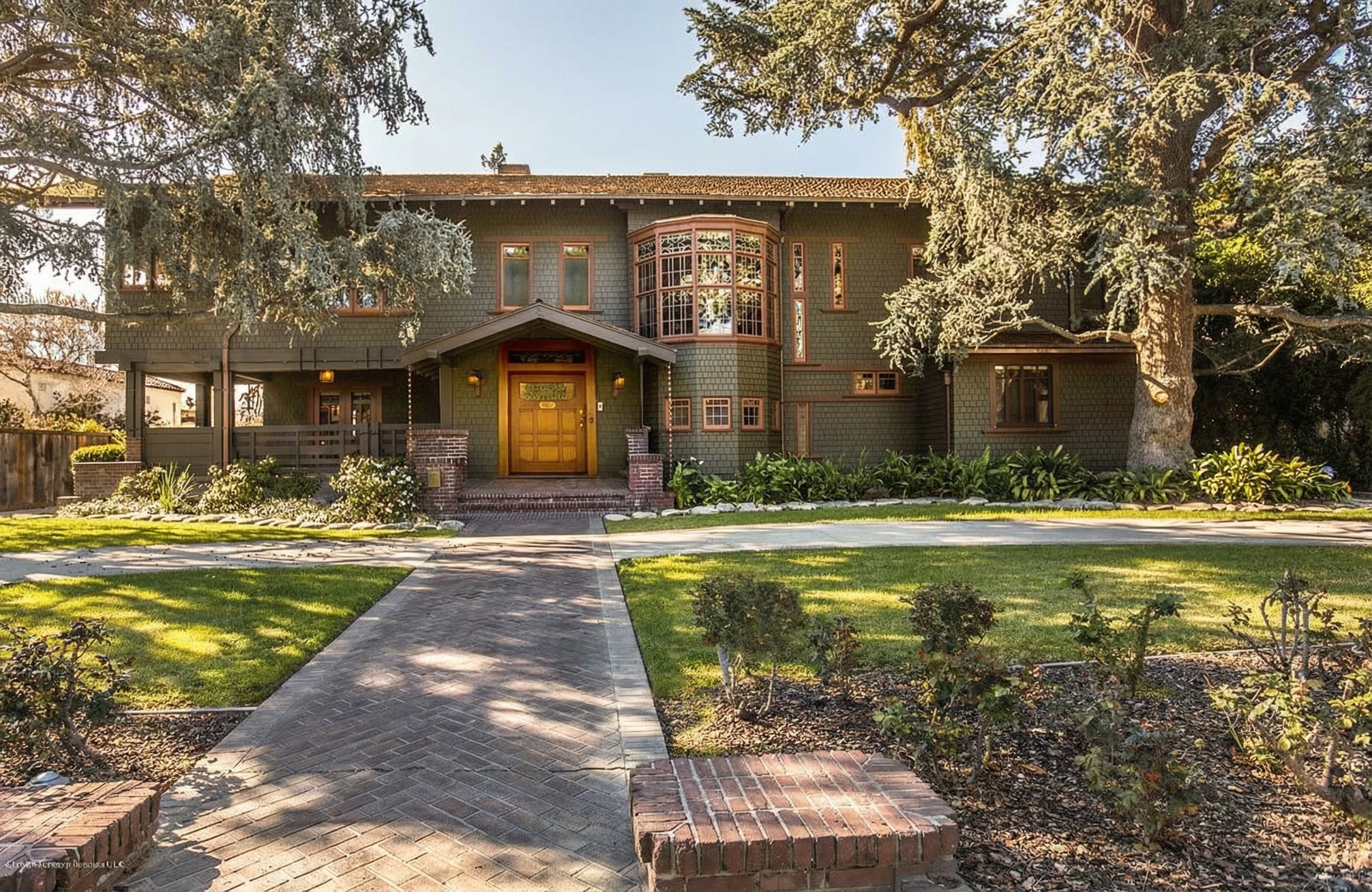
The most photographed feature of the Dr. W. T. Bolton House at 370 West Del Mar Boulevard in Pasadena is the projecting window on the north elevation — the five-panel oriel above the stair, with its little hipped roof and its leaded glass and its slight, deliberate forward tilt over the entry walk. Most people who post the photograph caption it Greene & Greene. Most realtors who list the house lead with it. It is the image the house is now known by.
It is not Greene & Greene.

The Bolton House was completed in 1906. It was the third commission Dr. William T. Bolton and his wife Alice gave the brothers — the first in 1900, the second in 1902, and the third the substantial Del Mar house, intended to be the family’s principal residence. Bolton did not live to occupy it. He died before move-in, and Alice took the house alone, and lived in it without him for eleven years.
In 1917 she sold the house to the Culbertson sisters — Cordelia, Margaret, and Kate — three unmarried siblings of independent means who had commissioned the brothers in 1911 to design a much larger and more elaborate house in the Oak Knoll neighborhood half a mile to the east. The 1911 house, the Cordelia A. Culbertson House, was by then nearly seven years old and already inadequate for them; the maintenance and staff requirements of the Oak Knoll commission, which had escalated during construction into one of the most demanding houses the brothers ever built, were apparently more than they had wanted. The Bolton House, a few blocks away and considerably more modest, became their new residence.
But they wanted alterations.
The sisters did not return to the brothers for the work. The Greene & Greene partnership, by 1917, was effectively over. Charles had moved north to Carmel in 1916. Henry was still in Pasadena but designing alone, and the firm as a unified practice had dissolved. The Culbertsons hired instead Garrett Van Pelt — who had been the brothers’ draftsman, who had drawn measured drawings of their houses, and who had set up his own Pasadena practice. Van Pelt knew their vocabulary. He had drawn it. He could approximate it on his own terms.
The principal alteration was the window.
In the original 1906 design, the north elevation of the Bolton House — the stair side, facing the front walk — had a rectangular bumpout housing the stair hall windows. The bumpout was square and modest and consistent with the Pasadena bungalow vocabulary the brothers had been working in for a decade. It was not a feature. It was a wall plane with windows in it. The 1906 photographs show this clearly: a flat north face, a rectilinear projection, ordinary fenestration.

Van Pelt replaced it. The square bumpout was demolished and a five-panel oriel was built in its place — a softly curved, leaded-glass window cantilevering slightly outward, with its own hipped roof and its own decorative bracket. The new feature read as more elaborate, more romantic, more visibly stylized than what the brothers had built. It was also, in the architectural press of the period, more fashionable; oriels were having a small Pasadena moment. Van Pelt was working in the vocabulary he had learned from the brothers but in a direction the brothers had not chosen.
The Culbertsons appear to have approved. Alice Bolton, who had lived in the house unaltered for a decade, no longer lived there.
For nearly a century after the alteration, the oriel was treated by photographers and historians as part of the original design. The Bolton House restoration of the 1980s, undertaken by Kenneth Ross and the architect Tim Anderson, preserved the oriel as it stood. The decision was reasonable: the window was by then more than sixty years old, its leaded glass was hand-set, and the alternative — reconstructing the 1906 bumpout from the period photographs — would have required removing a craftsman-era feature in order to install a different craftsman-era feature, with no obvious gain in authenticity. The oriel stayed. It is what the house has.
But it is not what the brothers built.
The standard surveys of the firm’s work — the Edward Bosley volume, the Bruce Smith Greene and Greene Masterworks, the Randell Makinson catalogs — note the alteration, but the note tends to be brief. The Wikipedia entry for the Bolton House records it. The Greene & Greene Virtual Archive at USC retains a separate folder labeled Alterations for the Bolton House, distinct from the original drawings. The information is available. It is simply not what most visitors carry with them.
The reason it matters is small but specific. The brothers, in 1906, were already on the trajectory that would produce the Robinson House later that year and the Blacker, Gamble, Pratt, Thorsen, and Ford houses over the next five. Their vocabulary was developing rapidly. The Bolton House sits at a particular point in that development: confident, restrained, materially honest, but not yet ornamental. The original 1906 north elevation reflected this restraint. The oriel reads as a different sensibility — slightly later, slightly more decorative, working within the brothers’ grammar but not from their hand.
To attribute the oriel to the brothers is to attribute to them a slightly more ornamental sensibility than they had in 1906. It is a small misreading. But the work of understanding the brothers’ development depends on small distinctions, and this one, like the question of which pieces of furniture were actually built by the Halls and which by earlier contractors, is worth getting right.
The window is beautiful. It is also Van Pelt’s. Both things are true.
What the Bolton House offers, when looked at carefully, is a record of three hands. The brothers, in 1906, built a restrained Pasadena house at the moment their practice was maturing. Van Pelt, in 1917, modified it for the Culbertsons in a vocabulary derived from but distinct from theirs. Ross and Anderson, in the 1980s, restored what they found, including what was not original. The oriel above the stair belongs to the second hand, not the first.
It is the window the second hand made, in the language the first hand had taught.