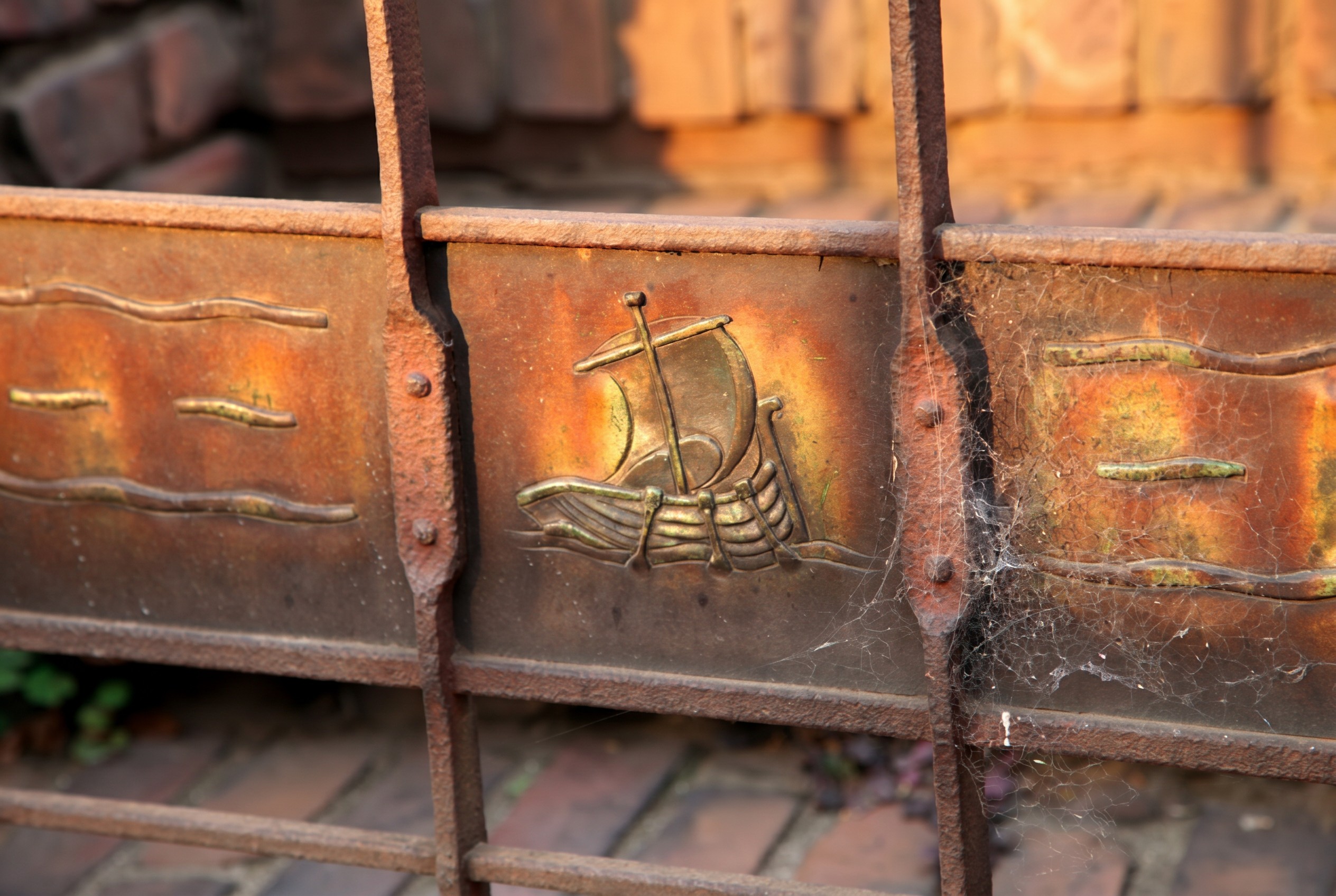
The wrought-iron entrance gate at the William R. Thorsen House in Berkeley does what the rest of the Thorsen will not do publicly. The house’s body speaks in the brothers’ usual idiom: Burma teak, clinker brick, leaded grape-glass after Emil Lange, cloud-lift transoms over the bay window, joinery left visible at the joints. The Norwegian heritage of the client is present inside — a fully rigged sailing vessel in a leaded-glass panel, repeated nautical motifs in the living-room and dining-room friezes — but those are private references, available only to a visitor who has already crossed the threshold. The street-facing argument, the heraldic one, is reserved for the gate.
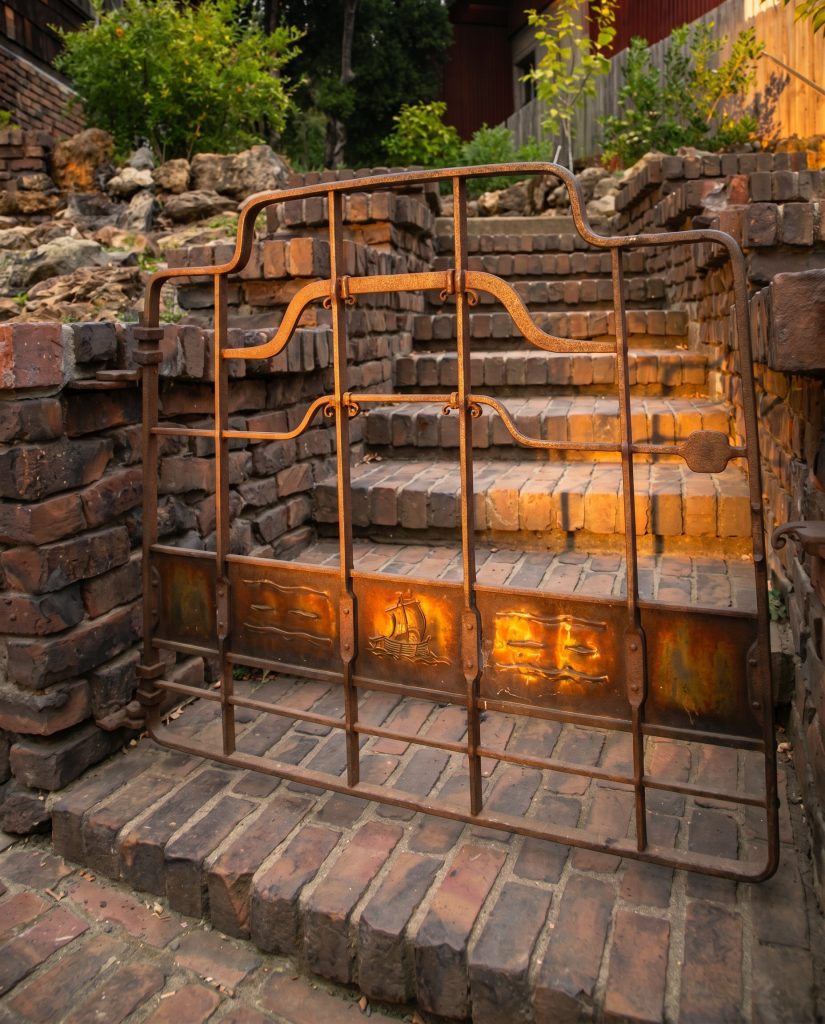
Approach the house from Piedmont Avenue. You climb the clinker-brick stairs at the corner. Before you reach the front door you pass through a wrought-iron arch — vertical bars in a rhythm that is also a pattern, the bars hand-bent at the joins, a hanging lantern at the apex of the arch — and built into the field of bars, just at eye level, is a single repoussé panel. A small longship under full sail. A Viking ship. The only piece of explicit ethnic-heritage symbolism the brothers ever set in iron.
The motif belongs to the client. William Randolph Thorsen (1860–1942) was the son of John Thorsen, a Norwegian immigrant who had partnered with John Canfield to incorporate the Stronach Lumber Company in Manistee, Michigan, in 1872 — the fortune that would eventually pay for William’s Berkeley house. The Norwegian line was not distant family. It was a generation back. William’s father had grown up on a coast where ships were the visible mark of his country, and the sea was the visible mark of the place he had come from. William carried that fact into his own house, and the brothers — by 1909 confident enough in their idiom to make a small exception within it — agreed to let the heritage stand at the gate.
The Greenes did not typically do this. Their syncretism — Japanese tea-house overhangs, Chinese cloud-lifts, Arts-and-Crafts joinery from England, vernacular timber from the American West — works by sublimation. The references are absorbed into a shared language that holds for every client. Charles Greene’s design vocabulary at the Gamble House does not say anything specific about the Gambles’ family origin in Cincinnati Procter & Gamble. The Blacker House does not say anything specific about Robert Blacker’s career in Michigan timber. The Pratt House does not announce that Charles Pratt was a Standard Oil heir. The houses are interpretations of who the brothers were as architects, not who the clients were as people. The interior carries the family as a private guest. The exterior speaks the public idiom of the firm.

The Thorsen gate is the exception. It is not a sublimation of the Norwegian heritage into a universal language — a longship abstracted into a cloud-lift, say, or a sea horizon worked into the rhythm of the rafters. It is, instead, a literal heraldic device: a ship in a panel, framed by a field of iron, set at the entrance, naming the lineage of the man who paid for the house. It is closer to a coat of arms than to anything else the brothers ever made.
A few things are worth saying about why it works.
First, the medium. The gate is iron, not wood. The brothers were not blacksmiths. They almost certainly did not draft the gate themselves; ironwork at this scale would have been subcontracted to a specialist firm. The Greenes signed off on the design, and they integrated it into the brick piers that frame the entrance — clinker brick, irregularly fired, the same vocabulary as the chimneys and retaining walls. But the act of forging is at one remove from the act of cabinetmaking that defines the rest of the house. Iron, in the Greenes’ work, is the medium of attachment, the medium of hinges and straps and the rare external bracket. It is not the medium in which they speak their own architectural voice. So when an iron panel carries a representational image, the panel is reading as a sign — a thing affixed, not a thing structural. The Viking ship is allowed its literalness because it is not in wood. Wood would have asked the brothers to subsume the motif into joinery. Iron leaves it free.
Second, the placement. The longship is at the gate, not at the door. The gate is where one crosses from the public street onto the private property; the door is where one crosses from outdoor to indoor. The brothers’ more characteristic gesture — the leaded-glass tree in the door, the carved Burmese teak of the entry hall — is reserved for that second threshold. The gate is the first, more public, less interior boundary. It is where the Greenes evidently felt a representational image could live without crowding the architecture inside.
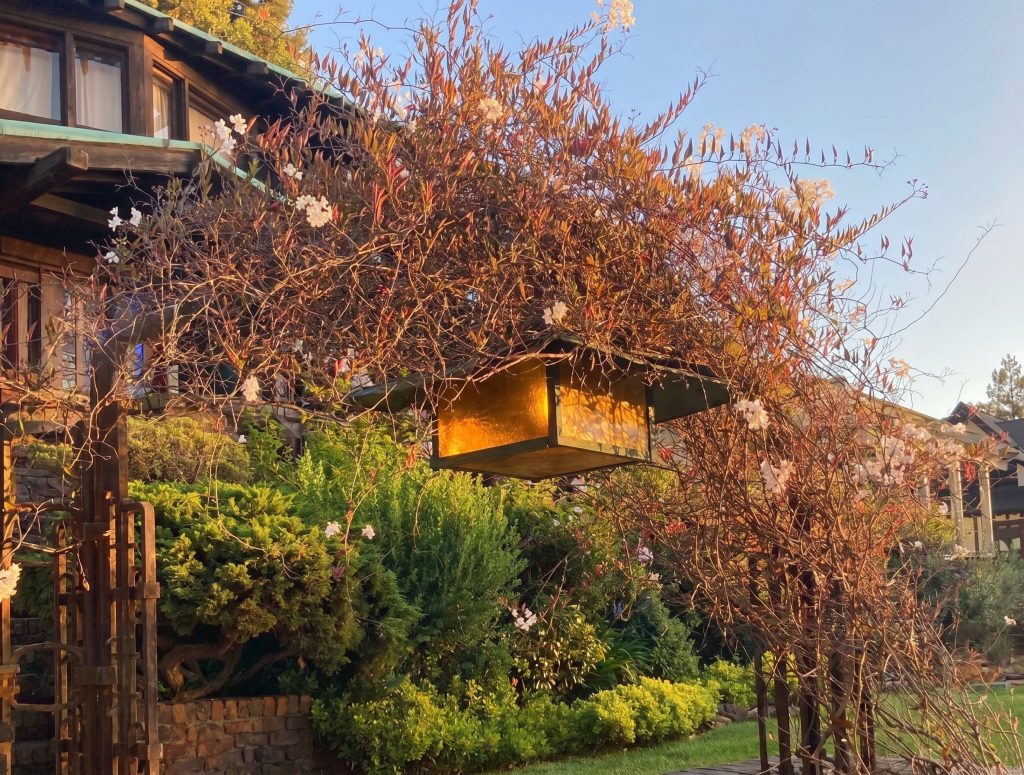
Third, the scale. The ship is small. It is not a billboard. You have to be at the gate to see it. From the street you read the gate as a pattern of vertical iron with a hanging lantern; from the steps you read it as a worked detail with a Viking panel; you would not even notice the panel from across Piedmont Avenue. The Greenes have built a discovery into the approach. The ethnographic declaration is private to anyone who walks up the brick stairs. From a distance, the house is the firm’s. Up close, it is the client’s.
There is one more reading the gate invites. The Thorsen House was the last of the ultimate bungalows. The brothers would not get another commission of this scale. By 1909 they were beginning to be exhausted by their practice — Charles would leave for England that summer, Henry would carry more of the office’s load — and one can feel, in the Berkeley house, a quiet willingness to acknowledge a client’s specifics that earlier commissions would have folded into the universal idiom. The gate is not a compromise of the Greenes’ aesthetic. It is a small permission, granted at the threshold, that says: we know who paid for this. We know where his father came from. We will not make you read a wall of redwood shingle and guess.
There is a small temptation, walking up to the gate, to read the ship as decoration. It is not. Decoration is what an architecture does to itself when the structure is satisfied and the client’s identity is otherwise unspeakable. The Viking panel is not the brothers decorating an entrance. It is the brothers ceding a piece of the entrance to the client and naming the cession in iron. That, by 1909, the firm could afford. The firm could not have afforded it in 1903, when Mrs. Garfield’s chalet was rising in Pasadena and every overhang had to be defended in writing. By the time the Thorsen gate was set into its piers, the brothers had built their way through the ultimate bungalow series and were beginning to think about leaving Pasadena. They could, at the last threshold of their last great commission, let the client speak.
The Viking ship sails out toward Berkeley under a hanging lantern, on a gate of vertical iron bars set into clinker brick, at the entrance to the last great house the firm would build. It is the only autobiography in iron the brothers ever did. The rest of the house was the architecture of the brothers. The gate is the architecture of the client.