
The Mrs. Kate A. White House, completed in 1904 in South Pasadena, California, represents one of the most significant milestones in Greene & Greene’s architectural development. While modest in scale, this bungalow holds extraordinary importance as the first house designed by the brothers to be built by Peter Hall, the contractor who would become essential to their greatest architectural achievements. The house demonstrates how even their smallest commissions could establish relationships and precedents that would prove crucial to their later masterworks.
Architectural Significance
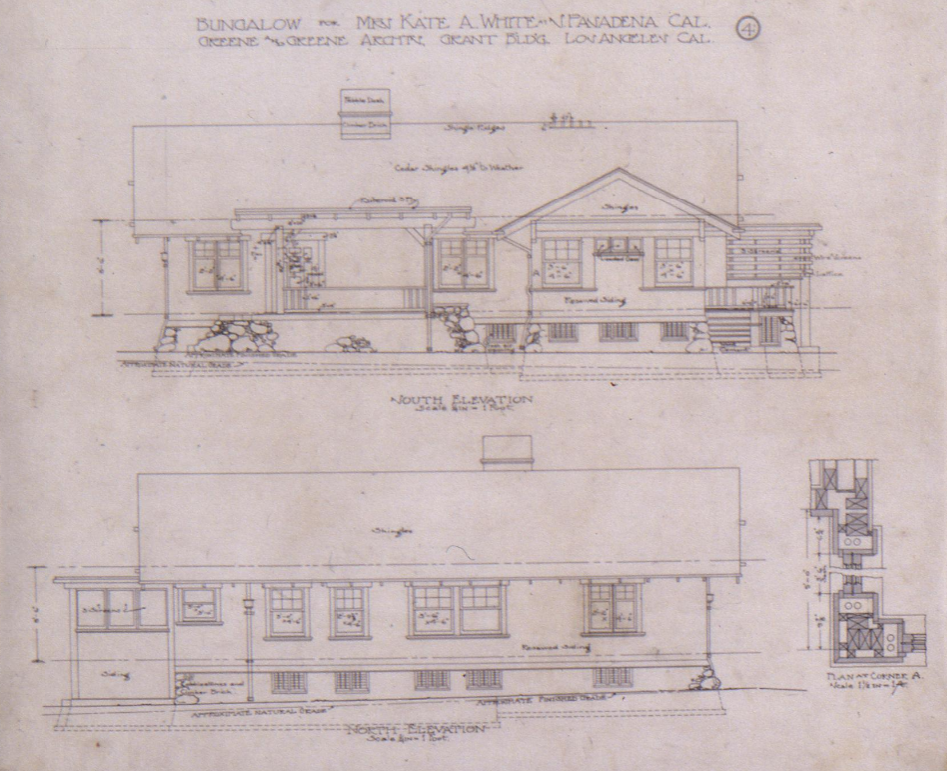
The White House showcases Greene & Greene’s developing mastery of the California bungalow form, presenting a design that achieves remarkable sophistication within modest proportions. The house features an Arroyo stone foundation that anchors the structure to its site, while the timber porch and deep eaves create the kind of indoor-outdoor relationship that would become central to California residential architecture. The design represents what the Gamble House Virtual Archives describes as “a near-pure craftsman aesthetic,” demonstrating the brothers’ ability to distill Arts and Crafts principles into their most essential elements.
The floor plan, modeled after their 1903 Edith Claypole House, reveals Greene & Greene’s thoughtful approach to design development and their willingness to refine successful concepts for new applications. This two-bedroom house with its generous living room proves that architectural distinction was not dependent on scale or budget, but rather on the quality of design thinking and attention to authentic materials and craftsmanship that distinguished all their work.
The Peter Hall Partnership Begins
The White House’s most profound significance lies in its role as the beginning of Greene & Greene’s collaboration with Peter Hall, a partnership that would prove essential to their architectural legacy. Peter Hall and his brother John would go on to build the brothers’ most famous houses and furnishings, including the Gamble House, the Blacker House, and other masterpieces of American residential architecture. The quality of construction achieved in this modest South Pasadena bungalow established the foundation of trust and shared commitment to excellence that would characterize this crucial professional relationship.
This first collaboration demonstrated Peter Hall’s understanding of Greene & Greene’s design intentions and his ability to execute their vision with the precision and craftsmanship their architecture demanded. The success of this project convinced the brothers that they had found a contractor who shared their commitment to authentic materials, superior workmanship, and attention to detail that would distinguish their work from conventional residential construction.
Design Innovation and Craftsmanship
Despite its modest scale, the White House incorporates several design innovations that would become hallmarks of Greene & Greene’s mature style. The deep eaves provide both practical weather protection and visual weight that grounds the house in its landscape setting. The timber porch creates a transitional space between interior and exterior that acknowledges California’s climate and lifestyle, while the Arroyo stone foundation connects the house to the regional building traditions that the brothers were helping to establish.
The house’s craftsman aesthetic represents a distillation of Arts and Crafts principles adapted to California conditions and building practices. Every element, from the foundation stones to the roof structure, demonstrates the kind of authentic material expression that would distinguish Greene & Greene’s work from both conventional construction and superficial stylistic imitation.

Client Relationship and Community Impact
Mrs. Kate A. White’s commission represents the kind of client relationship that enabled Greene & Greene to develop their architectural ideas through real-world application. Her willingness to trust the brothers with this important personal investment provided them with the opportunity to test design concepts and construction methods that would inform their later work. The house’s success in meeting her needs while advancing their architectural development demonstrates the mutual benefit that characterized their best client relationships.
The house’s location in South Pasadena also represents Greene & Greene’s expanding influence beyond their initial Pasadena base, proving their ability to create distinctive architecture that enhanced community development throughout the region. The quality of this modest house helped establish their reputation for creating architecture that served individual family needs while contributing to the broader development of California residential design.
Architectural Legacy and Influence
The White House’s influence extends far beyond its modest scale, establishing precedents for contractor relationships, design development, and construction quality that would characterize Greene & Greene’s most important work. The Peter Hall partnership that began with this house would prove essential to the brothers’ ability to realize their architectural vision with the precision and craftsmanship their designs demanded.
The house also demonstrates Greene & Greene’s commitment to design excellence regardless of project scale or budget, proving that their architectural principles could be successfully applied to modest residential commissions while maintaining the quality and authenticity that distinguished their work. This approach would influence California residential architecture for generations, establishing the principle that good design was not a luxury but a fundamental requirement for creating architecture that served both individual needs and community development.
Current Status
Location: 1036 Brent Ave., South Pasadena, California
Status: The Mrs. Kate A. White House continues to serve as a private residence, maintaining its original residential function while preserving the architectural integrity that made it such an important milestone in Greene & Greene’s development. The house remains a testament to their ability to create distinguished architecture at any scale and their commitment to establishing professional relationships based on shared standards of excellence and authentic craftsmanship.
Significance: The White House represents the crucial beginning of Greene & Greene’s partnership with Peter Hall, the contractor who would become essential to their greatest architectural achievements, while demonstrating their mastery of the California bungalow form and their ability to achieve remarkable sophistication within modest proportions. The house established important precedents for design development, construction quality, and professional relationships that would characterize their most important work and influence California residential architecture for generations.
Recognition: While modest in scale, the White House is recognized by architectural historians as one of the most significant milestones in Greene & Greene’s development, marking the beginning of their crucial partnership with Peter Hall and demonstrating their commitment to design excellence regardless of project scope. The house’s importance lies not in its individual architectural achievement but in its role as the foundation for relationships and standards that would enable their later masterpieces and establish their lasting influence on American residential architecture.
