
William Morris never saw California. He died in 1896, four years before Charles Greene made his first significant departure from the shingle-style cottages that had defined his early Pasadena practice, eight years before the Gamble House commission would arrive and change everything. Morris spent his life between London and Oxfordshire, between the smoky lecture halls where he argued for the dignity of labor and the workshops of Kelmscott where he practiced it. He never stood beneath a California live oak. He never felt the particular quality of Pasadena light in January — that cool, clarifying winter brightness that makes everything it touches look as though it were being seen for the first time.

And yet Morris is everywhere in Greene & Greene. He is in the philosophy that guided every joint and every surface. He is in the insistence that beauty and use are not separate categories. He is in the deep suspicion of the machine — not as technology exactly, but as a way of organizing human labor that strips the worker of judgment, of pleasure, of the chance to put something of himself into the thing being made. Morris believed that this stripping was not merely an economic problem. It was a spiritual one. The Arts & Crafts movement he helped found was, before it was an aesthetic, a moral argument.
That argument traveled. It crossed the Atlantic in the minds of architects, in the pages of magazines, in the hands of craftsmen who had read Ruskin on their lunch breaks and found something in his passionate, difficult prose that named what they felt about their work. By the 1890s, Arts & Crafts societies were forming in Boston, Chicago, Minneapolis. Gustav Stickley was publishing The Craftsman from Syracuse, translating the English movement into an American vernacular that was harder, simpler, more democratic in its material ambitions if not always in its price points. The bungalow — that most American of house types — was absorbing Arts & Crafts ideas about the honest expression of structure and the integration of interior and exterior, making them available to the middle class at a scale Morris’s hand-wrought socialism had never quite managed to reach.
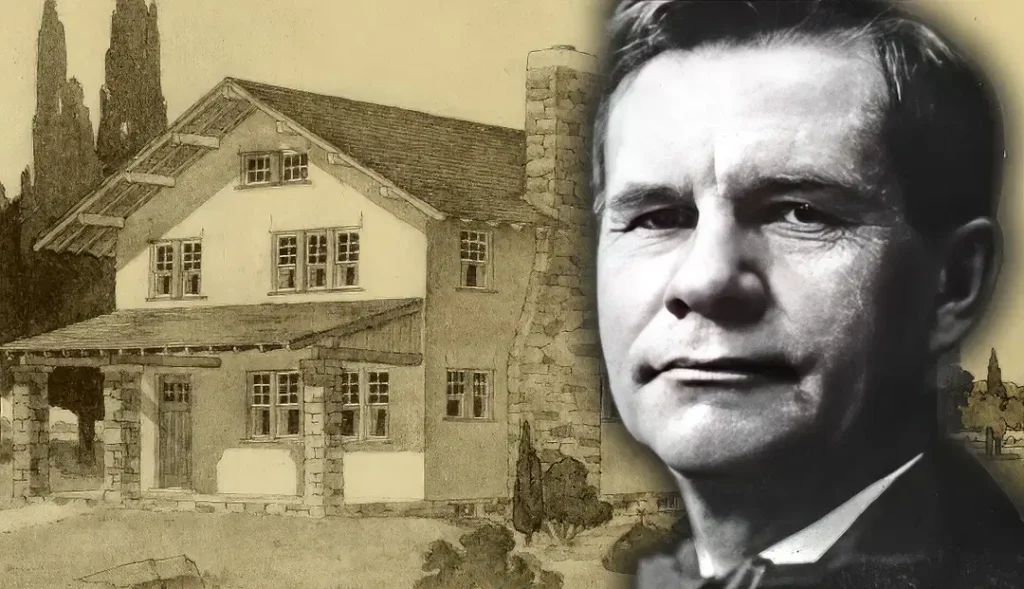
But something particular happened in California, and specifically in Pasadena, that happened nowhere else. The convergence of climate, wealth, intellectual culture, and available craftsmanship produced conditions in which the Arts & Crafts argument could be made not just in theory but in wood and brick and art glass, at the scale of a complete domestic world. The English movement had produced beautiful objects — Morris’s textiles, the furniture of Philip Webb, the metalwork of the Birmingham Guild — but it had struggled to produce buildings that fully embodied its principles. Construction at architectural scale brought compromises that the workshop could avoid. It brought contractors, subcontractors, building codes, client budgets, the sheer logistical complexity of assembling a building from many hands and many trades.
What the Greenes found in Pasadena — and what Morris never found in England — was a way through that complexity. The partnership with Peter Hall’s shop was the crucial instrument. It allowed the architects to treat the entire building as a single craft object, to maintain the workshop’s standard of attention across every element from the foundation bolts to the art glass transoms. The machine was not absent from this process — Hall used machinery in his shop, for milling and rough dimensioning — but the machine was subordinate. It prepared the material for the hand rather than replacing the hand’s judgment. This was, almost exactly, what Morris had theorized but never fully achieved: a productive relationship between industrial efficiency and craft finish that did not sacrifice one to the other.
The other thing California provided was the outdoor life, and this mattered philosophically as much as practically. Morris’s England was a wet, coal-smoked, industrialized island where the countryside was retreating before the factory town. His longing for an integrated life — work and leisure, indoor and outdoor, beauty and utility folded together into a daily existence — was largely elegiac, a mourning for a pre-industrial England that had probably never existed quite as he imagined it. In Pasadena, the climate made integration not a utopian fantasy but a design problem with actual solutions. The sleeping porch. The pergola that extended the living room into the garden. The broad overhanging eaves that shaded the terrace and made the boundary between inside and outside deliberately ambiguous. Greene & Greene houses do not merely reference the natural world; they reach toward it, open to it, structured by the same principles of growth and shelter that structure a tree.
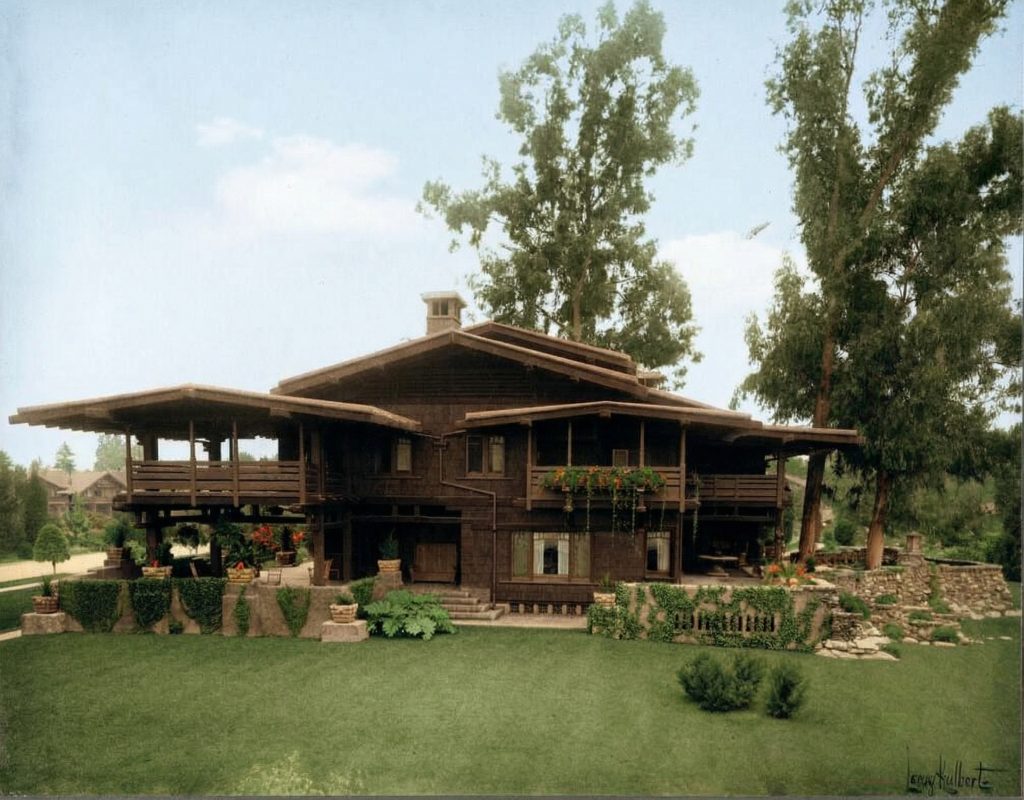
This is perhaps the deepest Morrisian inheritance: the idea that a well-made house is not a retreat from nature but a continuation of it. That the grain in the mahogany panel and the oak in the garden are participants in the same order of things. That craft, at its highest, is not the imposition of human will on resistant material but a conversation with that material’s own nature — its strength, its figure, its way of moving through time.
Morris wrote that he did not want art for a few, any more than he wanted education for a few or freedom for a few. It was a generous, impossible ambition, and like most generous impossible ambitions it was only partially achieved. The houses that most fully embody his principles — the Blacker House, the Gamble House, the Thorsen House — were built for the wealthy. The Gambles were Procter & Gamble heirs. The Blackers were lumber barons. The movement’s great irony, felt sharply by Morris himself and by nearly everyone who has written about it since, is that the honest, democratic, labor-dignifying objects it produced were almost immediately priced out of reach of the workers whose dignity they were meant to honor.
And yet the argument survived the irony. It survives still. The idea that how things are made matters — morally, not just aesthetically — is not diminished by the fact that its finest expressions were commissioned by the rich. The rich have always built the buildings that history keeps. What Greene & Greene kept, inside those commissions, was something that belongs to everyone: a demonstration that beauty and integrity are not incompatible, that a building can tell the truth about itself, that the hand of the maker can be present in the thing made and the presence can be a kind of grace.
Morris would have recognized it. He would have touched the wood too.
Explore the houses where this philosophy found its fullest form: the Gamble House, the Blacker House, and the Thorsen House.