
Greene & Greene are usually praised for the way they absorbed Japan without copying it. The cloud lift is not a Japanese motif with a Japanese name; it is the brothers’ own coinage for a borrowed silhouette. The exposed joinery is the spirit of the temple carpenter rendered in California redwood, not a reproduction of any actual joint. The lanterns evoke the paper lamp without being one. This is the standard and correct account of their Japonisme: they translated. They did not quote.
There is one exception, and it stood at the front of their first whole house.
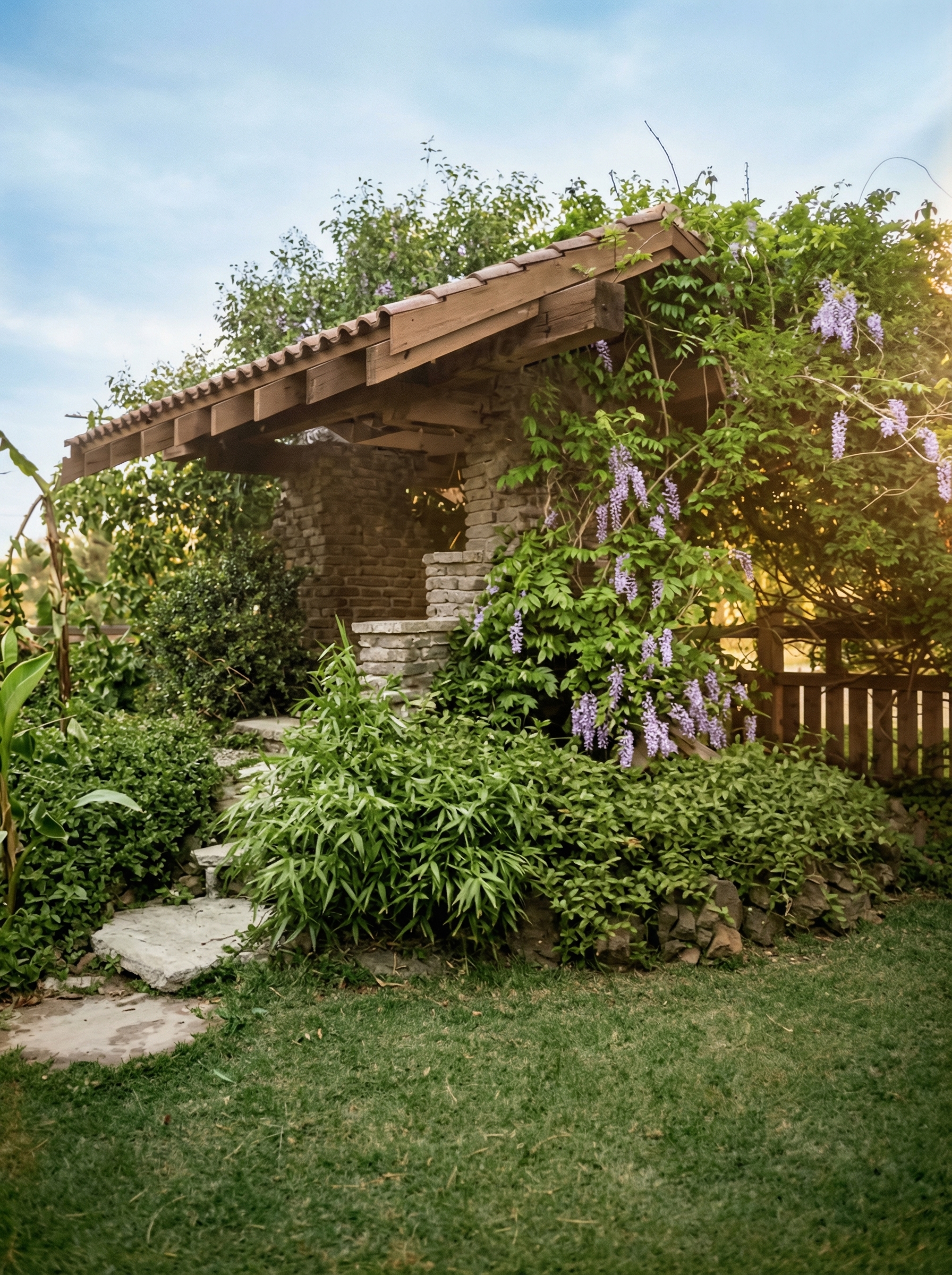
At the Adelaide M. Tichenor House in Long Beach, designed in 1904, the brothers built a torii. Not a torii-like gesture, not a gate with a Japanese flavor. A torii: the gateway form that marks the threshold of a Shinto shrine, two posts carrying a horizontal lintel, the universal sign in Japan that you are passing from ordinary ground into sacred ground. The brothers roofed theirs in clay tile and set it as the ceremonial entrance from Ocean Boulevard into the garden. The historical record, preserved in the Long Beach landmark designation, describes it plainly: a torii gate, fully roofed in tile, forming the formal entrance into an oriental garden, with an arched bridge over a pond beyond it. The design, the record adds, reflected the mutual interest in the Orient of both client and architects.
The Tichenor House is the most overtly Japanese building the brothers ever made, and it is the one that historians most often reach for when they want to show how far the early Greene & Greene was willing to go. The house was more openly oriental than anything that came after it. After Tichenor the Japanese content went underground — absorbed, abstracted, translated into the silent grammar that made the later houses great. At Tichenor it was still on the surface, and the torii was its loudest statement.
What makes the gate worth pausing over is exactly that it is a quotation and not a translation. A torii is not a structural necessity. It holds up nothing. It is a pure sign, a piece of architectural language whose entire job is to tell you where you are standing — outside, and about to be inside. To build one in Long Beach in 1904 was to do something the brothers almost never did: to take a Japanese form whole, with its meaning intact, and install it at the front of an American house. The tile roof they added is the giveaway that they were thinking about it carefully. A bare torii would have read, to a Californian eye, as merely a frame. Roofing it in tile gave it weight, shelter, and the look of a gatehouse — it married the Shinto sign to the practical gate of a walled garden, which is itself a very Greene & Greene kind of move. They quoted the form, then made it carry.
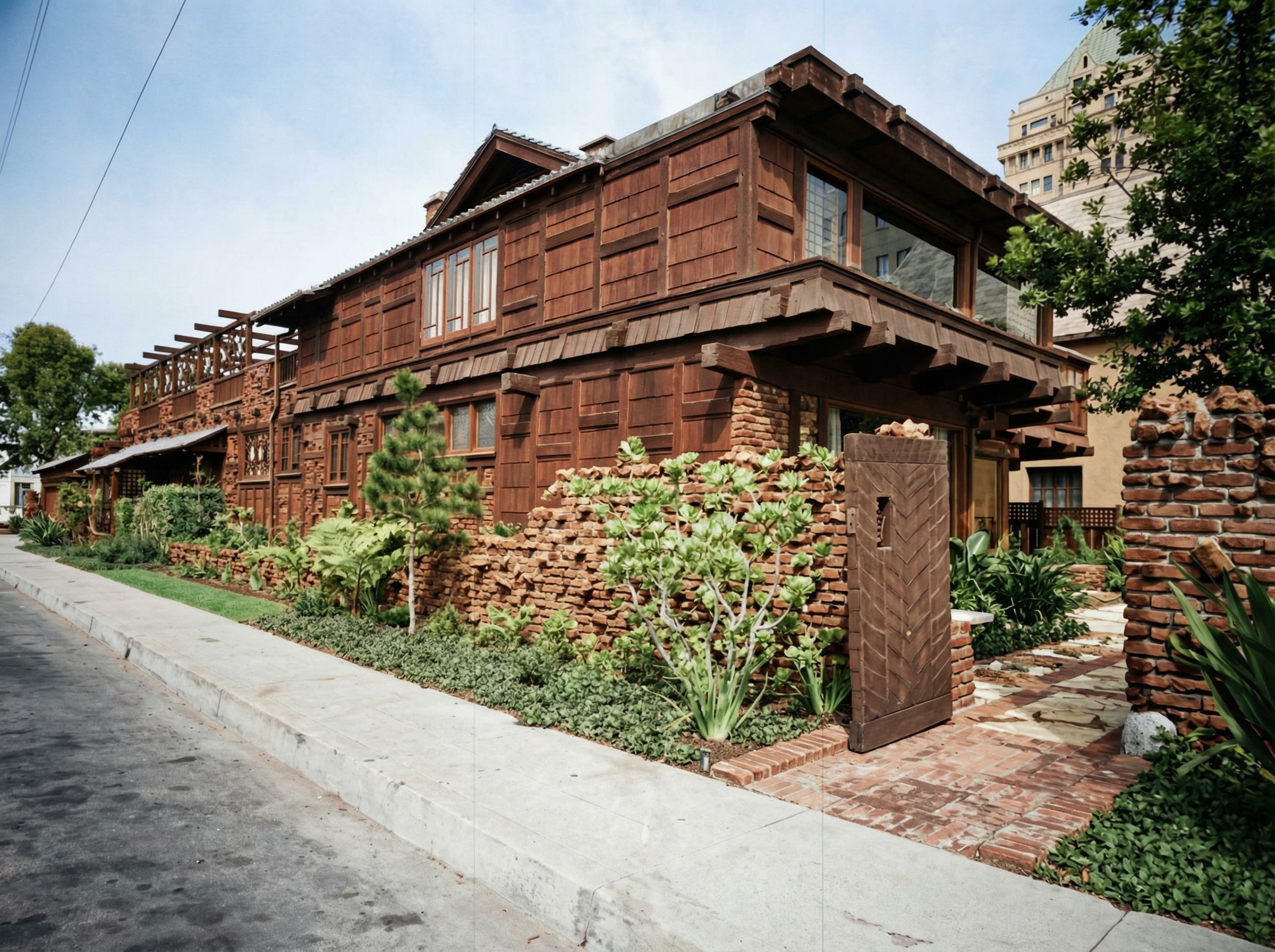
The client made the gesture possible. Adelaide Tichenor was a Long Beach businesswoman with a serious interest in Japanese culture and the means and conviction to indulge it. The garden behind the torii was a designed Japanese landscape — the pond, the arched bridge, the careful planting — and it was, by every account, her enthusiasm as much as the architects’. This is the phrase the record keeps returning to: the mutual interest of both client and architects. The brothers did not impose Japan on Mrs. Tichenor, and she did not impose it on them. They agreed on it, and the agreement is why the most literal Japanese object in the whole Greene & Greene canon got built. It took a client who wanted it as much as they did.
There is a continuity here with a pattern that runs through the brothers’ work: their boldest Japanese moments tend to coincide with clients who were themselves invested in Asia. The dealers who imported Asian art for a living — the Bentz family in Pasadena and Santa Barbara — hired the Greenes precisely because they recognized the sensibility. Adelaide Tichenor wanted a Japanese garden and got a torii to enter it by. The mutual interest was not a coincidence of taste. It was the precondition. The brothers went furthest toward Japan when the person paying the bill was already standing there.
The garden did not survive intact. The Tichenor House still stands, a recognized Long Beach landmark, but the original oriental garden with its pond and bridge was reconfigured over the decades, as gardens are, and the primary entrance that once came ceremonially through the torii from the boulevard was not the arrangement the house kept. The most literal Japanese gesture the brothers ever made was also among the most fragile, because a tile-roofed timber gate in a garden is exactly the kind of thing that does not last a century without devoted maintenance. We know it best now through the documentation — the descriptions, the early views, the landmark record — rather than through an unbroken physical survival.
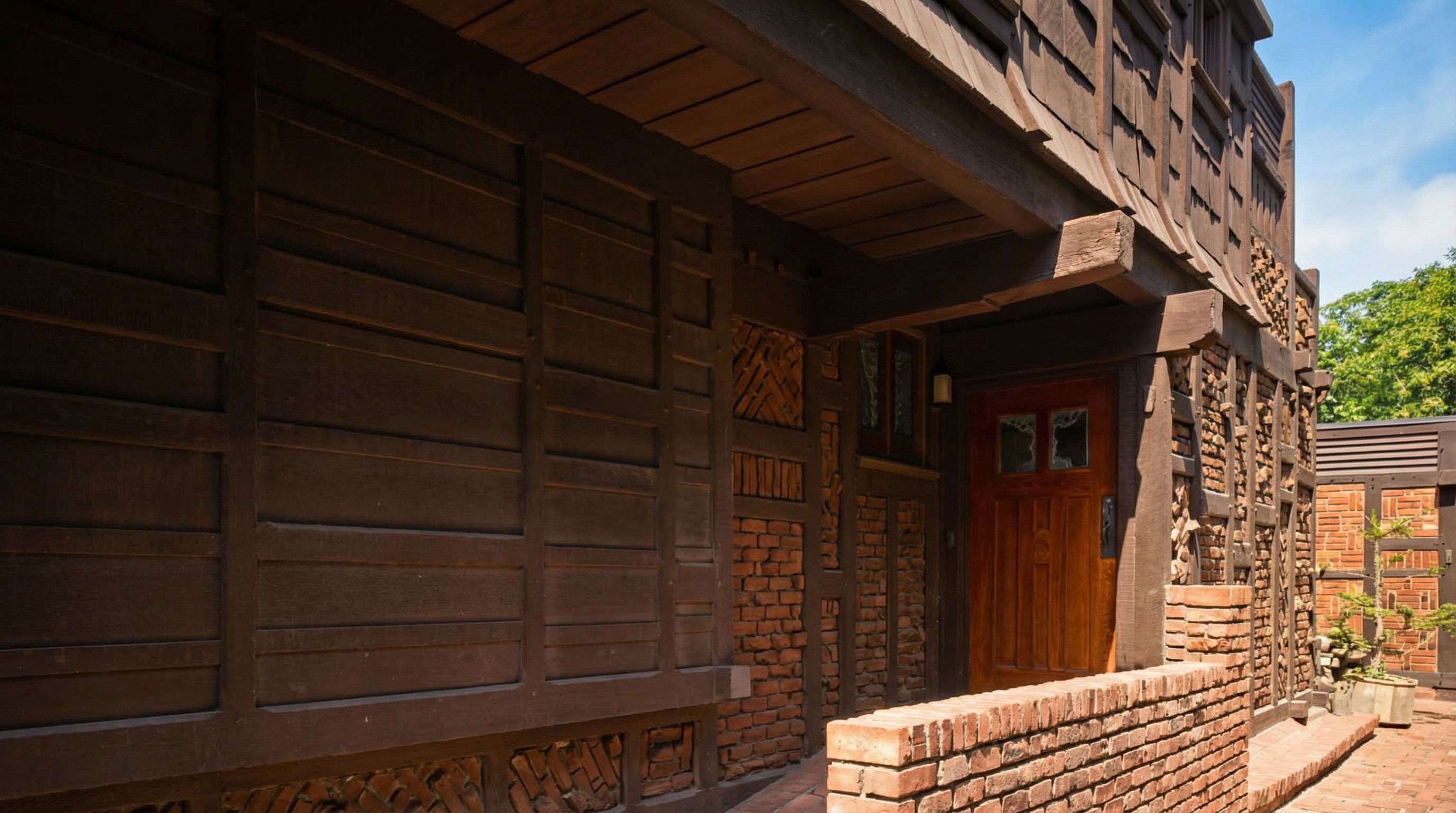
That is the small irony the gate leaves behind. The thing the brothers translated — the cloud lift, the joinery, the proportion, the abstracted Japan that they folded so deeply into the structure of the later houses that it could never be removed — is the thing that endured, because it had become inseparable from the building. The thing they quoted, the torii standing free in the garden as a discrete imported sign, was the thing most easily lost. Translation lasted. Quotation did not.
It is worth knowing, all the same, that they did it once. Before the Japan in their work went silent and permanent, before it became a grammar rather than a vocabulary, the brothers built one true Japanese gate and roofed it in tile and set it where you had to walk through it to reach the first whole house they ever designed. They quoted before they learned to translate. The gate was the sentence they spoke out loud, once, in the original language.