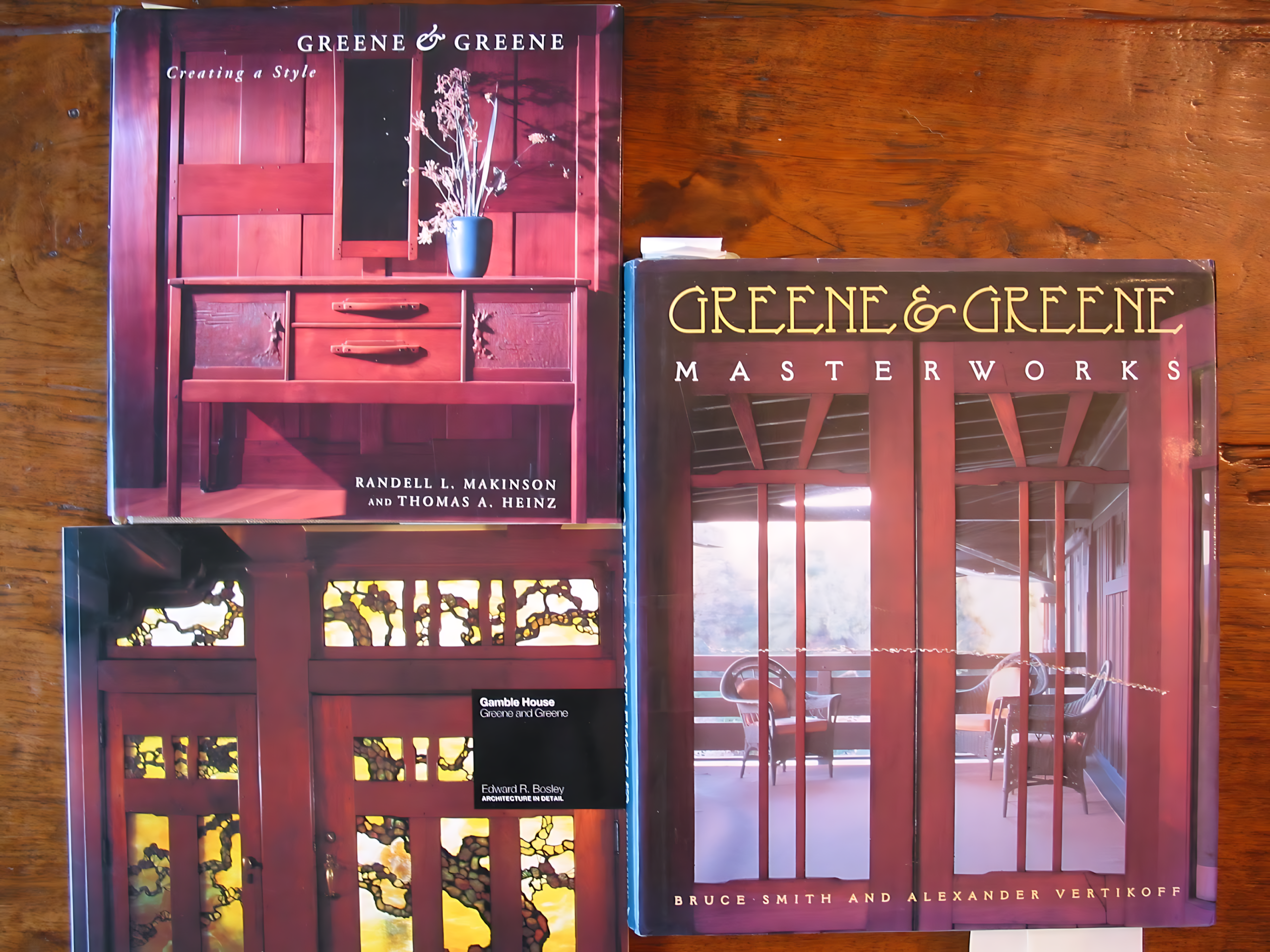
The first thing to understand about the literature on Charles and Henry Greene is that there is much less of it than you would expect. The brothers built about 130 commissions across a working life that ran from 1894 to 1922. They are now widely held to have made the finest American houses of their generation. And yet, if you set out to read everything serious that has ever been written about them, you can do it in a single long winter.
That fact has a history, and the history has a shape. For the first half of the twentieth century, almost nothing was written about Greene & Greene at all. Architectural fashion had moved on. The bungalow had become a real-estate cliché. The brothers themselves had stopped practicing in the early 1920s and withdrawn — Charles to Carmel and a long interior turn, Henry to a small late practice in Pasadena. By the time they died in the 1950s, the houses were still standing but largely uncelebrated, and the office records were close to being lost.
The literature we have now exists because, beginning in 1960, a handful of writers decided to put it back together. What follows is the whole shelf, in the order it was written. Read in sequence, these sixteen books are not a bibliography so much as a rescue, conducted in slow motion over sixty years. Each title is a stage in how the brothers were found again — and each is worth owning.
A note on the links below: the “Buy on Amazon” buttons go to current editions where available. Several of these titles are long out of print and circulate only on the used market, where prices swing widely; condition and edition matter, and the notes for each book say so where it applies.
1960 — Esther McCoy, Five California Architects

The book that begins this story did not belong to the Greenes alone. Esther McCoy’s Five California Architects, published by Reinhold in New York in 1960, gave a chapter each to Bernard Maybeck, Irving Gill, R. M. Schindler, Bernard Ralph Maybeck’s contemporaries, and the firm of Greene & Greene — five Californian practices the modernist canon of the period had let fall out of view.
McCoy is the founding figure of California architectural history. She had come west as a writer in the 1930s, worked for a time as a draftsman in R. M. Schindler’s office, and taught herself the discipline by practicing it. Five California Architects was the book that made the field. The Greene & Greene chapter was researched, in fact, by a young Pasadena architect named Randell Makinson, whom McCoy brought in for the purpose — the first appearance of the name that would dominate everything after.
What the book did was simple and decisive. It put the brothers in a sentence with names that mattered, and it treated them not as quaint regional curiosities but as serious architects with a fully developed argument. Almost every later study takes its starting position from a page of McCoy. It has been reissued more than once and is the one book on this list you should read last — but it is where the shelf begins.
Then, for fourteen years, almost nothing. McCoy’s chapter sat more or less alone while the houses themselves grew quietly more endangered. The Gamble family gave their house to the City of Pasadena, in concert with the University of Southern California, in 1966; the Gamble House became a place one could actually walk through. But the books did not come — until, in a single extraordinary year, four of them arrived at once.
1974 — Janann Strand, A Greene & Greene Guide

The first of the 1974 books was the smallest, and in one sense the most radical: it was the first book ever published about Greene & Greene and nothing else. Janann Strand’s A Greene & Greene Guide came out of Pasadena’s Castle Press as a slender, photograph-rich handbook to the houses of the brothers’ Pasadena years.
It carries little scholarly apparatus. It was not trying to. It was written for the person standing on a Pasadena sidewalk who wanted to know what they were looking at and where to walk next — addresses, dates, a photograph, a paragraph. Every later guide to the houses, every map, every walking tour, and in a real sense this very reading list, descends from Strand’s modest, clear-eyed little book.
It has never been reprinted at scale, and good copies are now genuinely scarce. For a collector it is one of the more quietly desirable items on the shelf — the first dedicated Greene & Greene book, and a charming one.
1974 — William R. & Karen Current, Architects in the Residential Style

The second 1974 book was a photographer’s book. Greene & Greene: Architects in the Residential Style was published by the Amon Carter Museum of Western Art in Fort Worth — the first museum anywhere to take the brothers up as a subject — with photographs by William R. Current and text by Karen Current.
William Current was an architectural photographer of the first rank, known for his studies of ancient Pueblo sites and of Japanese architecture. He brought to the Greene houses the eye he had trained on those subjects: patient, formal, unsentimental. The book is essentially a portfolio of austere black-and-white plates. It treats the houses the way a museum treats sculpture — frame by frame, detail by detail, lit for a seriousness no earlier publication had granted them.
It is a slim volume and a beautiful one, and it remains the best black-and-white photographic record of the work. If you care about the houses as objects — as compositions in light and shadow — this is the one to find.
1974 — Randell L. Makinson, A Guide to the Work of Greene and Greene

The third book of 1974 was the one that organized the field. Randell Makinson — no longer the young researcher of the McCoy years but by now the Director of the Gamble House — published A Guide to the Work of Greene and Greene with Peregrine Smith of Salt Lake City, the imprint that would carry most of his later work.
The Guide did the unglamorous, indispensable thing: it gathered, for the first time, a working catalog of the firm’s commissions, with addresses, dates, and notes. Before this book there was no single place to learn what the brothers had built and where it stood. After it, there was. Every subsequent study, including the scholarship that would eventually correct and extend it, rests on the list Makinson assembled here.
It is a compact, practical volume, frequently found and inexpensive on the used market — the most affordable way onto the shelf, and a working tool you will return to.
1974 — Andersen, Moore & Winter, eds., California Design 1910

The fourth book of 1974 set the brothers in their world. California Design 1910, edited by Timothy Andersen, Eudorah M. Moore, and Robert W. Winter, was the catalog of an exhibition mounted at the Pasadena Center late that year. It is not a Greene & Greene book in the strict sense — and it is essential reading anyway.
Robert Winter, one of its editors, was the great popular historian of Southern California architecture, later co-author of the indispensable Architectural Guidebook to Los Angeles. The book he and his co-editors made situates the brothers inside the wider Californian Arts and Crafts movement — the potters, the metalworkers, the printers, the furniture makers, the painters of the Arroyo — and treats their architecture as one expression of a regional culture rather than a private miracle.
It remains the indispensable book on the brothers’ context. Read it to understand the soil the houses grew in. It has been reprinted, most recently in expanded form, and is readily available.
The 1974 cluster did the structural work. Strand fixed the addresses; the Currents fixed the photographs; Makinson fixed the list; California Design 1910 fixed the frame. What the field still lacked was a full-scale interpretive history — a single book that argued, at length and with evidence, for how the brothers’ way of building actually worked and developed. The next twenty-five years would be spent supplying it, and they belong almost entirely to one man.
1977 — Randell L. Makinson, Architecture as a Fine Art
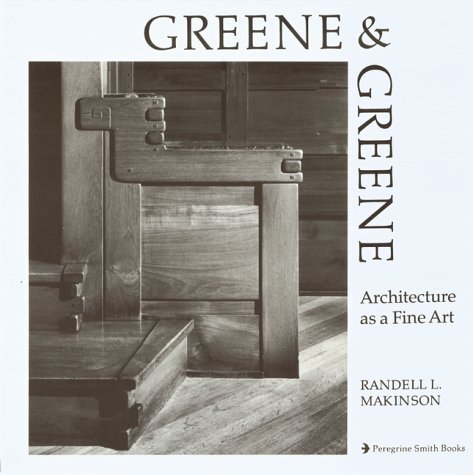
Greene & Greene: Architecture as a Fine Art, published by Peregrine Smith in 1977 with new photographs by Marvin Rand and an introduction by the British critic Reyner Banham, was the first full-scale monograph on the brothers — and it remains the foundational scholarly work on the firm.
It is organized chronologically, runs to nearly three hundred pages, and takes the major commissions one at a time, with plans, photographs, and a sustained prose argument about how the brothers’ architecture grew from the early Pasadena houses to the masterworks of 1907–1909. Banham’s introduction matters: it was the moment a critic of international standing certified the brothers as serious. Marvin Rand’s photographs became, for a generation, the way the houses were seen.
This is the book that turned a rediscovery into a discipline. With its companion furniture volume it was reissued by Gibbs Smith in a combined single edition in 2006, which is the form most readers will find today. Buy the combined edition if you can; it is the better value and the more complete book.
1979 — Randell L. Makinson, Furniture and Related Designs

Two years later Makinson published the companion volume, Greene & Greene: Furniture and Related Designs, again with Peregrine Smith and again with Marvin Rand behind the camera. Every earlier writer had treated the furniture as an appurtenance of the houses. Makinson reversed the order of importance.
He argued that the chairs, sideboards, beds, lanterns, and inlaid panels were not accessories but co-equal expressions of the same compositional intelligence that produced the architecture. The book was the first to publish Charles Greene’s own measured drawings of his furniture, and the first to track the design decisions through the cabinetmaking shop of Peter and John Hall, where the pieces were actually built. It made the case, almost single-handedly, that Greene & Greene was a furniture practice as fully as it was an architectural one — a case that the entire woodworking literature later in this list takes as settled.
It is now most easily found in the 2006 Gibbs Smith edition that combines it with the 1977 volume. Together they are the core of the shelf.
With the two Peregrine Smith monographs, the basic scholarly account of Greene & Greene was in place. For more than a decade it stood largely unchallenged. The next move came not from a rival historian but from the Gamble House itself — and from the man who took over its direction in 1992.
1992 — Edward R. Bosley, Gamble House: Greene & Greene

Edward R. Bosley became Director of the Gamble House in 1992, and in the same period contributed the Gamble House volume to Phaidon’s Architecture in Detail series — the elegant small-format books, launched in 1991, that each take a single building apart at close range.
It is the most concentrated book on this list: one house, examined through plans, drawings, and large photographs, with a compact architectural essay. Where Makinson’s monographs survey, this volume focuses — and on the Gamble House, the single most completely realized thing the brothers ever made, that focus is exactly right. It is the best short formal reading of the house in print.
Phaidon reissued it in a revised edition in 2002, and the two printings can be told apart by their ISBNs; either serves. It is inexpensive, slim, and the ideal book to carry if you are actually going to visit.
By the late 1990s the brothers were no longer at any risk of being forgotten. The risk had become the opposite one — that the work would harden into a settled, repeated view. The answer, when it came, arrived in a single year, and from two directions at once: a summing-up from the field’s founding scholar, and a fresh photographic survey from a new writer.
1998 — Randell L. Makinson, The Passion and the Legacy

Greene & Greene: The Passion and the Legacy, published by Gibbs Smith in 1998, is Makinson’s synthesis — the book in which he gathered, in one volume, what four decades of his own research and the new archival access had made possible.
Where the 1977 monograph proceeds house by house, The Passion and the Legacy is organized by period. It begins with the brothers’ arrival in Pasadena in 1893 and traces the work through what Makinson called the masterworks of 1907–1909 and on into the cooperative-but-separate practice of the teens and the late solo years. It is the most readable of his books, and it is the one to reach for if you want the whole arc of the partnership as a single, connected narrative.
It is the canonical story of Greene & Greene, told by the man who, more than any other, made their reputation. If you buy only one comprehensive history, buy this one — it remains in print and is easy to find.
1998 — Bruce Smith, Greene & Greene: Masterworks
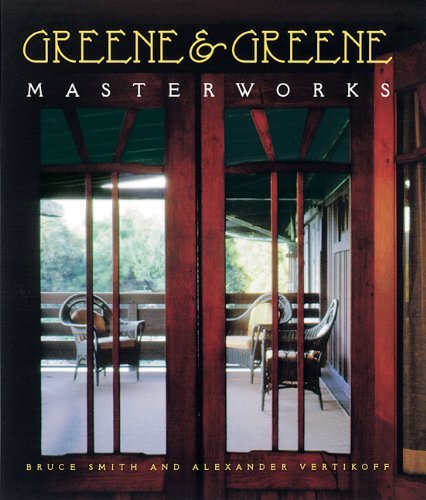
The same year brought the first major book on the brothers by a writer other than Makinson. Bruce Smith — a longtime Arts and Crafts writer, associated for years with American Bungalow magazine — published Greene & Greene: Masterworks with Chronicle Books of San Francisco.
It is the full-color photographic survey of the firm. Across twenty-five major commissions, with photographs by Alexander Vertikoff, it does in color what the Currents had done in black and white in 1974: it makes the houses available as images, in a sequence that lets the reader feel the development of the work across two decades. Vertikoff’s photography is the natural successor to Marvin Rand’s, and the book remains the single most reliable source of high-quality color images of houses that, being private, most readers will never enter.
It is the most purely beautiful object on this list — a large, generous, well-printed book. It is the one to give as a gift, and the one to leave where guests will pick it up.
With Makinson’s synthesis and Smith’s survey, the brothers had, at last, a complete shelf. What they did not yet have was a book that took them out of California — that read them against the wider currents of architecture in their own time. That book came in 2000, again from Bosley.
2000 — Edward R. Bosley, Greene & Greene

Bosley’s second book, titled simply Greene & Greene, was published by Phaidon in 2000, with new photographs by Mark Fiennes. It is the major non-Makinson monograph of the modern period, and in one important respect it does something Makinson’s books deliberately avoid.
It takes the brothers out of their California cocoon. Bosley reads their work against contemporary developments in English and European architecture and design — the Arts and Crafts movement in its British homeland, the currents the brothers absorbed and transformed. The book is shorter and more compressed in its argument than the Makinson volumes, and that compression is a virtue: it is the best single-volume introduction to the firm currently in print.
If you are coming to Greene & Greene for the first time and want one book to start with, this is the one. Begin here, then go to Makinson’s Passion and the Legacy for the long version.
2004 — Makinson & Heinz, Greene & Greene: Creating a Style

In 2004 Makinson published his last Greene & Greene book, Creating a Style, co-authored with Thomas A. Heinz and issued by Gibbs Smith. Heinz is an architect and photographer best known for his extensive work on Frank Lloyd Wright, and the collaboration gives the book a strongly visual character.
It is the most accessible of Makinson’s titles — less a work of scholarship than an extended, well-illustrated meditation on the design vocabulary itself: the way the cloud-lift is deployed, the recurring proportions, the relation of structural frame to infill panel, the integration of metalwork with cabinetwork. For a reader who has absorbed the histories and now wants to see how the style is actually assembled, detail by detail, it is genuinely useful.
Think of it as the bridge between the historical books above and the woodworking books below — the last word from the field’s founding scholar, pointed toward the workshop.
And that is where the literature of Greene & Greene does something unusual. Most architectural reputations live entirely inside architectural history. The brothers’ reputation escaped it. By the mid-2000s a second literature had grown up alongside the first — written not by historians but by furniture makers, for furniture makers, and it has been the busiest branch of all.
2006 — Robert W. Lang, Shop Drawings for Greene & Greene Furniture

Robert W. Lang’s Shop Drawings for Greene & Greene Furniture: 23 American Arts and Crafts Masterpieces was published by Fox Chapel in 2006. Lang is a working woodworker and a longtime editor at Popular Woodworking magazine, and his book does something no architectural history attempts.
It contains measured drawings — front, side, top, section, and detail — of twenty-three of the brothers’ most significant pieces, among them the Gamble House master bedroom bed and the Robinson House armchair. The drawings are precise enough to build from, prepared from the original Greene & Greene drawings and from direct study of the surviving pieces. It is the book a woodworker actually opens on the bench when reproducing a piece in the brothers’ style.
It is not architectural history, and it is one of the most valuable books on this list. A maker who has drawn out a Greene & Greene joint at full scale understands something about the brothers’ minds that no amount of looking at photographs will teach.
2006 — Darrell Peart, Design Elements for the Workshop

The same year brought the first book by Darrell Peart, a Seattle-area furniture maker who has spent some four decades working in the Greene & Greene idiom and is among the most respected makers in the style alive today. Greene & Greene: Design Elements for the Workshop was published by Linden Publishing in 2006.
Where Lang gives you whole pieces to build, Peart gives you the vocabulary they are built from. The book is a catalog of the brothers’ signature details — the square ebony peg, the breadboard end, the cloud-lift, the proud spline, the waterfall leg — with clear instruction on how each is cut and fitted. It is the book that teaches the grammar of the style rather than its sentences.
For anyone who wants not to copy a Greene & Greene piece but to design in the manner — to understand the logic well enough to use it freshly — this is the essential text.
2008 — Bosley & Mallek, eds., A “New and Native” Beauty

In 2008 the field changed register. A “New and Native” Beauty: The Art and Craft of Greene & Greene, edited by Edward R. Bosley and Anne E. Mallek and published by Merrell, is the catalog of the major exhibition mounted by the Huntington Library to mark the centennial of the Gamble House — a show that afterward traveled to the Renwick Gallery of the Smithsonian American Art Museum and to the Mint Museum.
It is the most important publication of the past twenty-five years, because it is the first to bring a whole second generation of scholars to the brothers. It collects essays by some ten contributors — including a substantial biographical essay by Bruce Smith and Virginia Greene Hales, a granddaughter of Henry Greene — and treats the decorative arts, the furniture, the metalwork, the art glass, and the drawings at a depth no earlier book attempted. It shifted the field from biography toward connoisseurship.
This is the book for the reader who already knows the houses and wants the current state of scholarship. It is out of print and rising in price; if you find a sound copy at a fair figure, do not hesitate.
2013 — Darrell Peart, In the Greene & Greene Style

The most recent book on the shelf is Darrell Peart’s second, In the Greene & Greene Style: Projects and Details for the Woodworker, published by Linden Publishing in 2013. It is the companion to his 2006 volume and, in a sense, its completion.
Where Design Elements taught the vocabulary, In the Greene & Greene Style puts it to work, with full project drawings and step-by-step detail for building complete pieces — and with the accumulated judgment of a maker who, by 2013, had spent a long career inside the idiom. It is a generous, practical, deeply experienced book.
That the most recent significant title on Greene & Greene is a woodworking book is itself worth noticing. It tells you the brothers’ argument is still being made — not only studied in libraries but cut, fitted, and pegged in workshops, which is exactly where they would have wanted it to continue.
The Shelf, and What Is Missing From It
Sixteen books. That is, very nearly, the whole serious literature on Charles and Henry Greene. It would fit on a single long shelf, and the shape of the shelf is also the shape of what has not yet been written.
There is no full biography of either brother. There is no monograph on the Hall brothers’ cabinetmaking shop, which built all of the firm’s furniture and most of its joinery. There is no book on Charles’s long late period in Carmel, where the architecture gave way to watercolor and a deepening interior life. There is no book on the Greene clients — the small, interlocking circle of Midwestern industrialists who commissioned the masterworks. Each of these is a book waiting for its author.
But what exists, exists because particular people decided the brothers were worth the cost of slow attention. Esther McCoy decided it in 1960, when the houses were nearly lost. Randell Makinson decided it and then spent a working life on it. Edward Bosley, Bruce Smith, the Currents, Robert Lang, Darrell Peart — each added a book because the last one left something unsaid.
If you are starting out, start with Bosley’s Greene & Greene of 2000, then read Makinson’s Passion and the Legacy. If the brothers do not let you go after that, the rest of the shelf is above, in the order it was written. Read it that way and you are not just learning about two architects. You are watching a reputation be rebuilt, book by book, across sixty years — the argument the brothers made in wood, preserved, finally, in print.