
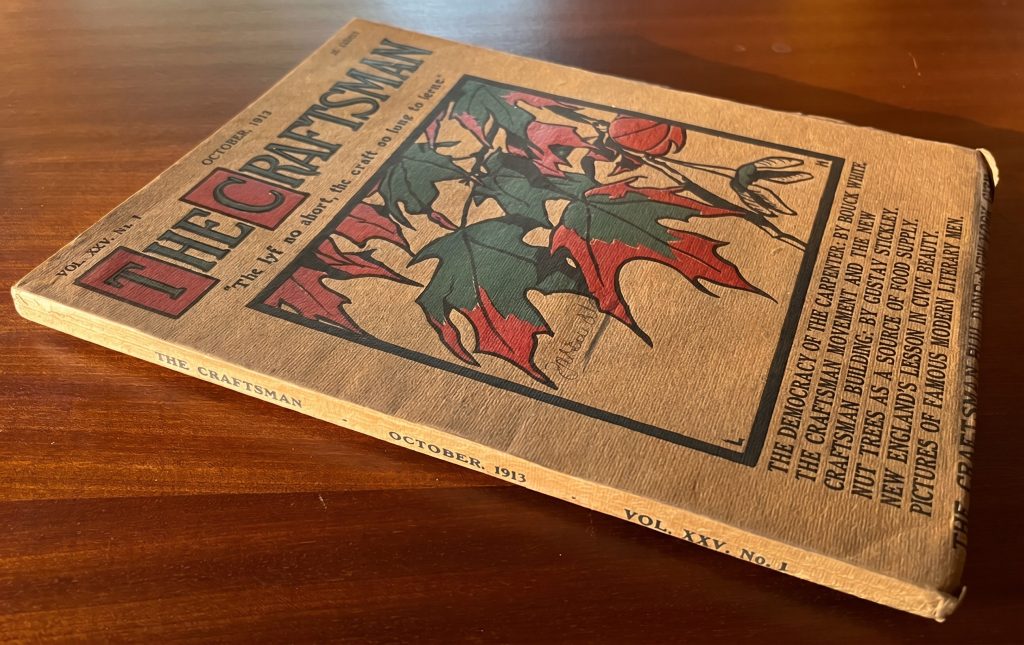
In October of 1901, a furniture manufacturer in Eastwood, New York, began a magazine. He had been making chairs and settles for three years, and had recently introduced a new line he called Craftsman furniture — straight-lined, quarter-sawn white oak pieces in the spirit of the English Arts & Crafts reformers he had visited in 1898. He had come to the conclusion that selling the furniture would require selling the philosophy that produced it. He called the magazine The Craftsman and put his own name on the masthead: Gustav Stickley, editor and publisher.
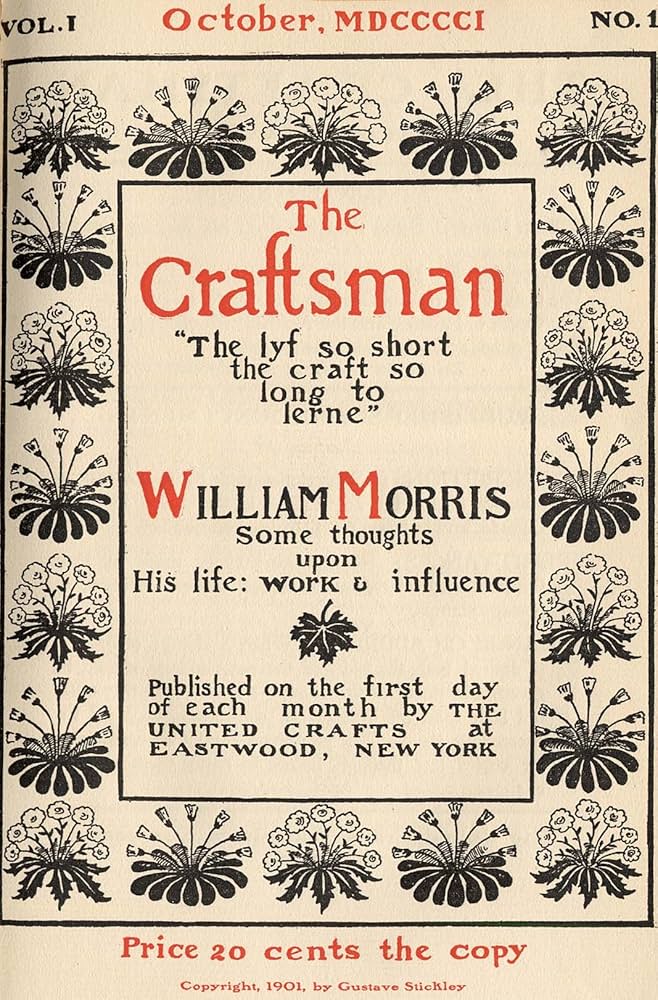
The magazine ran for fifteen years. It folded in 1916, three years after Stickley’s bankruptcy, and the cultural movement it had named did not long survive it. But in those fifteen years, The Craftsman did something no American publication had previously attempted. It took a loose collection of regional architects, furniture makers, metalworkers, and reformers — most of whom had never met each other — and bound them into a recognizable national tendency. It gave the Arts & Crafts movement in the United States its name, its vocabulary, its visual conventions, and its sense of itself as a movement.
It also, as a matter of historical record, gave Charles Sumner Greene and Henry Mather Greene their national audience. Without The Craftsman, the brothers would have remained what they were in the late 1890s: a pair of Pasadena architects with a respectable local practice and no readers east of the Sierras. With The Craftsman, they became, by 1912, the most photographed and most discussed residential architects in the American West. The magazine carried them out of Southern California and into the national conversation. It is impossible to write seriously about the Greenes’ reception history without writing about Stickley.
It is also, to be clear, impossible to write about Stickley without acknowledging what the Greenes did that he could not. The Stickley empire was a national company selling a regional idea — Mission furniture, Craftsman houses, the Craftsman magazine — to a country that had not yet decided what its domestic architecture should look like. The Greenes were a regional practice making a specific kind of California building for a specific kind of California client. Stickley wanted the Arts & Crafts movement to be American. The Greenes were content for it to be Pasadenan. The difference between those two ambitions explains, more than anything else, why Stickley’s company collapsed and the Greenes’ houses still stand.
This essay is about that difference. It is about what the Greenes took from Stickley, what they refused, and how a magazine published in upstate New York made a Pasadena practice visible to the world.
What Stickley Was Selling
To understand what the Greenes drew from Stickley, it helps to begin with what Stickley was actually doing in the years before The Craftsman launched.

He was, first and foremost, a furniture maker. Born in Wisconsin in 1858 to German immigrant parents, Stickley apprenticed in his uncle’s chair factory in Pennsylvania and spent the 1880s and early 1890s in the conventional American furniture trade — making period reproductions, ornate Victorian pieces, the kind of work that filled middle-class parlors before the turn of the century. In 1898 he traveled to England. He met C. R. Ashbee. He saw the work of the Guild and School of Handicraft in person. He came back to the United States persuaded that the American furniture industry was producing the wrong objects for the wrong reasons, and that something closer to William Morris’s vision could be made commercially viable in his own country.
The Mission line that emerged from that conviction in 1900 was, by the standards of its moment, radical. It was square where Victorian furniture was curved, oak where Victorian furniture was mahogany or walnut, exposed in its joinery where Victorian furniture was concealed beneath veneer and applied ornament. It was also, crucially, legible. A Stickley settle did not require connoisseurship to be understood. It announced its construction methods plainly. The mortise was visible. The tenon protruded. The pin was there to be seen. This was furniture that taught its own logic to the person sitting on it.

That legibility is the single most important thing Stickley contributed to the American Arts & Crafts vocabulary, and it is the single most important thing the Greenes took from him. The visible joint, the honored mortise, the exposed peg — all of these had English antecedents in the Morris circle, but Stickley made them available as an American visual language at exactly the moment the Greenes were beginning to define their own. The earliest dates at which the brothers’ work shows the mature Greene & Greene joinery vocabulary — the protruding ebony peg, the squared mortise expressed as a face element, the chamfered exposed beam end — coincide almost exactly with the first issues of The Craftsman arriving in California.
This is not coincidence, and the brothers never claimed it was. Charles in particular subscribed to The Craftsman from its first year. The magazine sat in the Pasadena office. The Stickley furniture catalogues circulated among the brothers’ clients. When the Gamble House was furnished in 1908 and 1909, it was furnished in part with pieces the Greenes designed themselves and in part with Stickley pieces — the Stickley work serving as the everyday backdrop against which the bespoke Greene & Greene built-ins did their more ambitious work. The Craftsman vocabulary was, for the Greenes, a baseline. Their own work began where Stickley’s ended.
What The Craftsman Did
The magazine was the engine. Without it, Stickley’s furniture would have remained a regional product sold from a single Eastwood factory to a regional clientele. With it, Stickley became a national figure and his vocabulary became a national style.
The Craftsman did several things at once. It published photographs, drawings, and floor plans of houses — not just Stickley’s own Craftsman bungalow designs, but houses by architects across the country whose work Stickley considered consistent with the movement’s principles. It published essays on furniture, metalwork, textiles, and gardens. It published manifestos by Stickley himself and by writers he commissioned, articulating what the Arts & Crafts ought to be and why. It published practical instruction — how to build a settle, how to lay out a hall, how to think about color in an interior. And it published, increasingly through the 1900s, photographic features on individual American architects whose work Stickley wanted to elevate.
The Greenes appeared in The Craftsman repeatedly. The most consequential single piece was the August 1912 feature on the Robert R. Blacker House, which gave the Blacker — then newly completed — a national photographic platform of a kind no Pasadena house had previously enjoyed. The article ran with multiple full-page photographs and a treatment of the brothers’ work that placed it explicitly within the broader Arts & Crafts conversation Stickley had been constructing for four years. After August 1912, the Greenes were not merely Pasadena architects. They were Craftsman architects. The magazine had certified them.
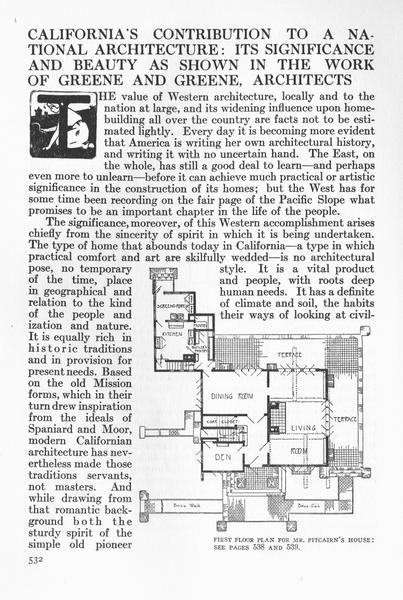
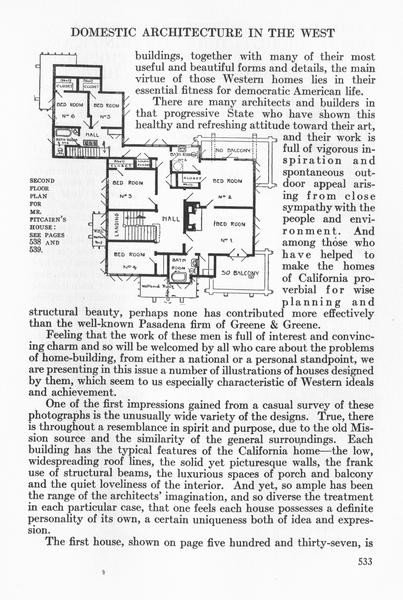
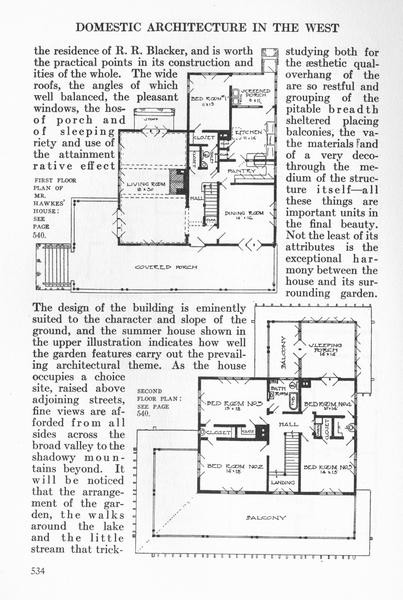
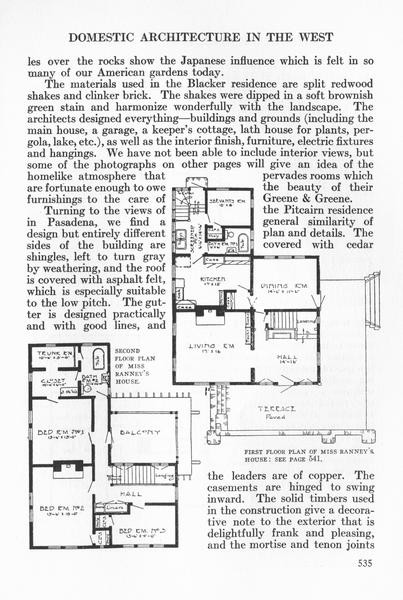
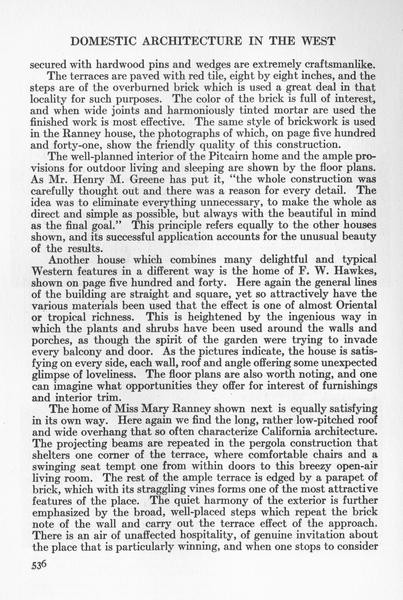
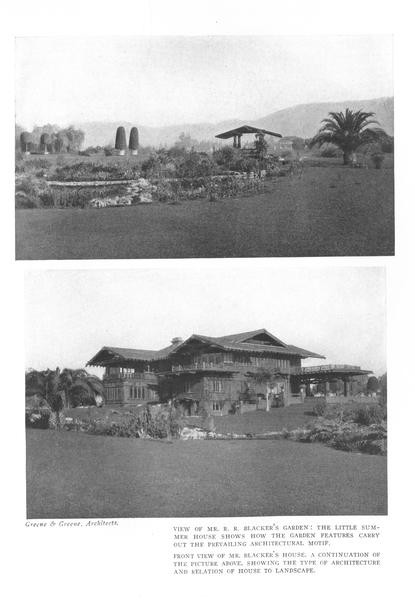
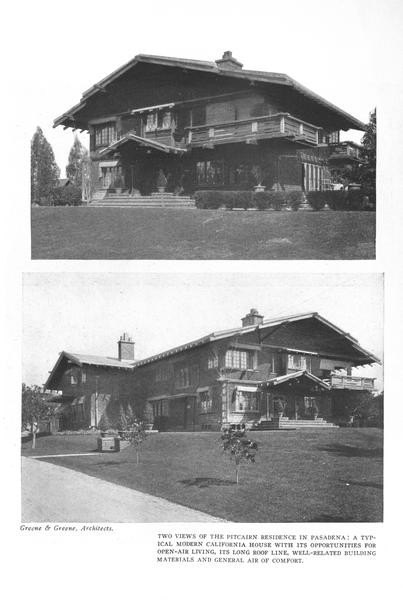
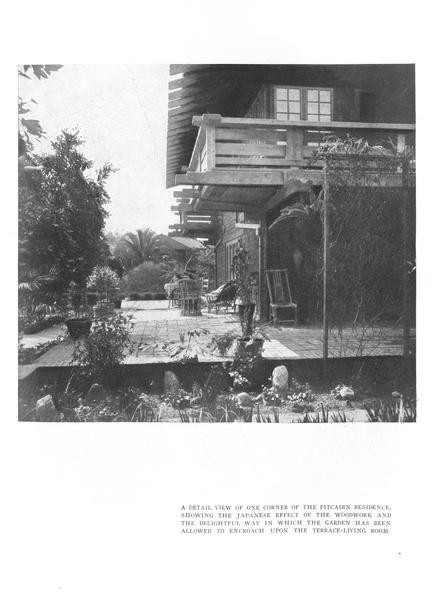
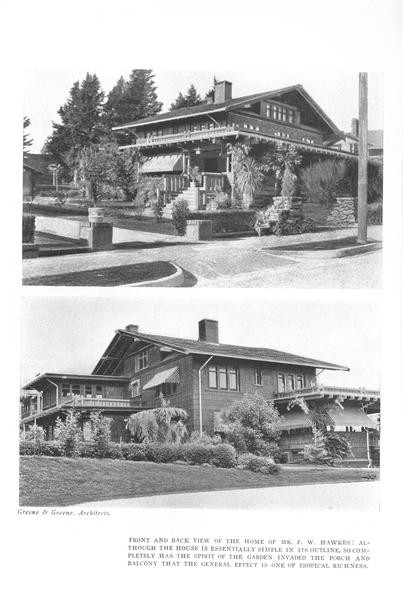
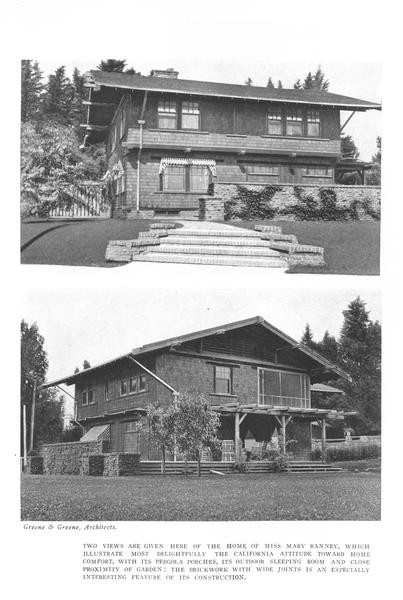
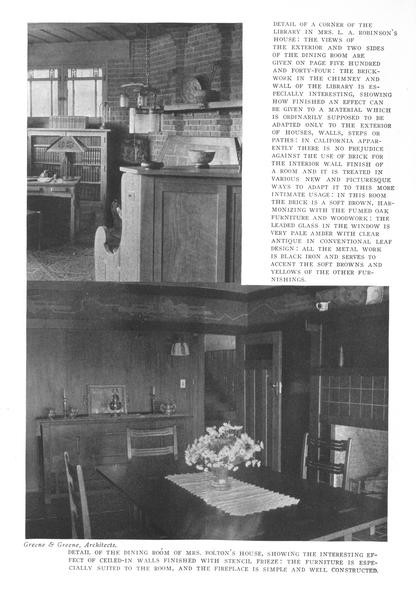
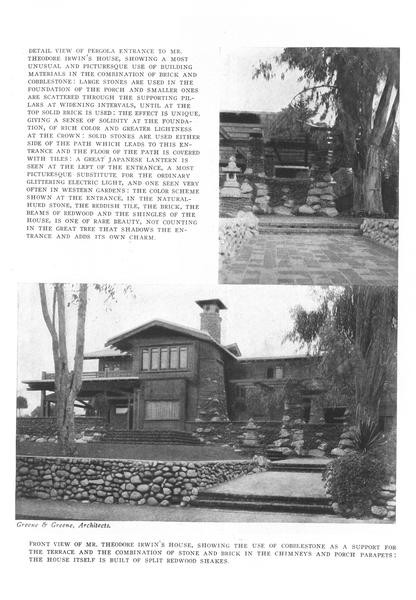
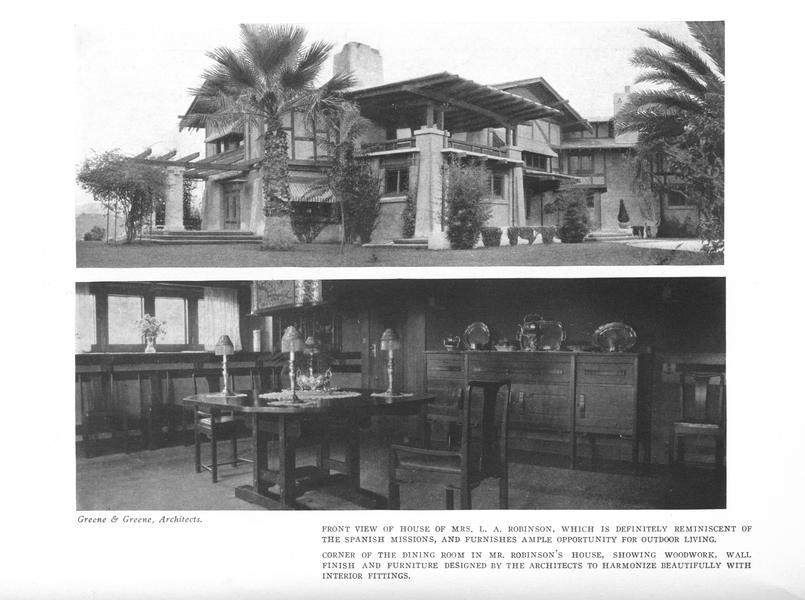
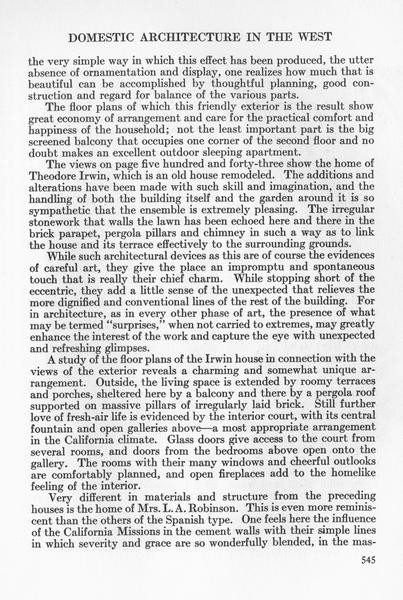
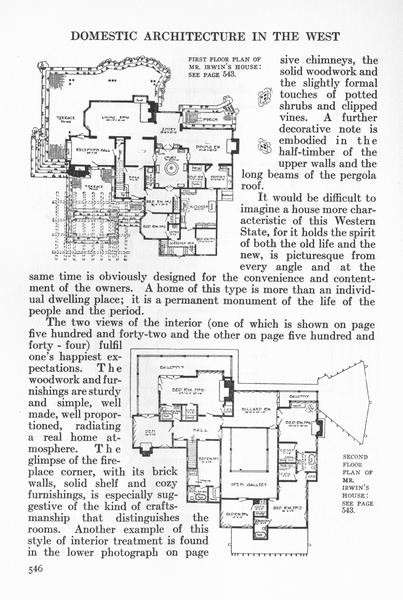
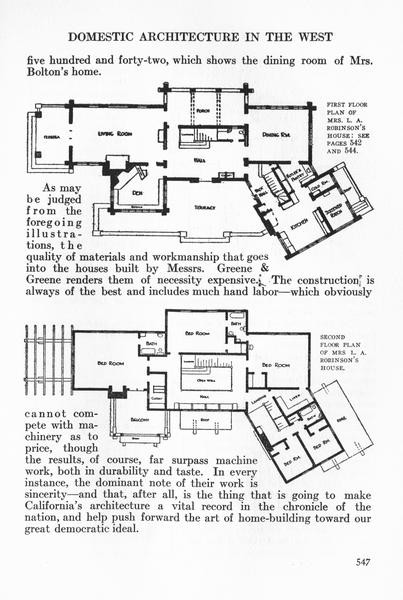
What this meant, practically, was that an architect in Indiana or a client in Connecticut who had never been west of the Mississippi could nonetheless know what a Greene & Greene house looked like. The photographs in The Craftsman did the work that travel could not. The brothers’ commissions remained almost exclusively Californian — the Pratt House in Ojai is the partial exception, the Thorsen in Berkeley another — but their visibility, their reputation, and their place in the developing canon of American domestic architecture were national from 1912 onward, and that nationality was a Craftsman effect.
It is worth pausing on what the magazine could not do. The Craftsman could not put readers inside a Greene & Greene house. The photographs, however generous, flattened the most important things — the way the rooms moved into one another, the way the timber framing gathered the light, the way the sleeping porch breathed with the canyon. A photograph of the Blacker living room is not the Blacker living room. The brothers’ work depended, more than most architects’ work, on the bodily experience of the space, and that experience was unreproducible in print. The Craftsman sold an idea of the Greenes that was necessarily partial. The houses themselves remained, then as now, things you had to travel to.
What the Greenes Refused
This is where the foil begins.
Stickley’s ambition was national. He wanted Mission furniture in every middle-class American house. He wanted Craftsman bungalows lining every American street. He wanted The Craftsman on every American coffee table. The economics of his enterprise — a factory in Eastwood, a magazine reaching tens of thousands of subscribers, a chain of Craftsman Farms enterprises he attempted to launch in the early 1910s — required that scale. Stickley was building a brand, and the brand required reach.
The Greenes, by every available indication, wanted no part of this. They never opened a satellite office. They never licensed a furniture line. They never produced a pattern book. They turned down commissions outside California with some regularity, and the few exceptions. The Greene & Greene practice was, by design, a practice that could not scale. It was bespoke work for specific clients in specific places, and the brothers understood that the moment it became anything else, it would cease to be what made it valuable.
This refusal looks, in retrospect, like the wisdom that saved the work. Stickley overextended himself in the early 1910s. He bought Craftsman Farms in New Jersey, intending to build a school and a model community. He opened a flagship Craftsman building in Manhattan in 1913. He launched a Craftsman home-building service. The expansion required capital he did not have. By 1915 the magazine was failing, the company was bankrupt, and the Mission furniture business had collapsed under competition from imitators who had been undercutting Stickley’s prices for years. The Stickley empire, having been built on scale, was destroyed by it.
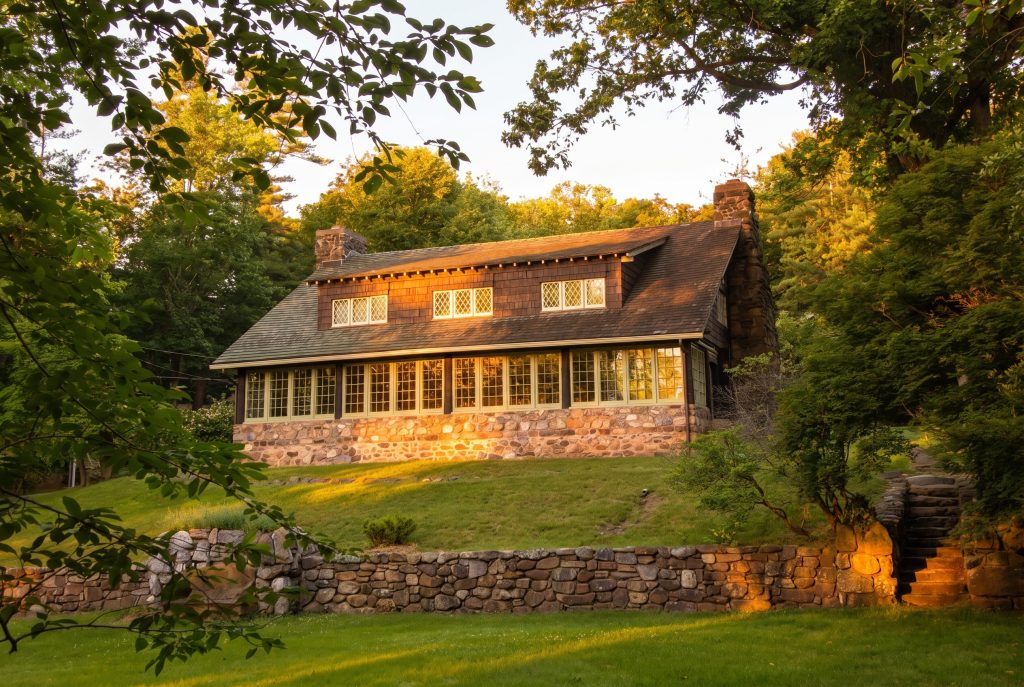
The Greenes’ practice, having been built on its opposite, did not survive the same period either — but for entirely different reasons. The brothers’ commissions slowed dramatically after 1910. Charles moved to Carmel in 1916. The partnership effectively ended. The cause was not commercial overreach but a change in taste — clients moved on, the bungalow-saturated Pasadena market moved on, and the brothers, having refused to become a brand, had nothing to fall back on. The same refusal that had preserved the integrity of the work also limited its capacity to outlast its moment.
There is a real lesson in this for the broader Arts & Crafts story. Stickley’s model was a model of distribution. The Greenes’ model was a model of integrity. Neither was sufficient to sustain a movement. The movement required both — wide visibility through commercial scaling, deep example through bespoke excellence — and when Stickley’s distribution machine collapsed and the bespoke practitioners had no next generation, the movement that The Craftsman had named simply ended. Not all at once. Not loudly. But by 1920 it was over, and what remained were the houses.
The Magazine as Medium, the Houses as Argument
Read the Greenes’ work back through Stickley’s, and a relationship emerges that is more interesting than either pure influence or pure rejection. The brothers borrowed Stickley’s vocabulary of legible joinery, exposed structure, and honored material. They borrowed his attitude toward the parlor — the dismissal of Victorian fussiness, the embrace of broad open public rooms anchored by inglenooks and built-ins. They borrowed, in some cases, the furniture itself.
But they consistently extended Stickley’s logic into territory he never reached. Stickley’s joinery was honest; the Greenes’ joinery was celebrated. Stickley’s furniture sat in rooms; the Greenes’ built-ins were the rooms, integrated into wall and floor in ways that made the distinction between architecture and furniture functionally meaningless. Stickley’s bungalow was a house type; the Greene & Greene house was a singular response to a specific lot, a specific climate, a specific client. Stickley wrote about regional materials; the Greenes used the actual stones from the actual canyon a hundred yards from the house.
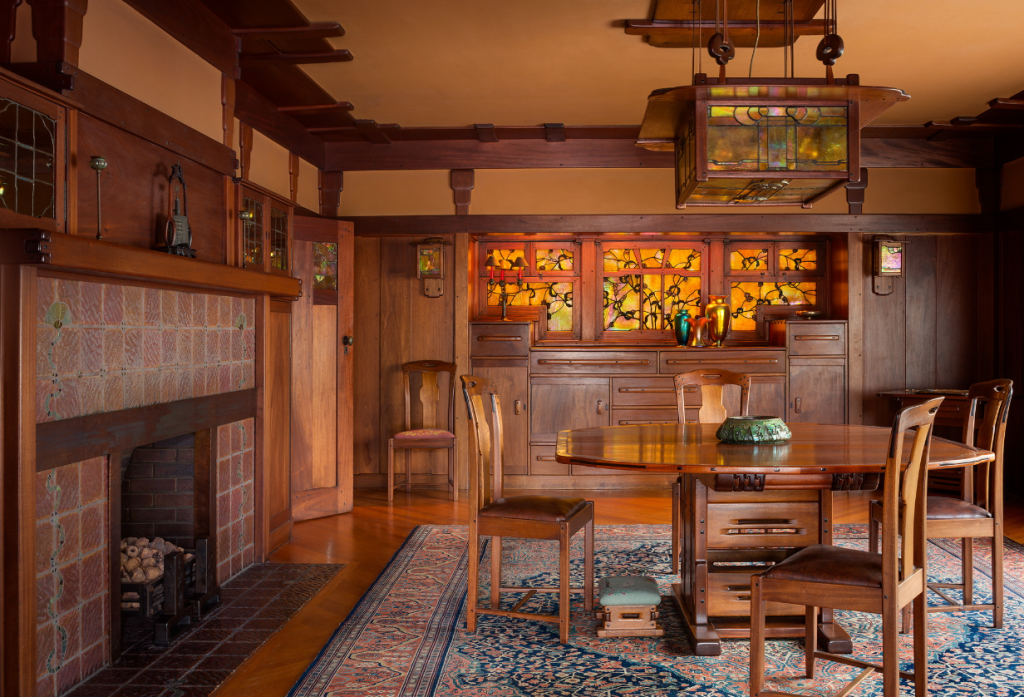
The relationship, in other words, was the relationship between a vocabulary and a literature. Stickley provided the vocabulary. The Greenes wrote some of the most consequential paragraphs in it. The two were collaborators, in a sense neither would have used — Stickley publishing his vocabulary in Eastwood and watching it land, magazine by magazine, on the desk of a Pasadena office where two brothers were doing things with it that he could not have done himself.
What Survives
The Craftsman is an archive now. Its bound volumes sit in the rare-book rooms of architectural libraries and the period photographs of the Greenes’ work look, in those pages, as fresh as they did in 1907. The magazine made the brothers visible at a moment when visibility was scarce, and the visibility outlasted Stickley’s commercial collapse by a century. The Gamble House, the Blacker House, and the Thorsen House are all preserved at least in part because their early photographic record gave later preservationists a baseline of what they were and what they had been. The Craftsman did that. Stickley did that.
What the Greenes did was different. They built buildings that earned the magazine’s attention and then continued earning attention long after the magazine was gone. They demonstrated, by their refusal to scale, that the bespoke practice could produce work of a quality the brand could not. They showed, by their refusal to standardize, that regionalism was not a limitation but a discipline.
The American Arts & Crafts movement was a national style with regional centers. Stickley’s Craftsman was its medium. The Greenes’ Pasadena was one of its arguments. Read either one alone and you have only half of what happened. Read them together and a clearer picture emerges of how an architectural sensibility moves from a single workshop to a continent — and of how easily, when the workshop closes, the continent forgets.
The houses remain. The magazine is in the libraries. The relationship between them is the subject this Journal will, slowly, keep returning to.