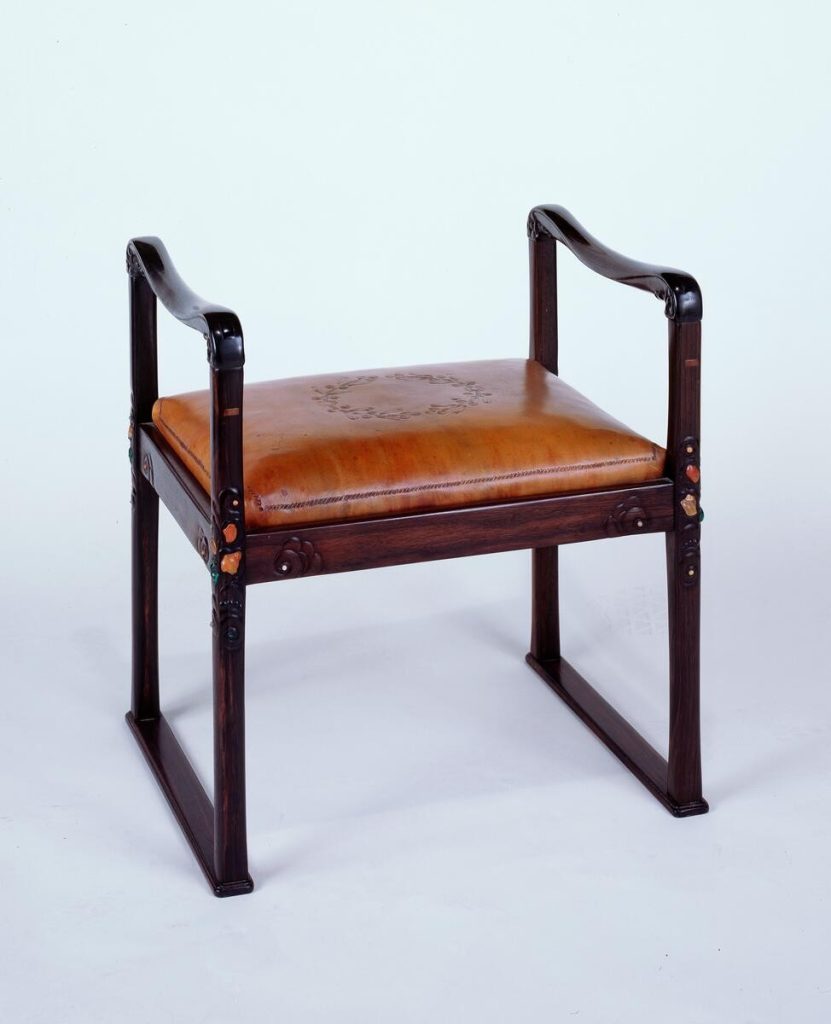
The Greene & Greene catalog includes, alongside its substantial residential building commissions, a small but distinct body of work consisting of furniture designed independently of any specific architectural commission. These furniture-only projects — pieces designed for clients who already had built residences and who engaged the firm specifically for furniture design rather than for a complete house — are relatively rare in the firm’s output. Most of the firm’s celebrated furniture was designed as integrated components of complete residential commissions, with the chairs, tables, sideboards, light fixtures, and other furnishings produced as part of the architectural envelope rather than as discrete commissions.
Among the small set of independent furniture commissions in the firm’s record stands the project the firm’s archives identify as “Moore, Mary J., furniture [San Jose] [CA], 1930, 1931″ in the Charles Sumner Greene Collection at the Environmental Design Archives at the University of California, Berkeley, and as “Mary J. Moore, (San Jose, California, 1930)” in the Greene & Greene Architectural Records and Papers at the Avery Architectural and Fine Arts Library at Columbia University. The dual archival cataloging — with Berkeley specifying “furniture” and providing the two-year date range of 1930 and 1931, and the Avery archive providing the more compressed 1930 designation — reflects the slightly different documentation conventions of the two principal archival repositories of the firm’s records, and reflects the way the project was preserved in two separate archives during their respective acquisition processes.
The commission is, in its position within Charles Sumner Greene’s late career, a particular kind of professional engagement. By 1930, Charles was sixty-two years old. The Greene & Greene partnership had been formally dissolved at the end of 1922. Charles had moved to Carmel-by-the-Sea in 1916. His Carmel residence and studio had been completed in 1923-24. His last complete original architectural commission, the John Langley Howard House and Studio in Monterey (House 19 in this directory), had been designed and built the previous year. The Mary J. Moore furniture commission represents Charles’s continuing professional engagement with discrete client commissions in the year immediately following the closing of his career as an originating architect — and it is one of the few documented late-career commissions in the firm’s record that was conceived from the outset as a furniture project rather than as part of an architectural commission.
The Furniture Commission as a Distinct Building Type
Within the broader catalog of Greene & Greene work, furniture occupies an unusual position. The firm’s Pasadena Peak Period had produced extraordinary integrated furniture — the dining tables, sideboards, chairs, light fixtures, and other furnishings designed for the Gamble House, the Blacker House, the Cordelia Culbertson House, the William R. Thorsen House, and the other Ultimate Bungalows of the 1907-1910 period had become some of the most celebrated examples of American Arts and Crafts furniture, with individual pieces from these residences now held in the collections of major American museums including the Metropolitan Museum of Art, the Huntington Library, and the Museum of Fine Arts in Boston. The firm’s furniture, in this Peak Period context, was executed as part of complete architectural commissions, with the residential envelope and its furnishings designed as a single integrated project.
Furniture commissions executed independently of building work — for clients who engaged the firm specifically for furniture rather than for a complete house — are substantially less common in the firm’s catalog. The pattern of such commissions, when they appear in the firm’s records, typically reflects one of several scenarios: a client who already owned a Greene & Greene residence and who commissioned additional furniture pieces beyond the original architectural commission; a client who had separately purchased a residence designed by another architect and who commissioned the firm’s furniture for that residence; or a client who simply wanted to commission Greene & Greene-designed furniture for use in their existing residence regardless of the architectural origin of that residence.
The Mary J. Moore commission appears, on the documentary evidence available, to fall within one of these patterns. The Berkeley archive’s identification of the project as “residential” furniture indicates that the pieces were intended for use in a residential setting; the absence from the firm’s records of any associated architectural commission for Mary J. Moore in San Jose indicates that the furniture was designed for use in a residence the firm had not separately designed. The specific nature of Mary J. Moore’s residence — whether it was an existing structure she already owned, a residence designed by another architect, or a property she had recently acquired — is not documented in widely accessible published sources, and the principal documentary record of the commission consists of the project drawings preserved in the two principal archives.
Charles Greene’s Late-Career Furniture Production
Charles Sumner Greene’s late-career furniture production was substantially different in character from the integrated furniture work of the Pasadena Peak Period. The Peak Period furniture had been produced through the firm’s established working relationships with cabinetmakers and craftspeople — most notably Peter Hall Manufacturing Company in Pasadena, which had executed many of the firm’s most celebrated furniture pieces — within a residential commission context that supported substantial craftsmanship investment and detailed integration with the architectural envelope. The late-career furniture produced from Charles’s Carmel studio operated in a different professional and craftsmanship context, with the Pasadena cabinetmaking infrastructure no longer immediately available, and with the discrete-commission furniture work occurring within smaller-scale design projects rather than as components of substantial architectural commissions.
Charles’s late-career interest in furniture design extended beyond his commissioned work. He had developed, through the 1910s and 1920s, a sustained personal interest in Asian decorative arts and Buddhist craft traditions; his Carmel studio at 13th Avenue and Lincoln Street, completed in 1923-24, included carved interior panels and decorative surface treatments that reflected his broader engagement with Asian craft aesthetics. The furniture work of his late career — discrete commissions like the Mary J. Moore project, alongside furniture work integrated with the late-career architectural commissions — represented Charles’s continuing engagement with furniture as an art form that bridged architectural design and decorative arts practice.
The Mary J. Moore commission’s two-year date range, 1930 through 1931, indicates that the project was not executed as a single quick design exercise but as an extended engagement with multiple iterations of design and refinement. The two-year span is consistent with Charles’s late-career working pattern, in which projects often unfolded across longer timelines than the Pasadena Peak Period commissions had typically required. The Spindrift engagement (1929-1941) extended across twelve years; the D. L. James House (1918 onward) extended across decades; the Mortimer Fleishhacker Sr. alterations and additions extended across multiple separate engagements. The Mary J. Moore furniture commission’s two-year duration, while substantially shorter than these major engagements, reflects the same pattern of extended timelines that characterized Charles’s late practice.
The 1930-1931 Dates and the Great Depression Context
The dating of the Mary J. Moore commission to 1930 and 1931 places it at a specific economic moment in American history. The October 1929 stock market crash had occurred approximately one year before the commission’s documented start, and the Great Depression that followed was substantially transforming the economic environment for American residential and decorative arts commissions. By 1930, discretionary commissions for architectural design, furniture, and interior decorative work were declining sharply across the American market as private wealth contracted and clients deferred non-essential building and furnishing projects. The architectural commission market that had supported much of the firm’s late practice through the 1920s was, by 1930, substantially altered.
Within this transformed economic context, the Mary J. Moore commission’s two-year timeline (1930-1931) reflects either continuing client commitment despite the broader economic disruption, or the kind of extended-timeline pattern that Charles’s late practice had developed independent of economic conditions. The discrete furniture commission was, in either case, the kind of smaller-scale project that could continue in the early Depression years even as larger architectural commissions became substantially more difficult to secure. The Mary J. Moore project documents that Charles’s solo Carmel practice continued to receive client commissions through the early Depression period, even as the broader market for residential architectural and decorative arts work contracted.
The 1931 end date of the Mary J. Moore commission also coincides with several other significant career-related developments. The same year, Charles received the commission for the Thomas Sumner Greene gravestone in Monterey — a memorial commission for his and Henry’s father, Thomas Sumner Greene, who would die that year. The 1931 dating thus places the Mary J. Moore furniture work alongside one of the most personally significant late-career commissions Charles would execute. The Moore furniture and the Greene gravestone, completed in the same year, represent two different kinds of late-career production: a discrete furniture commission for a private client, and a memorial commission for the architect’s own father.
Mary J. Moore and the San Jose Location
The biographical record of Mary J. Moore, the client of the 1930-1931 furniture commission, has not surfaced extensively in publicly accessible sources. The firm’s archives identify her by her full name (Mary J. Moore) but do not preserve the kind of detailed client biographical information that, in some cases, the firm’s correspondence or related documents would otherwise provide. What is documented is her residence in San Jose, California, and her engagement with Charles Greene’s solo Carmel practice for the discrete furniture commission across 1930 and 1931.
The San Jose location is notable within the Greene & Greene catalog because it represents one of the firm’s only documented commissions in San Jose, the principal city of the Santa Clara Valley. While the firm’s residential output had extended into many California cities — Pasadena, Altadena, San Pasadena, Santa Barbara, Long Beach, Los Angeles, Berkeley, San Francisco, Atherton, Woodside, Hillsborough, Monterey, Carmel, Carmel Highlands, Pebble Beach, Sacramento, Burlingame, Claremont, Whittier, Sierra Madre, Fresno, Ventura, Covina, Ocean Park, Beverly Hills, Lake Forest (Illinois), and others — the firm did not establish substantial residential practice in the Santa Clara Valley specifically. The Mary J. Moore commission’s San Jose location is, in this sense, an unusual geographic placement for the firm’s late-career work.
San Jose in 1930 was a substantial small city of approximately 57,000 residents, with an economy substantially driven by the agricultural production of the surrounding Santa Clara Valley orchards — particularly prunes, apricots, cherries, and walnuts. The city’s residential architectural character was developed primarily through the work of local architects and through speculative residential developers; the firm’s broader Pasadena and Carmel residential practice had not generally extended into the city’s residential market. The Mary J. Moore commission’s location in San Jose represents one of the few documented points of contact between the firm’s catalog and the residential or decorative arts work in this Santa Clara Valley city.
The Documentary Record
The principal documentary record of the Mary J. Moore commission exists in two archival locations. The Charles Sumner Greene Collection at the Environmental Design Archives at the University of California, Berkeley, holds the project drawings in Box 16, Folder 34, with the descriptive cataloging “Moore, Mary J., furniture [San Jose] [CA], 1930, 1931” and the project type designation “residential.” The Greene & Greene Architectural Records and Papers Collection at the Avery Architectural and Fine Arts Library at Columbia University holds related materials cataloged as “Mary J. Moore, (San Jose, California, 1930).”
The specific contents of the archived materials — the number of drawing sheets, the types of drawings preserved, the specific furniture pieces designed, and the project’s relationship to any associated correspondence — are not extensively documented in widely accessible online catalogs. The Berkeley collection’s general guide identifies the holding under the broader Project Records (1903-1946) section of the Charles Sumner Greene Collection, with detailed inventory information available through direct consultation with the archive’s staff. Researchers interested in the specific contents of the Mary J. Moore commission’s documentation would typically consult the archives directly, with the Berkeley Environmental Design Archives located at 230 Bauer Wurster Hall on the UC Berkeley campus, and the Avery archive located at Columbia University in New York.
The relatively limited public documentation of the Mary J. Moore commission’s specific contents reflects the broader pattern of Greene & Greene late-career furniture commissions in the firm’s archival record: while the existence of the projects is preserved through the archival cataloging, the detailed design contents are accessible primarily through direct archival consultation rather than through widely published architectural-historical literature. The Mary J. Moore commission, as a discrete late-career furniture project for a client without substantial subsequent biographical documentation, has not entered the broader popular literature on the firm’s work in the way that the major Pasadena Peak Period architectural commissions have.
The Commission’s Place in the Greene & Greene Story
The Mary J. Moore furniture commission occupies a particular position within the Greene & Greene catalog as one of the relatively few discrete furniture commissions executed independently of any associated architectural project, and as one of the firm’s only documented commissions in San Jose. The project is documented in the firm’s archives as a residential furniture commission spanning 1930 and 1931, executed by Charles Sumner Greene in the year immediately following his last complete original architectural commission, during the early years of the Great Depression.
The commission’s significance within the firm’s catalog lies less in any individual architectural distinction — the public documentary record does not preserve substantial information about specific furniture pieces, design details, or current condition — and more in its position as a documented late-career professional engagement that demonstrates Charles’s continued capacity to attract and execute client commissions in the years following his transition away from complete architectural production. The commission represents one piece of evidence about how Charles’s solo Carmel practice continued to function in the early 1930s, working on smaller-scale projects for individual clients across the broader Northern and Central California residential market that his Carmel-based practice had developed.
The commission also contributes to the broader documentary picture of how the firm’s residential and decorative arts production extended geographically across California beyond the firm’s traditional Pasadena base. The Mary J. Moore commission’s San Jose location, the John Langley Howard commission’s Monterey location, the Martin A. Flavin commission’s Carmel Highlands location, and the various Bay Area commissions of Charles’s late career together document a Northern and Central California practice that operated alongside, but largely independently of, Henry’s continuing Pasadena solo practice. The Mary J. Moore commission is one piece of evidence about that distinct geographic and professional center.
Quick Reference
- Location: San Jose, California (specific street address not documented in widely accessible online sources; the Avery archive’s catalog title gives only the city designation)
- Date: 1930-1931 (per the UC Berkeley Charles Sumner Greene Collection’s two-year date range)
- Architect: Charles Sumner Greene, working from his Carmel-by-the-Sea studio
- Avery archive cataloging: “Mary J. Moore, (San Jose, California, 1930)” in the Greene & Greene Architectural Records and Papers Collection at Columbia University
- Berkeley archive cataloging: “Moore, Mary J., furniture [San Jose] [CA], 1930, 1931” in the Charles Sumner Greene Collection at the Environmental Design Archives at the University of California, Berkeley (Box 16, Folder 34)
- Project type: discrete furniture commission for residential use, executed independently of any associated architectural commission
- Client: Mary J. Moore, of San Jose, California (additional biographical information not extensively documented in publicly accessible sources)
- Period framing: the year immediately following Charles Sumner Greene’s last complete original architectural commission (the John Langley Howard House and Studio in Monterey, 1929, House 19 in this directory); contemporaneous with the early years of the Great Depression following the October 1929 stock market crash; concurrent with the continuing twelve-year Spindrift engagement (House 18) and the multi-decade D. L. James House project; concluded the same year as the Thomas Sumner Greene Gravestone commission in Monterey (1931, House 22 in this directory)
- Significance within the firm’s catalog: one of the few documented Greene & Greene late-career furniture commissions executed independently of any associated architectural project; one of the firm’s only documented commissions in San Jose, California
- Documentation accessibility: the principal documentary record exists in the two archival repositories noted above; the project’s specific design contents and any current condition of surviving furniture pieces are accessible primarily through direct archival consultation rather than through widely available published sources
- Current status: the contemporary status of any furniture pieces produced from the commission is not documented in widely accessible public records
Closing Reflection
A discrete furniture commission, executed across two years of late-career professional work by an architect whose career was at its closing phase, for a client whose biographical record has not been substantially preserved in the public historical record, in a California city that the firm’s broader practice had not generally engaged with — the Mary J. Moore commission is, in its specifics, a quiet piece of the larger Greene & Greene story. It does not announce itself in the way that the Gamble House, the Blacker House, or the Cordelia Culbertson House announce themselves. It does not appear on architectural tours, in coffee table books, or in the standard published surveys of the firm’s work. It exists in the firm’s archival record, in two folders at two universities, with the dates 1930 and 1931 providing the temporal coordinates that anchor the project within the firm’s broader chronological development.
But the commission is there. Charles Sumner Greene, in 1930 and 1931, working from his Carmel studio, designed furniture for a client named Mary J. Moore in San Jose, in the year immediately following his last complete original architectural commission, in the early years of the Great Depression that was substantially transforming the American residential and decorative arts commission market. The work was discrete. It was small in scale. It was executed in the form of furniture pieces rather than buildings. It contributed to a career that, by 1930, had essentially completed its architectural production and had transitioned into the kind of smaller-scale, extended-timeline late-career work that would characterize Charles’s last decades of professional engagement.
The drawings survive at Berkeley and at Columbia. The furniture, if it survives, exists somewhere in the broader inheritance of California decorative arts. The client’s name is preserved in two archival catalogs. The dates are preserved. The location is preserved. The project type is preserved. What was made — chairs, tables, sideboards, beds, desks, light fixtures, or any other category of residential furniture — is documented in the archival record but not in the publicly accessible historical literature.
A career has chapters, and within those chapters there are smaller passages — discrete projects, brief engagements, individual pieces of work that contributed to the broader sustained production. The Mary J. Moore furniture commission is one of those smaller passages, at the early edge of Charles Sumner Greene’s last decade of significant professional production. It exists in the archival record. It is part of the documented firm catalog. It contributes one small but real piece to the historical understanding of how Charles’s solo Carmel practice operated in the years between his last complete architectural commission and his eventual retirement from active professional work.
The commission was executed. The drawings were drawn. The furniture, presumably, was made. The client, Mary J. Moore of San Jose, presumably used the furniture. The work, when it was completed, took its place in the broader fabric of early-1930s California residential and decorative arts production. The architectural record preserves what it preserves; the rest is held in the silence of unfilled archival cataloging fields and the gaps in the publicly accessible historical literature.
The Mary J. Moore commission, in 1930 and 1931, in San Jose, by Charles Sumner Greene. Two years. One client. Furniture for residential use. The documentary record continues, beyond the dramatic visibility of the better-known commissions, into the quieter spaces of the firm’s broader catalog.